A capacitor at half its initial voltage stores one quarter of its initial energy
Half voltage does not mean half stored energy. For an ideal capacitor with constant capacitance, the energy in its electric field is proportional to the square of its voltage. Reducing the voltage to one half therefore leaves one quarter of the original energy, even though the charge magnitude has fallen to one half. The difference comes from how much work is needed to move each additional unit of charge.
This distinction matters whenever a percentage is used without naming the quantity it describes. A fraction of voltage, a fraction of charge, and a fraction of energy are not interchangeable. They can be related precisely, but only after the capacitor model and the quantity held constant have been stated.
Start with the constant-capacitance model
For a linear capacitor, charge magnitude and voltage magnitude satisfy Q = CV. Here C is the capacitance in farads, Q is measured in coulombs, and V is measured in volts. The stored energy is U = CV²/2. Equivalent expressions are U = Q²/(2C) and U = QV/2.
These formulas describe the same energy, not three separate contributions that should be added. Choosing a formula is a matter of which values are known. In this article the capacitance stays constant, so halving V also halves Q. The energy then becomes C(V/2)²/2, which is U/4.
More generally, if the voltage becomes a fraction a of its original value, the energy becomes a² times its original value. This square applies to the energy ratio, not to the capacitance. If the capacitance also changes, the simple voltage-ratio conclusion needs to be reconsidered rather than carried over unchanged.
A numerical comparison keeps the quantities separate
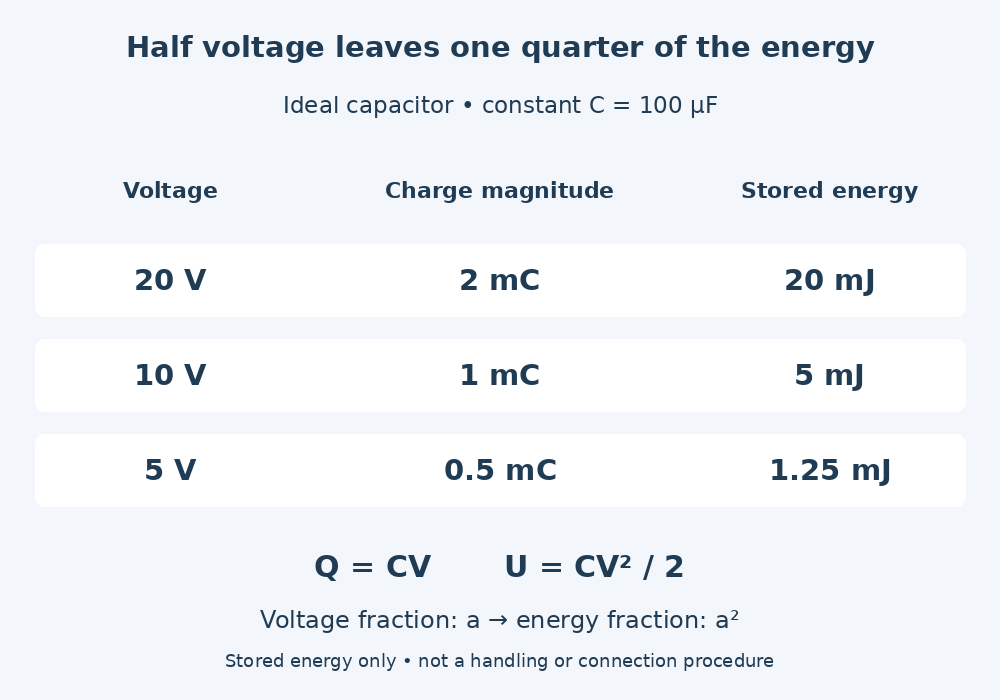
Consider an ideal capacitor with C = 100 µF and an initial voltage of 20 V. Its charge magnitude is 100 µF × 20 V = 2000 µC, or 2 mC. Its energy is 100 × 10⁻⁶ × 20²/2 joules, which equals 0.020 J, or 20 mJ.
At 10 V, the charge magnitude is 1 mC and the stored energy is 5 mJ. Half the charge remains, but only one quarter of the energy remains. The decrease in stored energy is 15 mJ, which is three quarters of the initial amount. The remaining energy and the energy transferred away must not be confused.
At 5 V, one quarter of the initial voltage remains. The charge magnitude is 0.5 mC, and the stored energy is 1.25 mJ, or one sixteenth of the original energy. Each halving of voltage quarters the energy that was present before that halving, provided C stays constant.
Why the square is physically reasonable
During idealized charging, the capacitor voltage rises as charge is transferred. Moving a small additional charge dq requires work dW = v dq, where v is the voltage at that stage. With v = q/C, adding up the work from zero charge to Q gives U = Q²/(2C).
The final voltage cannot be used as though it had applied to every earlier increment of charge. In the constant-capacitance model, the voltage rises linearly from zero to its final value. The average voltage during that charge transfer is half the final voltage, which explains the factor of one half in U = QV/2.
Likewise, when voltage falls from 20 V to 10 V, the charge transferred away moves through a higher average capacitor voltage than charge transferred during the later fall from 10 V to zero. The two intervals remove equal charge magnitudes, but they do not remove equal amounts of stored energy.
Stored energy is not the same as useful output
The formula tells us the change in the capacitor's stored energy. It does not by itself say how that energy is divided among a useful load, resistance, switching elements, or other parts of a real system. That requires a model of the transfer process. A statement about remaining capacitor energy is not automatically a statement about delivered useful energy.
Real capacitors also have voltage ratings, leakage, internal resistance, and capacitance that may depend on operating conditions. The numerical example is a theoretical comparison, not handling advice or a charging and discharging procedure. It does not establish that a partly charged component is suitable to touch or connect.
The general reading rule is simple: identify whether a percentage refers to voltage, charge, or energy. For constant capacitance, voltage and charge scale together, while stored energy follows their square. Keeping those relationships separate turns an ambiguous statement about being half charged into a calculation with a clear meaning.
Continue your educational path at academiamastertrader.com.br and on the Aprenda page.