A cavity energy lifetime is not the decay time of its field amplitude
When light stored in a passive optical cavity fades after the input is removed, the word lifetime needs a defined quantity. Stored energy, optical power and electric field amplitude do not all follow the same numerical decay time.
The distinction is especially useful when connecting a cavity decay trace to its resonance linewidth or quality factor. A factor of two can enter before any arithmetic is difficult, simply because one description concerns energy and another concerns field amplitude.
Begin with an energy lifetime
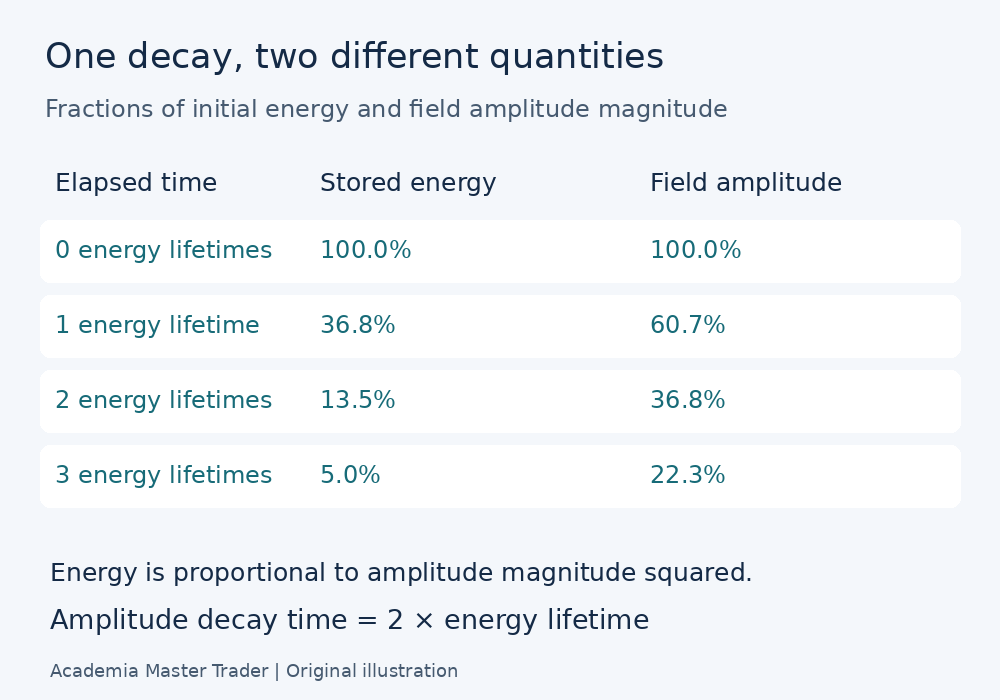
Consider a passive cavity mode whose stored energy decays exponentially. Define the energy lifetime as the time after which that energy has fallen to one divided by e of its initial value. That fraction is about 36.8 percent.
After two energy lifetimes, the remaining energy is about 13.5 percent. After three, it is about 5.0 percent. These are fractions of the starting energy, not statements that the same amount is removed in every equal interval.
An exponential decay removes the same fraction during each interval of a given duration. The absolute decrease becomes smaller as less energy remains. A lifetime therefore does not mean that the cavity is completely empty when that time has passed.
Field amplitude follows a different time scale
For a fixed cavity mode, stored energy is proportional to the square of its field amplitude magnitude. To obtain the amplitude fraction from an energy fraction, take the square root.
When the energy has reached 36.8 percent, the field amplitude magnitude is still about 60.7 percent. It reaches about 36.8 percent only after two energy lifetimes.
Thus the exponential decay time of the field amplitude magnitude is twice the energy lifetime. Both descriptions refer to the same physical decay. They use different quantities, so they assign different characteristic times.
This statement concerns the amplitude envelope, not the rapid positive and negative oscillations of the electric field. The optical oscillation period is a separate time scale and should not be confused with either decay time.
A power trace can represent the energy decay
If the output coupling remains fixed and the measurement isolates the freely decaying cavity mode, the optical power leaking through that coupling is proportional to stored energy. Its exponential decay time then equals the energy lifetime.
That relationship is why the measured quantity matters. An optical power detector does not directly report the electric field amplitude. Reading a power trace as though it were an amplitude trace changes the interpretation of the lifetime.
The conditions belong with the result. A changing coupling, continued input or several overlapping contributions can make a single exponential description unsuitable. A clean numerical fit alone does not establish which physical quantity the instrument recorded.
Relate the lifetime to the linewidth consistently
For an isolated, weakly damped resonance with exponential energy decay, the full width at half maximum in ordinary frequency is one divided by two pi times the energy lifetime.
As a numerical example, an energy lifetime of 10 nanoseconds corresponds to a linewidth of approximately 15.9 megahertz. The associated field amplitude decay time is 20 nanoseconds, not 10 nanoseconds.
Using the amplitude time in the energy-lifetime formula would give the wrong linewidth. An equivalent formula written explicitly for the amplitude time has a different factor. Keeping the quantity beside the time avoids this ambiguity.
Angular frequency also needs its own label. A linewidth expressed in radians per second is not numerically the same as a linewidth expressed in hertz. The conversion introduces another factor of two pi, separate from the distinction between amplitude and energy.
Quality factor refers to the optical oscillation
In this same high quality factor regime, the quality factor equals two pi times the optical resonance frequency times the energy lifetime. It also equals resonance frequency divided by the full resonance linewidth in hertz.
The frequency in that expression is the optical resonance frequency, not the inverse round trip time. A cavity can contain many optical oscillations during a single round trip. Substituting the mode spacing for the resonance frequency changes the meaning of the ratio.
A useful report therefore names the recorded quantity, the lifetime convention, the linewidth convention and the relevant resonance. Those labels make the relationships readable without relying on an unstated factor of two.
Academia Master Trader shares educational explanations built around clear definitions and worked examples. Explore our structure at academiamastertrader.com.br and continue learning with Aprenda.