A charged particle can follow a helix in a uniform magnetic field without gaining speed
A curved path does not necessarily mean that a particle is gaining or losing kinetic energy. In an ideal uniform magnetic field, a charged particle can turn continuously while keeping the same speed. If its initial velocity has components both parallel and perpendicular to the field, its path is a helix. The two components explain the shape without requiring the magnetic field to supply energy.
This model assumes that the magnetic force is the only significant force, the field is steady and uniform, and the particle is moving slowly enough for nonrelativistic mechanics to apply. Collisions, electric fields, radiation losses, and changes in the magnetic field are left out. Those limits matter because they define when the simple relationships describe the motion.
Split the velocity before describing the path
Let θ be the angle between the particle's velocity and the magnetic field. The component parallel to the field has magnitude v∥ = v cos θ. The perpendicular component has magnitude v⊥ = v sin θ. For an acute angle, both components are positive in these expressions, and the particle advances along the chosen field direction while circling around it.
The magnetic force is q v × B. Its magnitude depends on the perpendicular component: F = |q|v⊥ B. A velocity component parallel to the field makes no contribution to this force because its cross product with the field is zero. That parallel motion therefore continues unchanged under the assumptions of the model.
The perpendicular component supplies the circular part of the motion. The magnetic force turns that component without changing its magnitude. Combining the circular motion with the steady advance along the field produces the helix. Neither component needs to grow for the path to keep curving.
The perpendicular component sets the radius
Balancing the magnetic force with the centripetal requirement for the circular part gives r = mv⊥/(|q|B). The total speed does not belong in place of v⊥ unless the velocity is entirely perpendicular to the field. Using the total speed for an oblique entry would overestimate the radius.
For a fixed particle and fixed field, doubling v⊥ doubles the radius. Changing only the parallel component does not change the radius. It changes how far the particle travels along the field during each turn. These are two different geometric features of the same path.
The time for one revolution is T = 2πm/(|q|B). In this nonrelativistic model it does not depend on either velocity component. The distance advanced parallel to the field during one revolution is the pitch, p = v∥ T. The pitch is a distance between successive turns measured along the helix axis, not the length of the curved track in one revolution.
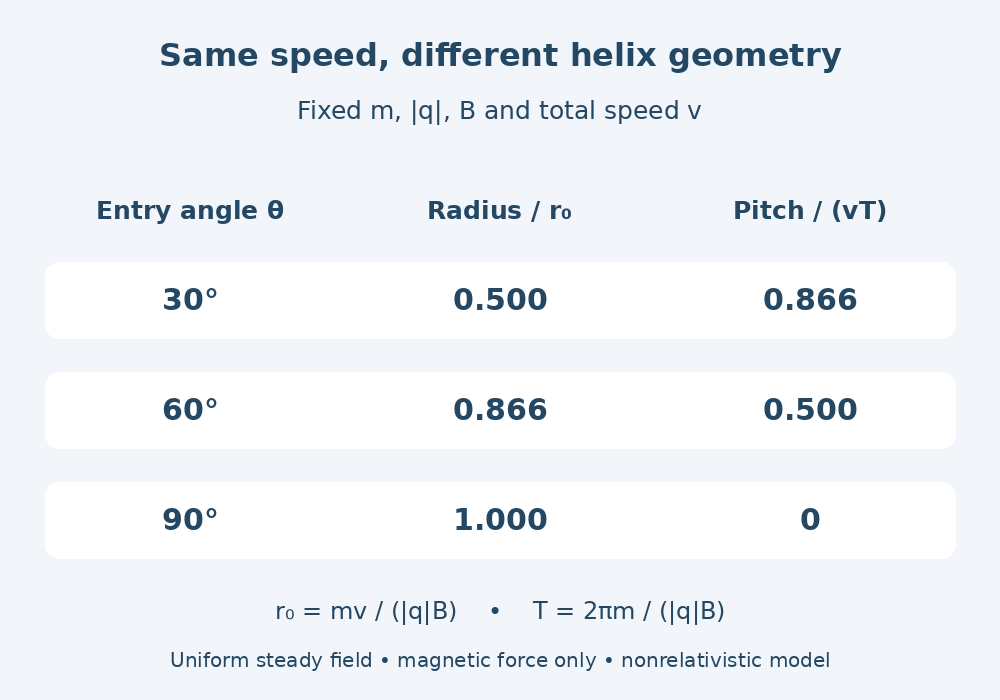
Changing the entry angle changes two features at once
Consider particles with the same mass, charge magnitude, and total speed in the same field. Define a reference radius r₀ = mv/(|q|B). At an entry angle of 30°, the radius is 0.500 r₀, while the pitch is about 0.866 vT. At 60°, the radius is about 0.866 r₀ and the pitch is 0.500 vT.
These values come directly from sine and cosine. The larger angle gives more perpendicular motion and less parallel motion. The helix becomes wider, with less advance along the field per turn. The speed and kinetic energy remain the same in both cases, but the velocity has been divided differently between the two directions.
At 90°, the parallel component is zero, so the pitch is zero and the helix reduces to a circle. At 0°, the perpendicular component is zero and there is no magnetic force: the path is straight along the field. In that last case there is no actual circular turn to observe, even though the formula for T remains a useful characteristic timescale of the particle-field combination.
No magnetic work does not mean no acceleration
The magnetic force is perpendicular to the instantaneous velocity, so its power F · v is zero. It changes the direction of motion rather than the speed. Acceleration can therefore be present even when the kinetic energy is constant. Confusing speed with velocity hides this distinction.
When reading a helical path, identify the field axis first. Then separate radius from pitch and ask which velocity component controls each one. Finally, check whether electric forces or other effects are present before using the constant-speed model. The geometry becomes easier to understand when direction changes and energy changes are kept separate.
Continue your educational path at academiamastertrader.com.br and on the Aprenda page.