A fiber acceptance angle is a half-angle, not the full width of the cone
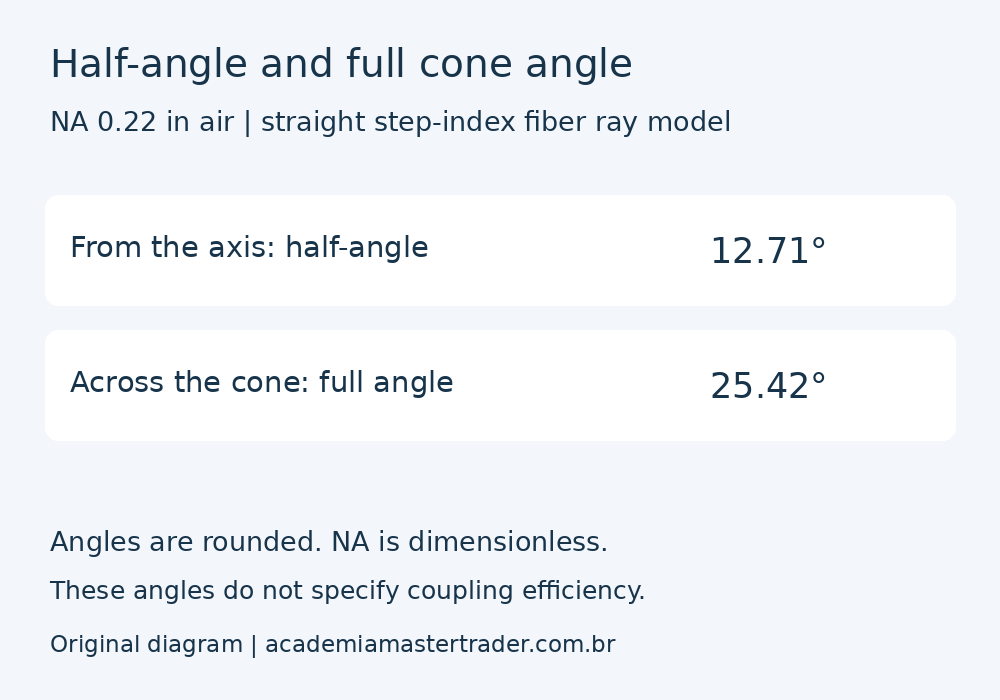
A numerical aperture of 0.22 does not mean an acceptance angle of 0.22 degrees. Numerical aperture is dimensionless. To obtain an angle, the surrounding medium and the definition of the angle must be specified. For a simple ray model of a straight step-index fiber in air, an NA of 0.22 corresponds to a maximum input angle of about 12.71 degrees from the fiber axis.
The full cone extends to both sides of that axis. Its angular width is therefore about 25.42 degrees in the same model. Confusing the half-angle with the full angle changes the stated geometry even when the numerical aperture itself has been copied correctly.
Start from the axis and the input medium
The relevant input angle is measured between an incoming ray and the fiber axis, before the ray enters the fiber. It is not the angle between the ray and the core-cladding boundary farther inside the fiber.
In the geometrical description, numerical aperture equals the refractive index of the input medium multiplied by the sine of the maximum accepted input angle. In air, using an index approximately equal to one, the sine of the half-angle is approximately the numerical aperture.
An angle cannot be obtained by simply attaching a degree symbol to the NA. The inverse sine is needed. For 0.22 in air, that calculation gives approximately 12.71 degrees. Doubling the angle, rather than doubling the NA before taking the inverse sine, gives the full cone angle.
The same numerical aperture can describe a smaller external angle
Now keep the fiber model and its numerical aperture unchanged, but let the input medium have a refractive index of 1.33. The sine of the external half-angle is then 0.22 divided by 1.33.
The resulting half-angle is about 9.52 degrees. This is smaller than the air value. In this comparison, the fiber's core and cladding indices have not been changed; the angle in the surrounding input medium has changed.
This distinction prevents a common shortcut: treating NA as if it were itself an angle that must remain fixed when the external medium changes. The index factor belongs in the relation. Any practical use of a different surrounding medium would also require attention to the actual fiber construction and its suitability for that environment.
Acceptance is not a promise of complete coupling
An incoming beam can satisfy an angular condition and still fail to place all its power into guided light. Its position at the input face matters. Light that misses the core is not brought into the core merely because its direction lies inside a nominal acceptance cone.
The beam's size and spatial distribution also matter. The angular description is one part of an input geometry, not a complete efficiency calculation. Alignment, the input surface and the relation between the incident field and the supported modes can affect coupling.
For that reason, a specification of NA alone cannot establish a percentage of transmitted power. A useful coupling description states both where the light lands and how its directions are distributed.
Keep the model visible
The simple cone picture is most directly associated with geometrical rays in a straight step-index fiber. It should not be treated as a universal sharp boundary for every fiber and every illumination condition.
Single-mode fibers are better understood through their supported optical mode and the overlap with the incident field. Graded-index profiles also need care because the local conditions can vary across the input face. Bending can change guidance conditions as well.
These qualifications do not make numerical aperture unhelpful. They identify what the number describes and where another description is needed. A clear model is more informative than an unexplained cone drawn around any fiber.
Record the half-angle explicitly
A short technical note can state the NA, the input-medium index, the reference axis and whether the angle is a half-angle or a full angle. It should also name the fiber model used for the calculation.
For the air example, the complete result is straightforward: NA 0.22, straight step-index ray model, approximately 12.71 degrees from the axis, or approximately 25.42 degrees across the full cone. None of those angular values is a guaranteed coupling efficiency.
Academia Master Trader supports learning through clear definitions and visible assumptions. Explore the structure at academiamastertrader.com.br and continue with Aprenda.