A gas can warm during compression without receiving heat
A rise in temperature does not, by itself, prove that heat entered a system. A gas can become warmer because its surroundings do work on it. Adiabatic compression provides a clear example: energy enters through work even though no heat crosses the system boundary.
This distinction is useful whenever we describe a piston, an insulated cylinder, or an idealized thermodynamic process. Temperature is a property of the gas. Heat and work describe different ways energy can cross its boundary. They should not be used as interchangeable names for the same thing.
Start with the system and the signs
Take a fixed amount of ideal gas as the system. Assume that changes in the motion and height of the system as a whole are negligible, and that the only work is associated with compression or expansion.
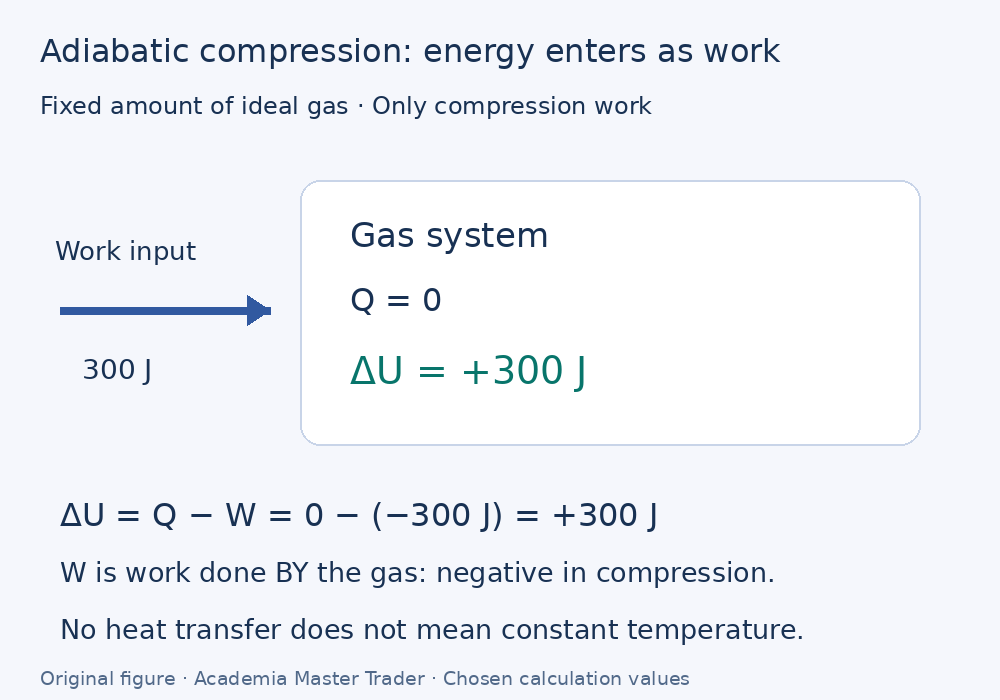
Use the first law in the form ΔU = Q − W. Here Q is positive when heat enters the gas, while W is positive when the gas does work on its surroundings. During compression, the surroundings do work on the gas, so W is negative.
An adiabatic process has Q = 0. Under these assumptions, the energy balance becomes ΔU = −W. If W is negative, the change in internal energy is positive. No heat input is needed for that increase.
A small numerical balance
Suppose the surroundings do 300 joules of work on the gas during an adiabatic compression. With the convention above, W = −300 J. Since Q = 0, the change in internal energy is 0 − (−300 J), which equals +300 J.
The numerical value is chosen to illustrate the signs. It is not a prediction for every cylinder or every compression. The temperature rise also depends on how much gas is present and on its heat capacity.
For an ideal gas, internal energy depends only on temperature. If its molar heat capacity at constant volume can be treated as constant over the interval, ΔU = nCᵥΔT. A positive internal-energy change therefore corresponds to a temperature increase.
What insulation does and does not prevent
Thermal insulation limits energy transfer as heat. It does not automatically prevent a moving boundary from transmitting work. A piston can move inward and transfer energy to the gas even when the cylinder walls are treated as thermally insulating.
In a practical process, adiabatic behavior can also be a useful approximation when heat transfer is negligible during the time available. Calling a process quick does not establish that approximation on its own. The material, geometry, temperature differences, and duration all matter.
The ideal description states Q = 0 exactly. A real calculation may instead justify treating a small heat transfer as negligible. Keeping that distinction visible avoids turning a convenient model into an unsupported claim about every physical device.
Constant temperature is a different condition
An isothermal process keeps temperature constant. An adiabatic process has no heat transfer. Neither term is a substitute for the other.
For an ideal gas compressed isothermally, its internal energy does not change. The work input must then be balanced by heat leaving the gas under our stated assumptions. For adiabatic compression with positive work input, the energy remains in the gas as increased internal energy instead.
The word compression is also important. Adiabatic does not mean that temperature must always rise. An ideal gas doing positive work during adiabatic expansion loses internal energy and cools. In insulated free expansion into a vacuum, both heat transfer and boundary work are zero, so an ideal gas has no temperature change.
Apply the right relation to the right process
For a quasistatic adiabatic process of a fixed amount of ideal gas, with heat capacities treated as constant, pVᵞ is constant. The symbol γ is the ratio Cₚ/Cᵥ. This relation needs those conditions; it is not a general formula for every insulated process.
The most dependable starting point is simpler: identify the system, state the sign convention, decide whether heat transfer is negligible, and describe the work. That sequence explains how a gas can warm without receiving heat before any specialized formula is needed.
Academia Master Trader shares educational content at academiamastertrader.com.br.