A heat pump's coefficient of performance can exceed one without creating energy
A heat pump moves energy as well as receiving energy as work. Its heating coefficient of performance compares the heat delivered to the warm side with the work supplied. Because some of that delivered energy comes from the cold side, the ratio can be greater than one without violating energy conservation.
The same cycle can also be assessed as a refrigerator, with the useful result defined as heat removed from the cold side. Changing the numerator changes the coefficient. It does not change the energy balance of the cycle being considered.
Put the three energy transfers in one balance
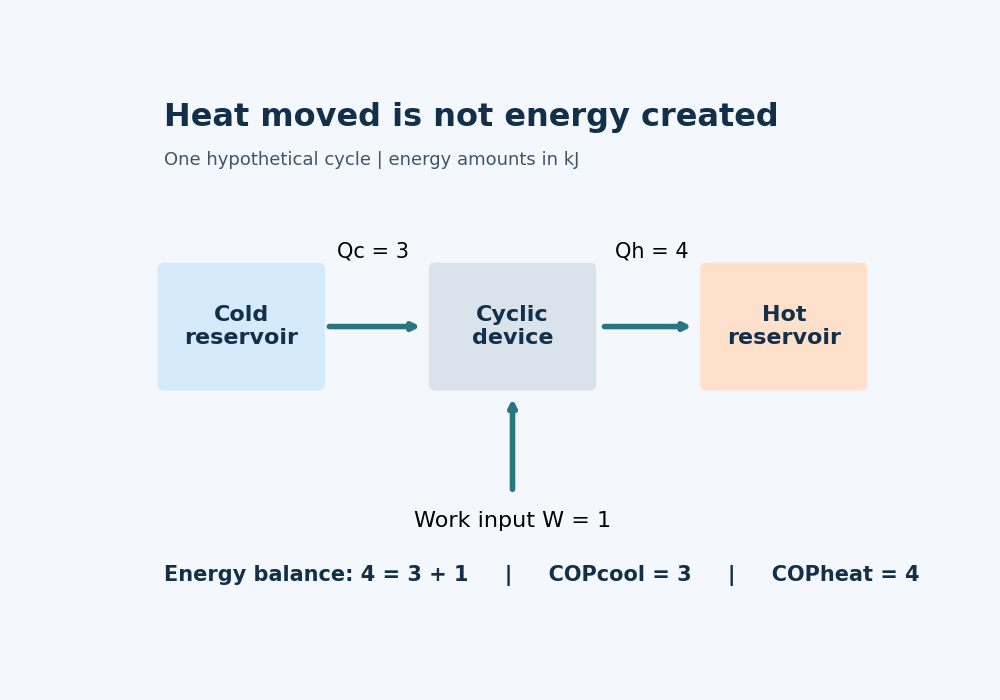
Consider a cyclic device operating between a cold reservoir and a hot reservoir. Let Qc be the positive heat absorbed from the cold reservoir, Qh the positive heat delivered to the hot reservoir, and W the positive work supplied to the device.
These symbols represent energy amounts over the same complete cycle or the same accounting interval. Their directions are stated in words rather than hidden in negative signs.
For a complete cycle, the working substance returns to its initial state, so its internal energy has no net change. If these are the only energy transfers across the chosen boundary, conservation gives Qh = Qc + W.
The device is not turning only the supplied work into the entire delivered heat. It combines that input with energy removed from the cold reservoir. Leaving out Qc would make the balance appear to contain an unexplained energy source.
Define the useful result before calculating COP
In cooling mode, the coefficient of performance is COPcool = Qc/W. In heating mode, it is COPheat = Qh/W. Both ratios are dimensionless when numerator and denominator use matching energy units.
For the same cycle and the same boundary, substitute Qh = Qc + W. The result is COPheat = COPcool + 1. This is an accounting relation, not an extra performance assumption.
Suppose a hypothetical cycle uses W = 1 kJ of work to remove Qc = 3 kJ from the cold reservoir. It delivers Qh = 4 kJ to the hot reservoir. Its cooling COP is three and its heating COP is four.
The heating COP of four does not mean four units of work were produced from one. No net work is produced in this example: work is supplied. The four units refer to heat delivered, of which three came from the cold side.
Keep a thermodynamic ratio separate from a product rating
The numerical example illustrates the balance only. It does not identify a commercial appliance or predict its performance. Actual conditions determine whether a particular set of transfers is achievable.
For reversible operation between constant absolute temperatures Th and Tc, the limiting coefficients are COPcool,rev = Tc/(Th − Tc) and COPheat,rev = Th/(Th − Tc), with Th greater than Tc.
Temperatures in these expressions must be in kelvin. A smaller temperature gap improves these reversible limits when the relevant absolute temperature is held fixed. Irreversible processes lower performance relative to the reversible device between the same reservoirs.
The example's COP values would equal the reversible limits for Tc = 300 K and Th = 400 K. That observation checks consistency; it does not show that a real device reaches those limits.
A reported appliance coefficient may use total electrical input, including fans, pumps, controls, and other components. Its useful heat measurement also depends on the declared boundary. Before comparing two reported values, check that they cover matching conditions and equipment.
Do not confuse energy amounts with rates
A kilojoule is an energy amount. A kilowatt is an energy-transfer rate. If every transfer in the example occurs steadily over one second, the corresponding rates are 3 kW absorbed, 1 kW of input, and 4 kW delivered.
The coefficient can be calculated from matching average rates over the same interval as well as from matching energy amounts. Mixing a heat quantity in kilojoules with an input power in kilowatts does not produce the intended dimensionless COP.
Likewise, heating capacity and COP answer different questions. Capacity describes how quickly heat is delivered. COP compares that useful transfer with the input needed under the stated conditions.
The practical sequence is to draw the boundary, name the useful side, balance all energy transfers, and only then form the ratio. A coefficient greater than one becomes straightforward once energy moved from the surroundings is included.
Academia Master Trader shares educational material at academiamastertrader.com.br.