A list of distinct values describes variety, while counts describe repetition
A dataset can contain many observations but only a few different values. Listing those distinct values answers which values occur. It does not answer how often each one occurs, nor does it preserve the order of the original observations.
These are different kinds of information. A short list of distinct values can be useful for inspecting categories or checking the range of recorded codes. But it should not quietly replace the full data when repetition or sequence still matters to the question.
Six observations, three distinct values
Consider the sequence four, two, four, seven, two and four. It contains six observations. Its distinct values, written in ascending order, are two, four and seven. There are three different values, not three observations in the original sequence.
The value two occurs twice, four occurs three times and seven occurs once. These counts add up to six, which matches the original number of observations. Each count must remain attached to the value it describes.
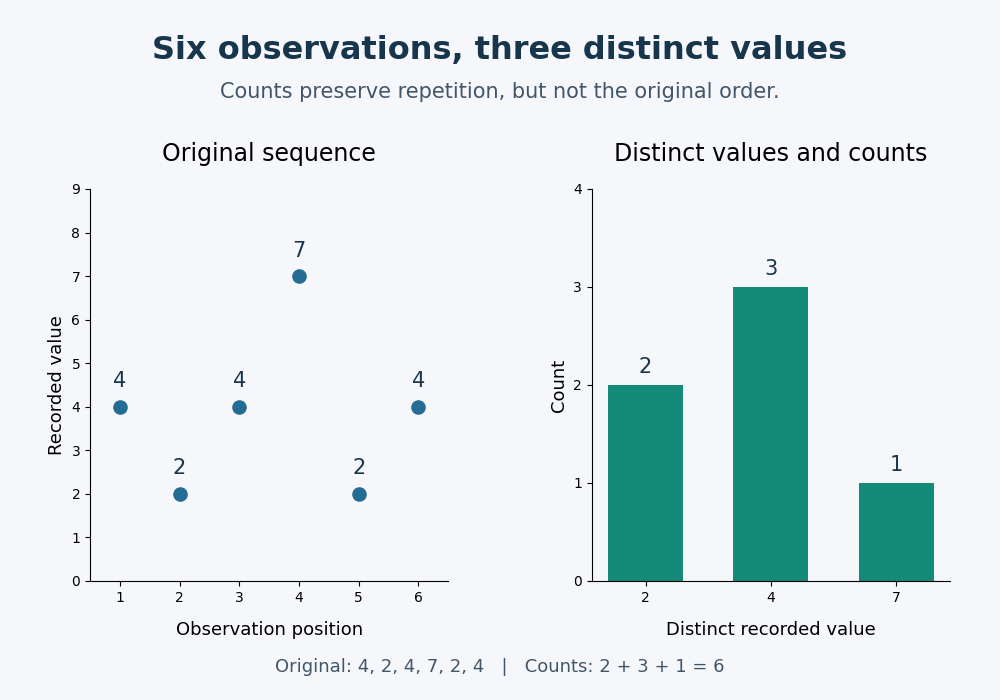
The figure shows the original sequence alongside its frequency summary. The summary preserves repetition through counts, but it does not preserve position. It tells us that four occurs three times, without telling us where those three occurrences appeared.
The order of the summary needs a rule
A distinct-value summary can be arranged numerically, alphabetically or by first appearance. These arrangements answer different presentation needs. A sorted summary is easy to scan, while an order based on first appearance may be useful when following a sequence of newly encountered categories.
In our example, ascending order gives two, four and seven. First-appearance order gives four, two and seven. Both lists contain the same distinct values, but their positions differ. Any counts or other associated columns must move with their values when the summary is reordered.
A program's output order should be checked rather than assumed. A function that returns sorted distinct values is not automatically preserving the order in which the input first introduced them. Changing a sorting option also does not necessarily promise a particular alternative order.
Counts do not recover the original sequence
Suppose we keep only the values two, four and seven with their counts two, three and one. We could arrange those observations as two, two, four, four, four and seven. That sequence matches the counts but differs from the original order.
Recovering the original sequence requires more information. One option is a position code for every original observation, identifying which entry in the distinct-value list it used. With the sorted list two, four and seven and zero-based codes, our original sequence becomes one, zero, one, two, zero and one.
Looking up each code in that list reconstructs four, two, four, seven, two and four. The codes are references to the summary, not the observed values themselves. A code of one refers to the second summary entry, which is four.
Define what counts as the same
For simple whole numbers, equality is straightforward. Other data needs an explicit rule. Text can differ in spaces, letter case or spelling. A decision to treat those forms as equivalent is a data-cleaning choice, not a consequence of counting alone.
Numerical closeness is also different from exact equality. Two measurements that differ slightly may remain two distinct recorded values. Rounding or grouping them before counting changes the definition of a distinct value and should be stated.
Missing entries require their own convention. A summary might exclude them or represent them according to a chosen missing-data rule. Readers need to know which approach was used before interpreting the number of categories or comparing totals.
A value is not the same thing as a record
In a table, finding distinct entries in one column is different from finding distinct rows. Two records may share the same category while differing in time, quantity or another field. Removing one because the category repeats could discard information the analysis still needs.
Before producing the summary, decide whether the unit of comparison is a single value, a selected combination of columns or an entire row. Then label the output accordingly. The word distinct only becomes clear when the reader knows what was compared.
A useful frequency summary therefore keeps its values, counts, ordering rule and inclusion rule together. It describes variety and repetition honestly, while leaving the original sequence available for questions that depend on where each observation occurred.
Academia Master Trader shares educational material about data, sequences and measurement at academiamastertrader.com.br.