A magnetic force can change a particle's direction without changing its speed
A force does not have to make a particle move faster or slower. It can change the direction of motion while leaving speed unchanged. The magnetic force on a moving electric charge provides a clear example when we consider that force alone.
In the simple model used here, a charged particle moves in a static, uniform magnetic field. There is no electric field, and we neglect collisions, radiation, gravity, and other forces. These assumptions let us separate magnetic deflection from changes caused by other effects.
Velocity includes direction
Speed is the magnitude of velocity. Velocity also includes a direction. A particle travelling around a circle at constant speed therefore has a changing velocity, because its direction changes continuously.
That change requires acceleration. Acceleration is not limited to an increase in speed. In uniform circular motion, it points toward the center of the circle, perpendicular to the instantaneous velocity.
The magnetic force on a particle is F = q v × B, where q is the signed charge, v is its velocity, and B is the magnetic field. The cross product makes the force perpendicular to the velocity whenever the magnetic force is nonzero.
Perpendicular force means no magnetic work
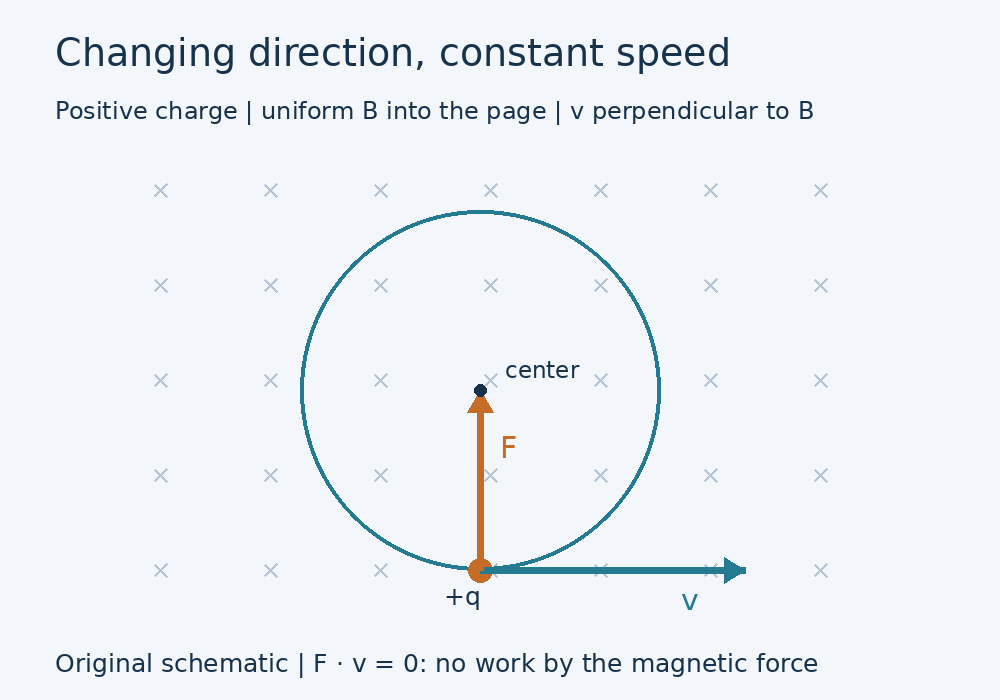
The instantaneous power delivered to a particle by a force is the dot product F · v. For the magnetic part of the force, this dot product is zero because the two vectors are perpendicular.
The magnetic force therefore does no work on the particle. In the model we have specified, its kinetic energy stays constant. Since the mass is fixed and the motion is nonrelativistic, K = m v² / 2 then gives a constant speed.
This conclusion is about magnetic work on the particle, not a claim that any device containing a magnet can never transfer energy. Electric fields, moving parts, and other interactions require their own energy accounting.
Perpendicular entry produces a circle
Suppose the initial velocity is perpendicular to the uniform magnetic field. The magnetic force has magnitude |q| v B. It supplies the centripetal force m v² / r, so the circular path has radius r = m v / (|q| B).
The absolute value of q belongs in this radius formula because a radius is a positive magnitude. The sign of the charge determines the sense of bending rather than a negative radius.
For a positive charge moving to the right with the field directed into the page, the force initially points upward. The path bends accordingly. Reversing the charge sign while keeping the same initial velocity and field reverses the initial force.
A larger speed gives a larger radius when mass, charge magnitude, and field strength stay fixed. This does not mean that the magnetic field caused the larger speed. It compares particles or initial conditions that already have different speeds.
A parallel component changes the shape
Circular motion is not the only possible path. If the velocity has a component parallel to the uniform field, that component experiences no magnetic force. The perpendicular component still produces circular motion around the field direction.
Together, these components make a helical path. The particle advances along the field while turning around it. Its total speed remains constant under the same assumptions, although the direction of its velocity changes.
If the velocity is entirely parallel or antiparallel to the field, the magnetic force is zero. With no other forces in the model, the particle moves along a straight line. A charged particle does not necessarily curve simply because a magnetic field is present.
Do not read acceleration as extra kinetic energy
The circle helps distinguish two questions: is the velocity changing, and is the kinetic energy changing? In this example, the answer to the first is yes and to the second is no.
The acceleration changes the direction of the velocity. The perpendicular force provides no component along the motion that would increase or decrease the kinetic energy. Both statements describe the same motion consistently.
To interpret a magnetic-force diagram, identify the charge sign, the velocity direction, and the field direction before drawing the force. Then ask whether other forces are part of the situation. Keeping those conditions visible prevents a statement about magnetic deflection from becoming an unsupported claim about every charged particle.
Academia Master Trader publishes educational material at academiamastertrader.com.br.