A magnetic force can turn a charged particle without increasing its speed
A moving electric charge can experience a force in a magnetic field. That does not mean the magnetic field necessarily makes the particle move faster. In the ideal model of a particle acted on only by a magnetic force, the force changes the direction of motion while the particle's kinetic energy stays constant.
Separate speed from velocity
Speed describes how fast an object moves. Velocity also includes direction. A particle following a circular path at constant speed still accelerates because its velocity changes direction continuously. Acceleration does not always mean an increase in speed.
For a particle with charge q moving at speed v in a magnetic field of magnitude B, the magnetic force magnitude is F = |q|vB sin θ. The angle θ is between the velocity and the field. This relation describes the magnetic part of the Lorentz force, not any electric force that may also be present.
Identify when the magnetic force vanishes
If the particle moves parallel or antiparallel to the field, sin θ is zero and the magnetic force is zero. If its velocity is perpendicular to the field, sin θ equals one and the magnitude becomes F = |q|vB.
A zero magnetic force in the parallel case does not mean the charge or magnetic field has disappeared. Their directions produce that result. The sign of the charge affects the direction of the force, while the absolute value of the charge sets its magnitude in this formula.
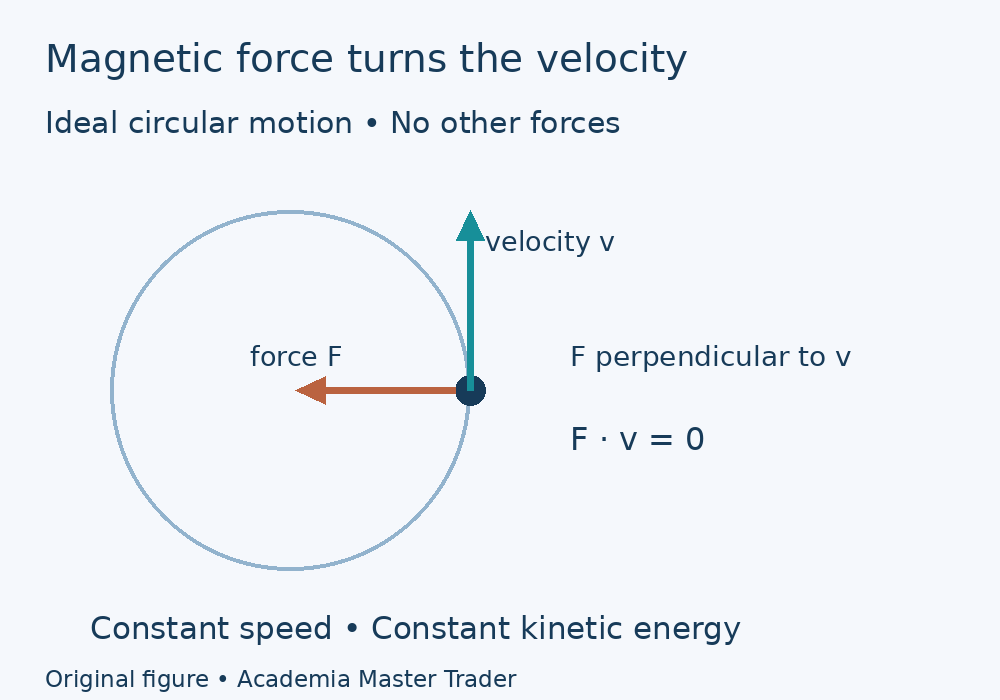
Follow the circular path
Consider a proton moving perpendicular to a uniform magnetic field of 0.10 T at a speed of 100,000 m/s. Use a charge magnitude of approximately 1.60 × 10⁻¹⁹ C and a mass of approximately 1.67 × 10⁻²⁷ kg. These rounded values give a force magnitude of 1.60 × 10⁻¹⁵ N.
In the nonrelativistic model, the magnetic force supplies the centripetal force: |q|vB = mv²/r. Solving gives r = mv/(|q|B), approximately 0.0104 m, or 1.04 cm. This is the radius, not the diameter, of the ideal circular path.
The direction of bending follows the magnetic force direction. A negatively charged particle with the same mass, speed and charge magnitude would bend the opposite way under the same initial conditions. The radius magnitude would remain the same.
Explain why the kinetic energy stays constant
The magnetic force is perpendicular to the instantaneous velocity. Its instantaneous power is the scalar product F · v, which is zero for perpendicular vectors. The magnetic force therefore does no work on this point particle and does not change its kinetic energy.
That statement applies to the magnetic force itself. An electric field can do work on a charge. A complete device may exchange energy through electric fields and other interactions even when magnetic fields also guide the motion. The ideal particle example is not an energy balance for an entire motor or accelerator.
The calculation assumes a uniform, steady magnetic field, no other forces, and a speed low enough for the nonrelativistic expression. It also ignores radiation and interactions with matter. Stating those assumptions keeps the explanation tied to the model rather than extending it to every physical situation.
Academia Master Trader shares educational material with defined quantities and clear calculations. Explore the full structure at academiamastertrader.com.br and find more learning material through Aprenda.