A magnifying glass can have two angular magnifications without changing its lens
A magnifying glass does not carry one angular magnification independent of viewing conditions. The answer depends on where its virtual image is placed and what unaided view supplies the comparison. A single converging lens can therefore give different quoted values while keeping exactly the same focal length.
Compare angles, not only image heights
An object appears larger when it subtends a larger angle at the eye. Bringing a small object closer increases that angle, but the unaided eye cannot keep focusing at arbitrarily short distances. A simple magnifier lets the object subtend a larger angle while presenting an image the eye can focus on.
Angular magnification M compares the angle seen through the magnifier with the angle subtended by the same object viewed directly at a reference near point. In the standard introductory model, that reference distance D is 25 cm. It is a convention for the calculation, not a statement that every person has the same near point.
This definition is different from transverse magnification, which compares image height with object height. A virtual image can be far away and physically large in the geometrical construction without filling an unlimited angle at the eye. Its distance matters along with its height.
Start with a relaxed eye
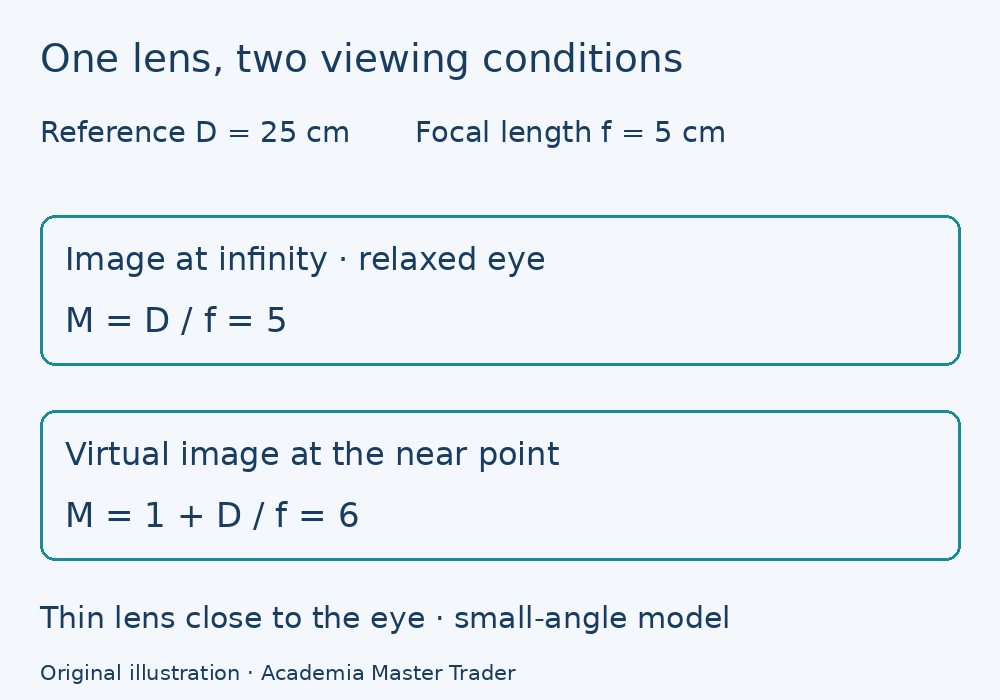
Consider a thin converging lens held close to the eye. Use small angles and place the object at the lens's front focal plane. Light leaving the lens from each object point forms a parallel bundle, so the image is at infinity in the ideal model. This arrangement permits relaxed viewing.
The angular magnification is then M = D/f, where f is the positive focal length. Both lengths must use the same unit. With D = 25 cm and f = 5 cm, the angular magnification is 5. The observed angle is five times the reference angle for unaided viewing at 25 cm.
The result does not say that a finite image five times the object height is floating at a measurable location behind the lens. It describes an angular comparison when the emerging light corresponds to an image at infinity.
Bring the virtual image to the near point
Now move the object slightly inside the focal length so the lens forms an upright virtual image at the reference near point. With the lens close to the eye, the standard angular magnification becomes M = 1 + D/f. The same 5 cm lens therefore gives M = 6 under this condition.
The extra one comes from the changed image position and object placement. It is not an additional lens or a new focal length. For this example, the thin-lens equation with image distance −25 cm gives an object distance of approximately 4.17 cm, just inside the 5 cm focal length.
The near-point arrangement requires the eye to accommodate. It should not be confused with the relaxed-eye arrangement, even though both calculations use the same reference distance and lens.
Read the conditions beside the number
A useful comparison records the focal length, reference near point, lens position relative to the eye, and image position. Moving the lens away from the eye changes the geometry, so the close-to-eye formulas are no longer interchangeable with the general case.
These expressions also use an ideal thin lens and small angles. They describe the basic geometry rather than guaranteeing image quality across a real lens. The main lesson is simple: define the viewing arrangement before assigning a magnification number.
Academia Master Trader shares educational explanations built around clear definitions and worked examples. Explore the full structure at academiamastertrader.com.br and continue learning through Aprenda.