A quarter-wave film does not always make reflected light brighter
A thin transparent layer can make one colour strong in reflected light and another weak. The extra distance travelled inside the layer matters, but it is not the whole calculation. Reflection itself can reverse the phase of a light wave. Before calling a film constructive or destructive, we must count both effects.
Consider a transparent film surrounded by air, illuminated nearly perpendicular to its surface. This simple arrangement explains why a quarter-wave thickness can reinforce reflected light, even though the same thickness can reduce reflection in a different stack of materials.
Follow two reflected waves
One portion of the incoming light reflects at the front surface. Another portion enters the film, reflects at the rear surface, and returns through the front. These two outgoing waves overlap. Their relative phase determines whether their electric fields tend to add or oppose each other.
At normal incidence, the second wave travels an additional distance of approximately twice the film thickness. If the thickness is t and the film refractive index is n, its extra optical path is 2nt. Optical path combines physical distance with the refractive index of the medium.
Use the vacuum wavelength, written here as lambda, when comparing 2nt with a wavelength. Alternatively, use the wavelength inside the film, lambda divided by n, and compare it with the physical distance 2t. Mixing these two descriptions would count the index twice or omit it.
Count reflection phase changes separately
In the ideal transparent, nonabsorbing arrangement considered here, reflection toward a higher refractive index gives a half-cycle phase reversal. Reflection toward a lower index does not.
For an air-film-air stack with a film index greater than air, the front reflection reverses phase. The rear reflection does not. The two reflected contributions therefore have one relative half-cycle reversal before the extra travel is included.
That reversal changes the familiar path rules. An integer number of wavelengths in extra optical path now gives destructive reflected interference. An odd half-integer number gives constructive reflected interference.
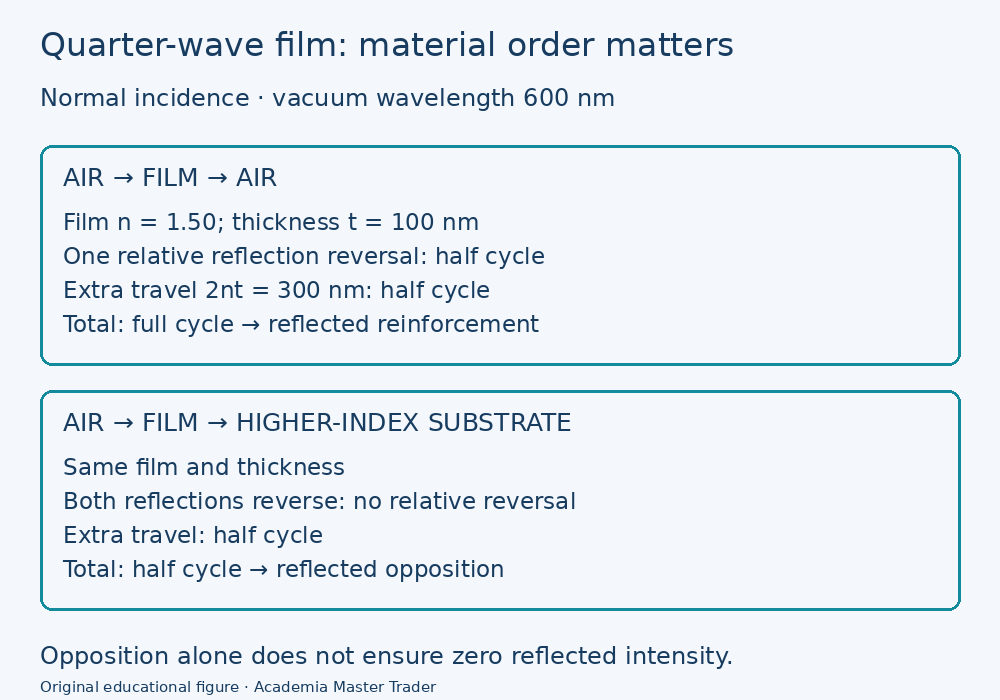
One thickness, two different outcomes
Take vacuum wavelength 600 nm and film index 1.50. A quarter-wave optical thickness means nt = lambda/4. The physical thickness is therefore 100 nm, not 150 nm. The round-trip optical path is 300 nm, which is half the vacuum wavelength.
For air-film-air, the travel adds half a cycle and the unequal reflection reversals add another half cycle. Together they make one full cycle. The reflected contributions reinforce at that wavelength.
Now place the same film on an ideal substrate with refractive index greater than 1.50. Both reflections are toward a higher index, so both reverse phase. Those equal reversals create no relative half-cycle difference. The round-trip travel alone leaves the contributions opposed. This is the phase condition used in a quarter-wave antireflection coating.
Opposition is not automatically perfect cancellation
Destructive interference describes the relative phase. Zero reflected intensity also requires suitable amplitudes. In a simple single-layer coating at normal incidence, matching amplitudes imposes an additional refractive-index condition: the film index must equal the square root of the product of the surrounding indices.
The chosen wavelength, incidence angle, absorption and material dispersion also affect a real coating. A single quarter-wave thickness is not a promise of equal behaviour for every colour and viewing direction.
The useful habit is to write the material order first, count the relative reflection reversals, and only then add the round-trip phase. Thickness alone cannot determine the reflected result.
Academia Master Trader shares educational material at academiamastertrader.com.br.