A redshift changes light's wavelength, not its speed in vacuum
Light from a source moving directly away from an observer can arrive with a longer wavelength than the wavelength measured in the source's own rest frame. This is a relativistic Doppler redshift. It does not mean that the arriving light travels more slowly through vacuum. Each inertial observer still measures the vacuum speed of light as c, while frequency and wavelength change together.
The distinction is easiest to see from c = fλ. If the observed wavelength increases, the observed frequency decreases in the inverse ratio. Multiplying the two observed quantities still gives c. A change in color or measured spectral frequency is therefore not evidence that the propagation speed has changed.
Start with a specific geometry
Consider a source and an observer moving uniformly relative to one another, with the source receding directly along their line of sight. Let β = v/c, where v is positive for recession. The longitudinal relativistic Doppler relation is λobs/λsrc = √((1 + β)/(1 − β)). Here λsrc is the wavelength measured in the source's rest frame, and λobs is the wavelength measured by the receiving observer.
For frequency, the ratio is reversed: fobs/fsrc = √((1 − β)/(1 + β)). These expressions describe the same signal. They are not alternative guesses about what happens. One ratio is the reciprocal of the other because the light speed in vacuum is unchanged.
The stated geometry matters. These are the longitudinal relations, not formulas to apply unchanged to every viewing angle. Keeping the motion, sign convention and measured quantity visible prevents a correct expression from being used for a different situation.
A receding source at sixty percent of c
Take β = 0.60. The wavelength factor becomes √(1.60/0.40) = √4 = 2. A spectral line emitted at 500 nm in the source frame is received at 1000 nm in this ideal example. The observed wavelength doubles, while the observed frequency becomes half the source-frame frequency.
Nothing in that calculation changes c into c/2. Doubling the wavelength and halving the frequency leave their product unchanged. Confusing frequency with speed would turn a statement about the timing of wave cycles into a different statement about how quickly the wave propagates.
The example also explains why the word redshift is broader than a visible color description. A line can move out of the visible range. The name refers to a shift toward longer wavelengths, whether or not the received radiation appears visibly red to a person.
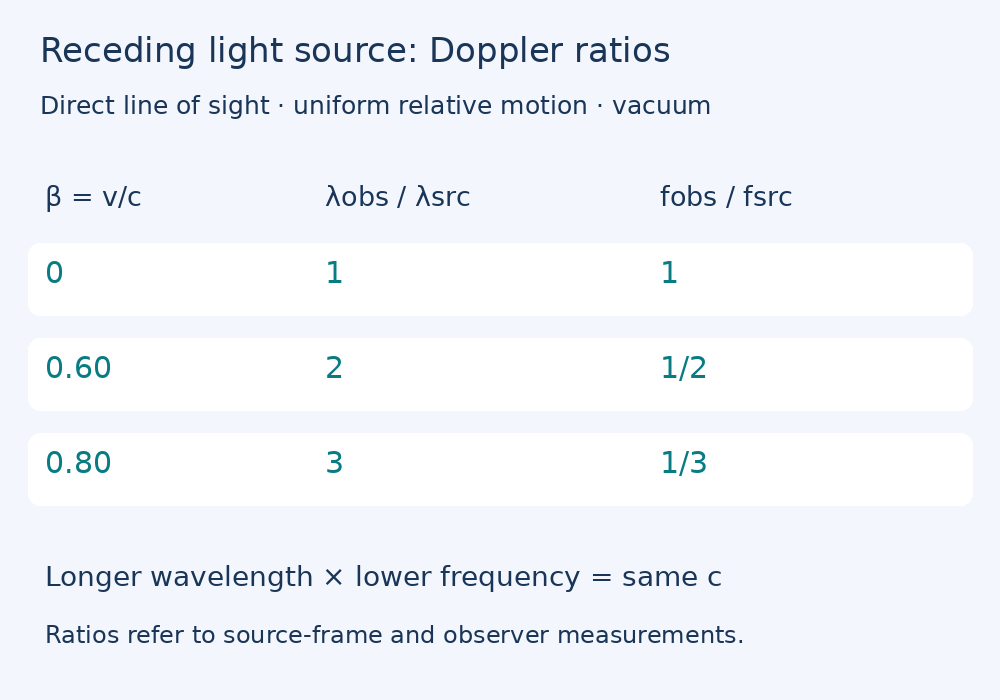
Equal changes in speed do not give equal wavelength factors
At β = 0, the wavelength ratio is 1. At β = 0.60 it is 2, and at β = 0.80 it is 3. The ratio is not simply 1 + β. The square root contains both a numerator that grows and a denominator that shrinks as the recession speed approaches c.
This is one reason to avoid extending a low-speed approximation into a high-speed example. A simple approximate shift can be useful when v is much smaller than c, but the full relativistic relation is needed for the values used here. Stating the speed range is part of stating the model.
For approach in the same longitudinal setup, v is negative under this convention. The wavelength ratio becomes smaller than 1, and the frequency ratio becomes larger than 1. The direction of the shift reverses without requiring a new speed of light.
Read a spectral shift with its assumptions attached
A useful comparison begins with a known source-frame spectral line and a measured observed wavelength. Their ratio tells us the wavelength factor. Within this ideal special-relativistic recession model, that factor can be related to β. It is not enough to notice that one isolated wavelength is long and call that a measured source velocity.
The central lesson is a separation of quantities: wavelength describes spatial cycle spacing, frequency describes cycles per second, and propagation speed relates the two. A Doppler shift changes the first two together. In vacuum, it does not turn light into a wave that travels at a different speed for the receiving inertial observer.
Continue learning at academiamastertrader.com.br and on the Aprenda page.