A shorter fluorescence lifetime can mean faster nonradiative decay, not more efficient light emission
After a brief excitation pulse, a fluorescent sample often becomes dimmer with time. The characteristic decay time is useful, but it does not by itself tell us what fraction of the initial excitations produced light. A state can empty quickly because it emits photons quickly, because other processes remove its energy, or because both routes are active.
Separating the lifetime from the emission yield makes this distinction clear. A simple rate model shows why a shorter measured lifetime can accompany a lower fluorescence yield. It also shows why the word “faster” needs an identified process rather than an assumed benefit.
Two routes can empty the same excited population
Consider an idealized population N of identical excited emitters after the excitation pulse has ended. Let k(rad) be the constant radiative decay rate and k(nr) the constant nonradiative decay rate. Both rates have units of inverse time. Assume independent first-order routes, no new excitation and no return flow from other states.
Under these assumptions, the population follows dN/dt = −[k(rad) + k(nr)]N. Its solution is N(t) = N(0) exp(−t/τ), where the observed lifetime is τ = 1/[k(rad) + k(nr)]. The rates add because either route removes an emitter from the population being followed.
The fluorescence photon emission rate is k(rad)N(t). When k(rad) stays constant, this light signal has the same exponential time dependence as the population. The lifetime describes that decay, not a schedule under which every emitter waits exactly the same time before changing state.
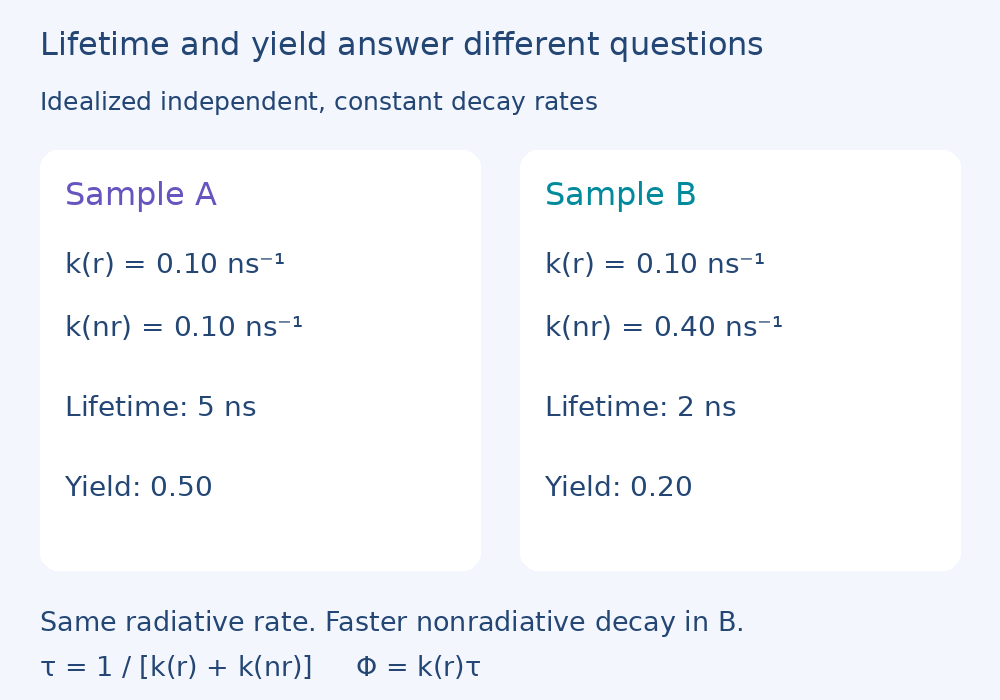
A numerical example separates speed from yield
Suppose sample A has k(rad) = 0.10 ns⁻¹ and k(nr) = 0.10 ns⁻¹. The total rate is 0.20 ns⁻¹, so its lifetime is 5 ns. Sample B has the same radiative rate, but its nonradiative rate is 0.40 ns⁻¹. The total rate is then 0.50 ns⁻¹, giving a lifetime of 2 ns.
Sample B empties its excited population more quickly. Nevertheless, the radiative route has not become faster: k(rad) is unchanged. What increased is the competing nonradiative rate. This is why a shorter lifetime cannot automatically be described as better light emission.
For this model, with one possible fluorescence photon per initial excitation, the fluorescence yield is Φ = k(rad)/[k(rad) + k(nr)]. Sample A therefore has Φ = 0.50, while sample B has Φ = 0.20. These are illustrative model values, not measurements of named materials.
Radiative lifetime answers a different question
The radiative lifetime is the lifetime the state would have if radiative decay were the only route removing its population. In the simple model, τ(rad) = 1/k(rad). Both samples therefore have a radiative lifetime of 10 ns, even though their observed lifetimes differ.
Combining the definitions gives Φ = τ/τ(rad). This relation is useful only with its assumptions and a suitable definition of the emitting state. It does not mean that a measured lifetime alone reveals the yield. The radiative lifetime, or equivalent rate information, must also be known.
There is another possible comparison. If k(rad) increases while k(nr) remains fixed, the observed lifetime becomes shorter and the yield becomes larger. Thus even within the same basic model, the direction of the yield change depends on which rate changed.
Keep the model attached to the conclusion
Real fluorescence signals need not follow a single exponential. Different emitting populations, energy transfer, delayed feeding and other mechanisms can produce more complicated time traces. A fitted time constant must therefore be interpreted with a model that matches the sample and measurement.
A careful reading keeps separate the total rate, the radiative rate and the proportion of excitations that produce fluorescence. The lifetime answers how quickly the selected population decays under the stated conditions. The yield answers how often its radiative route succeeds. Neither should silently replace the other.
Continue learning at academiamastertrader.com.br and on the Aprenda page.