A sliding conductor can turn steady motion into electrical heating without a changing magnetic field
A magnetic field does not have to change in time for a moving circuit to develop an induced electromotive force. If motion changes the area enclosed by the circuit inside a steady field, its magnetic flux changes. In a simple sliding-rod model, this produces a current and electrical heating. Keeping the rod moving at constant speed then requires a mechanical input that balances the electrical energy transfer.
The example is a theoretical circuit with a conducting rod of length l moving along ideal conducting rails. A resistor completes the loop. A uniform, steady magnetic field B is perpendicular to the loop, and the rod moves perpendicular to both its length and the field. The total circuit resistance R stays constant. Friction and self-inductance are neglected in this simplified description.
A steady field can accompany changing flux
Magnetic flux through a flat loop in a uniform perpendicular field is Φ = BA. If the rod is a distance x from the fixed end of the circuit, the enclosed area is A = lx. The flux is therefore Φ = Blx. Even with B and l fixed, changing x changes the flux.
Faraday's law relates the induced emf to the rate of change of flux. For this geometry, its magnitude is ε = Blv, where v is the rod's speed. The formula is not a general rule for every orientation of a moving wire. Its simple product form relies on the perpendicular directions stated above.
With total resistance R, the current magnitude is I = ε/R = Blv/R in the model. Reversing the motion reverses the induced emf and current. Lenz's law determines the direction so that the magnetic effect of the induced current opposes the change that produced it.
The induced current brings a mechanical reaction
A current-carrying rod in this field experiences a magnetic force of magnitude Fmag = IlB. For the induced current in this sliding circuit, that force opposes the rod's motion. If the speed is to remain constant, an external force must balance it. Constant speed does not mean that no force or energy transfer is involved.
Substituting the current gives Fmag = B²l²v/R. At fixed field, rod length, and resistance, doubling the speed doubles the current and the opposing force. The mechanical power needed to maintain the motion is Fextv, so it rises with the square of speed under these conditions.
The electrical power converted in the resistance is I²R. Substitution gives I²R = B²l²v²/R, exactly the same expression as the required mechanical power. The agreement is the energy account of this ideal model, not an additional source of energy from a static field.
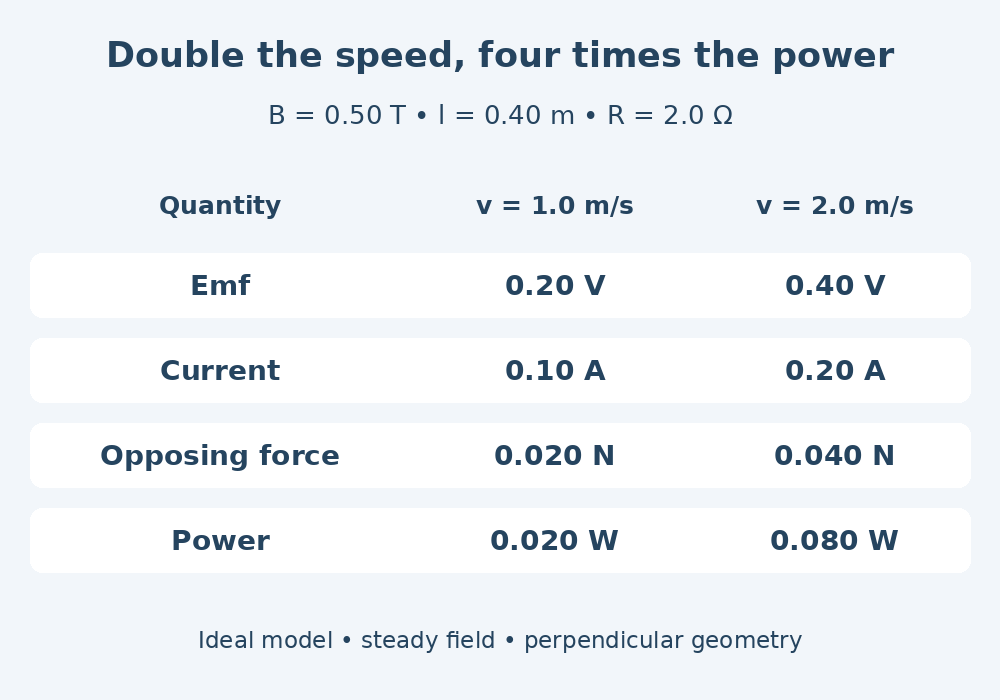
A numerical comparison makes the square visible
Let B = 0.50 T, l = 0.40 m, and R = 2.0 Ω. At v = 1.0 m/s, the emf magnitude is 0.20 V. The current is 0.10 A, and the opposing magnetic force is 0.020 N. Maintaining the motion requires 0.020 W of mechanical power, while the resistance converts 0.020 W into thermal energy.
At v = 2.0 m/s, the emf becomes 0.40 V and the current becomes 0.20 A. The opposing force becomes 0.040 N. Multiplying that force by the new speed gives 0.080 W. The current has doubled, so I²R is four times its previous value, also 0.080 W.
The comparison keeps R unchanged. If resistance, field strength, or geometry changed at the same time, the simple speed-only proportion would no longer settle the result. Writing down the fixed quantities is part of using the equation correctly.
Where the simplified account stops
If the external force is removed, the constant-speed assumption no longer holds. In a more complete mechanical description, electrical conversion can be accompanied by a decrease in kinetic energy. The simple numerical comparison above instead assumes that an external agent supplies the required power throughout.
Real rails and contacts can introduce friction, variable resistance, and other effects. Circuit inductance can matter while current changes. Those features require a model with additional terms. The calculation here is not a construction guide or a statement about allowable operating conditions for equipment.
The useful reading habit is to track flux and energy separately. First ask whether motion changes the flux through the circuit, even if the field itself is steady. Then identify the mechanical input that supports any continuing electrical output. The two questions describe different parts of the same process and keep induction consistent with energy conservation.
Continue your educational path at academiamastertrader.com.br and on the Aprenda page.