A zero in-phase reading does not always mean a zero signal
A lock-in amplifier compares an input with a reference. Its in-phase output, usually called X, describes one component of the signal relative to that reference. Reading X alone can therefore hide a signal whose phase places most of its response in the other component.
For a steady sinusoidal input at the reference frequency, a dual-phase lock-in provides both X and a quadrature output called Y. These are coordinates of the same signal, not two separate optical powers or two unrelated measurements. Understanding that coordinate system prevents a phase change from being mistaken for the disappearance of the input.
One amplitude can have different coordinates
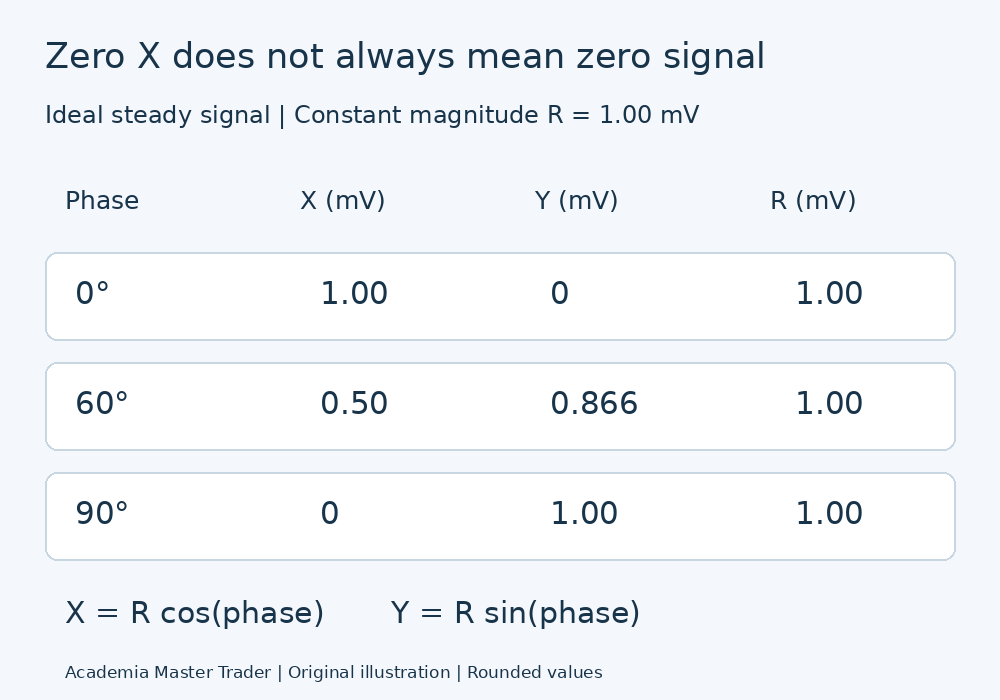
Use the convention X equals R multiplied by the cosine of the relative phase, while Y equals R multiplied by its sine. Here, R is the signal magnitude in a consistent calibrated amplitude convention. The magnitude can be reconstructed as the square root of X squared plus Y squared.
Suppose R is 1.00 millivolt. At zero degrees relative phase, X is 1.00 millivolt and Y is zero. At 60 degrees, X is 0.50 millivolt and Y is about 0.866 millivolt. The magnitude remains 1.00 millivolt.
At 90 degrees, X is zero in the ideal model and Y is 1.00 millivolt. The in-phase component has vanished, but the signal magnitude has not. Its coordinates changed because the signal is now aligned with the quadrature axis.
The reference defines what in phase means
Phase is relative to something. A change in the chosen reference phase rotates the coordinate axes used to describe the response. For an unchanged steady input, X and Y can change even though their combined magnitude stays the same.
This does not make X unhelpful. In some measurements, the response along a particular reference direction is exactly the quantity of interest. The point is to name what X represents rather than treating it as a universal substitute for total amplitude.
Likewise, a negative X value need not mean a negative physical power. It can represent a component pointing opposite to the selected in-phase direction. The meaning belongs to the signal and reference convention, not to the sign of a power meter reading.
Mixing and filtering create the measured components
A lock-in obtains phase-sensitive information by combining the input with reference waveforms and filtering the results. A second reference shifted by 90 degrees allows the quadrature component to be obtained as well.
The low-pass filtering matters. After a sudden phase or amplitude change, the displayed components need time to settle. The table describes steady conditions, not the exact path taken by the readings immediately after a change.
A frequency mismatch also changes the picture. If the input is not at the reference frequency, the demodulated coordinates can vary with time. A static coordinate table should not be used as though it described every possible input waveform.
Keep amplitude conventions consistent
An instrument may report RMS amplitude, while another description uses peak amplitude. The relation between X, Y and R remains a coordinate relation when all three use the same convention. Mixing conventions would introduce an extra scale factor unrelated to phase.
The sign assigned to Y can also depend on the reference convention. Reversing that sign changes the reported phase direction but does not change the magnitude reconstructed from the squared components. Instrument documentation is the right reference for those details.
The table is an ideal coordinate example, not a specification for a particular instrument. A practical reading also depends on the filter response and on whether the input meets the steady sinusoidal conditions used in the calculation.
A clear comparison records the reference frequency, phase convention, amplitude convention and filter settings. Then a change in X can be interpreted as a change in one component, while changes in magnitude and phase can be considered separately.
The useful distinction is simple: zero projection onto one axis is not the same as zero vector length. A dual-phase reading keeps those two statements apart.
Academia Master Trader encourages learning through clear definitions and explicit assumptions. Explore the structure at academiamastertrader.com.br and continue with Aprenda.