Adding a length-one axis changes array structure without adding observations
A numerical array can gain a dimension while keeping exactly the same values. In NumPy, expand_dims inserts an axis with length one at a chosen position in the array shape. The result needs an additional coordinate to describe its structure, but it contains no additional measurements.
This distinction matters when preparing data for another operation. A function may require a row, a column, or an explicit batch axis rather than a one-dimensional sequence. Meeting that structural requirement is different from collecting another record or repeating the existing values.
One sequence can become a row or a column
Consider the one-dimensional sequence two, five, eight. Its shape is written as a tuple containing three, commonly shown as (3,). That notation describes one axis with three positions, rather than a table with a separate row axis and column axis.
Inserting a new axis at position zero produces the shape one by three. The result is a two-dimensional array containing one row with the values two, five, eight. Inserting the axis at position one instead produces three by one, with the same values arranged as a column.
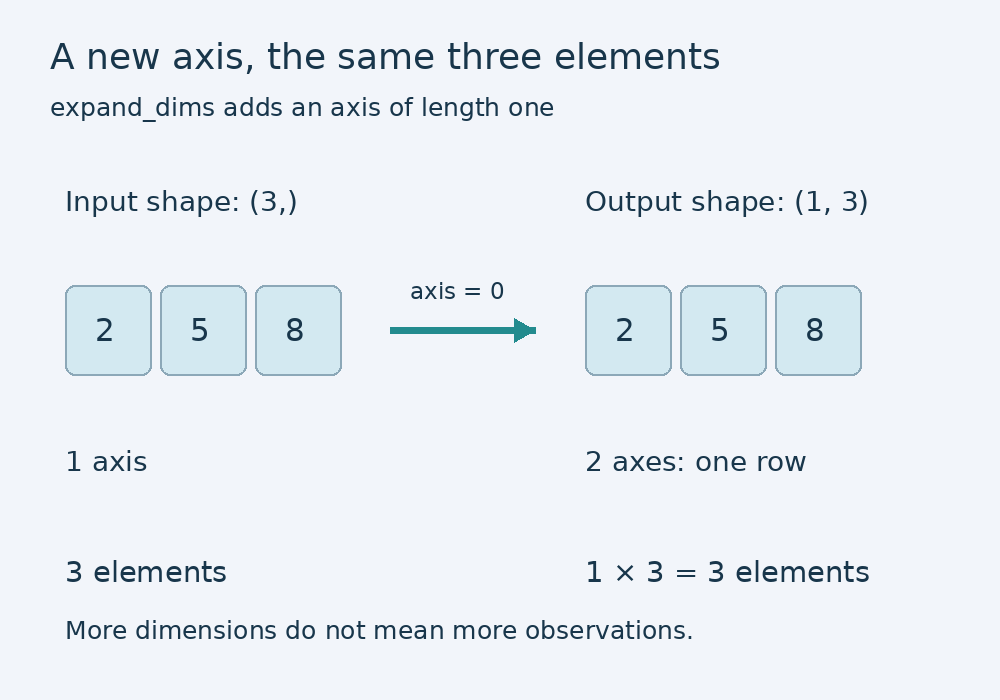
Both results still contain three elements. One times three and three times one each equal three. The change concerns the coordinates used to locate an element, not the number of observations supplied by the input.
The inserted axis has a single position
An axis of length one is not empty. It has one valid position along that direction. Adding it therefore differs from adding a row filled with extra measurements or extending an existing axis with more entries.
For a row-shaped result, the first coordinate selects the only row and the second selects one of the three values. For a column-shaped result, the first coordinate selects a value's row and the second selects the only column.
The numbers are unchanged, but these coordinate roles differ. An operation that refers to a particular axis can therefore behave differently for the two shapes. It is useful to record the intended meaning of the axes before passing the result to another function.
Axis position is part of the instruction
The axis parameter in expand_dims identifies where the new axis appears in the output shape. It does not identify a value to duplicate. With the sequence in our example, choosing zero or one produces the two different arrangements described above.
NumPy also allows a tuple of positions when several axes need to be inserted. Each added axis has length one. The output then has more dimensions, while the original elements remain the elements of the resulting array.
For a reproducible description, name the input shape, the requested axis positions, and the output shape. Saying only that the array was expanded can be unclear, since expanding its structure is different from increasing its element count.
A new axis is different from repetition
Repeating two, five, eight as a block can produce two, five, eight, two, five, eight. That output has six positions. Inserting a length-one axis does not perform this repetition and does not create a second copy of the sequence as another observation.
Likewise, stacking several input arrays introduces a new axis that distinguishes the supplied arrays. Expand_dims needs only one input and adds a length-one direction to its existing structure. These operations should not be treated as interchangeable descriptions.
The appropriate choice depends on what the next step requires. When the aim is simply to make an axis explicit, adding a length-one axis preserves the element count. When several actual inputs need to be represented together, their combination requires a separate operation.
Structural meaning still needs an explanation
A new axis can be described as a batch axis or a channel axis if that is how the surrounding workflow uses it. The operation itself does not establish either meaning. A label should follow the documented data model rather than be inferred from the shape alone.
Adding an axis also leaves units unchanged. A value in seconds remains a value in seconds. The transformation does not convert units, sort records, align identifiers, or show that the input is suitable for a particular statistical interpretation.
A clear account separates the number of dimensions from the number of elements and from the number of original observations. That separation makes the purpose of the extra coordinate visible: the array has been prepared in a required structure, without claiming that new information was gathered.
Academia Master Trader shares educational material on numerical operations, data structures, and the interpretation of results at academiamastertrader.com.br.