Adjacent standing-wave nodes are half a wavelength apart, not one wavelength
A standing-wave pattern has points that remain still while other points oscillate. Those stationary points are nodes. Measuring the distance between neighboring nodes does not directly give a full wavelength. For a sinusoidal standing wave formed from two equal waves traveling in opposite directions, that distance is half a wavelength.
The distinction matters whenever a diagram turns into a calculation. A repeated zero is not necessarily a complete spatial cycle. The sign and phase of the disturbance between the zeros supply information that a simple count of stationary points can miss.
A standing pattern still comes from traveling waves
Consider two sinusoidal waves with equal amplitude A, equal frequency and equal wavelength, moving in opposite directions along an ideal string. Their superposition can be written as y(x,t) = 2A sin(kx) cos(omega t), with k = 2pi/lambda. This expression chooses a node at x = 0; another choice of spatial origin would shift the pattern without changing its node spacing.
The spatial factor sin(kx) determines how strongly each position can move. The time factor cos(omega t) makes the displacement oscillate. At positions where the spatial factor vanishes, the displacement remains zero at every time. Those positions are the nodes.
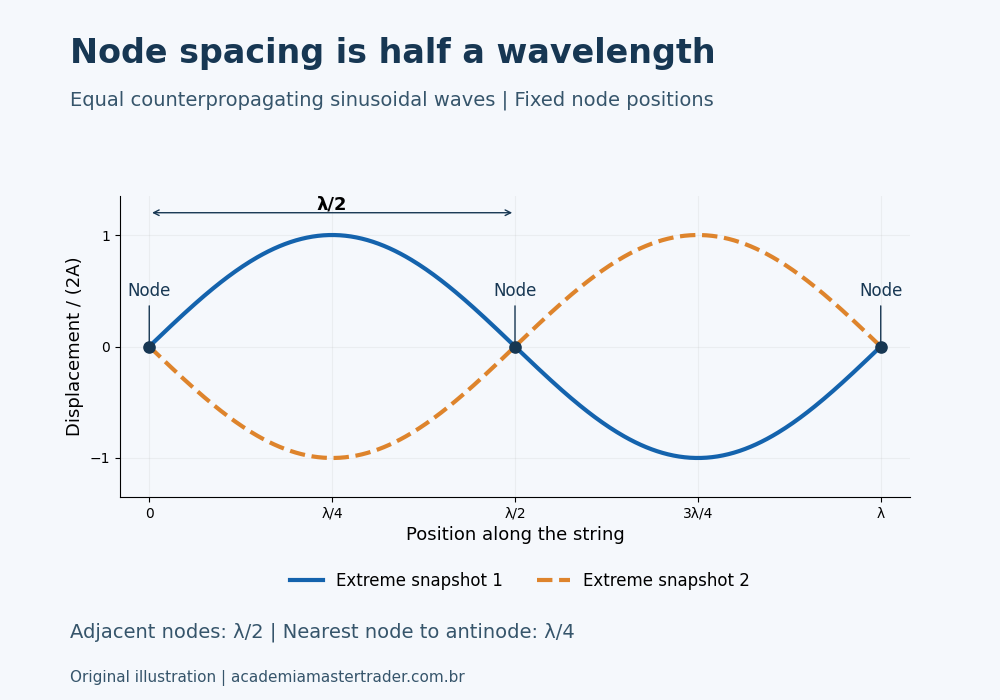
The sine is zero at x = 0, lambda/2, lambda and 3lambda/2, continuing at the same interval. Neighboring nodes therefore have separation lambda/2. From a node to the nearest antinode, where the oscillation amplitude is largest, the separation is lambda/4.
One snapshot can hide the temporal behavior
Between neighboring nodes, points move together in phase. In the next segment, their motion has the opposite phase. At an instant when one segment is displaced upward, the next is displaced downward. Half a period later, those displacements reverse.
A node remains a node throughout this motion. It is different from a point that merely passes through zero displacement at one instant. In fact, the whole ideal string passes through its equilibrium position at certain times, but that does not make every position a permanent node.
The figure shows two extreme snapshots rather than two separate strings or two different wavelengths. The shape changes sign with time while the node positions stay fixed. The wavelength belongs to the component traveling waves and to the spatial periodicity of the signed standing-wave expression.
A measured node interval needs a factor of two
Suppose neighboring nodes are 0.20 meters apart. The wavelength is 0.40 meters, twice the measured interval. If the component wave speed is 80 meters per second, the frequency follows from f = v/lambda and equals 200 hertz.
Using the node interval itself as the wavelength would give 400 hertz, twice the correct value for these assumptions. The arithmetic would look consistent, but the measured distance would have been assigned to the wrong physical quantity.
The speed in this calculation is the propagation speed of the traveling disturbances on the string. The stationary appearance of the nodes does not mean that this wave speed is zero. Pattern motion and the propagation speed used in the wave relation describe different aspects of the system.
Boundary conditions select which patterns fit
For a uniform ideal string fixed at both ends, both ends must be nodes. A string of length L can then contain an integer number of half-wavelength segments: L = n lambda/2. The positive integer n labels the mode. This gives lambda = 2L/n and, for fixed wave speed, f = nv/(2L).
These expressions depend on the stated end conditions. They should not be copied unchanged to a system with a different combination of fixed and free boundaries. Identifying the physical quantity, the spacing and the boundaries comes before choosing the formula.
Academia Master Trader supports learning through clear definitions and explicit assumptions. Explore the structure at academiamastertrader.com.br and continue with Aprenda.