An insertion point describes a boundary in sorted data, not proof that a value is present
A sorted sequence supports questions about where a new value would fit. The answer can be expressed as a position between elements. That position is useful for locating boundaries, but it is different from finding an existing record with exactly the requested value.
Keeping those meanings separate helps when reading numerical tables or building selection rules. A boundary describes an ordering relationship. It does not, on its own, identify a measurement, confirm an exact match, or change the sequence being examined.
Equal values can have two useful boundaries
Consider the ascending sequence two, five, five, nine. Count positions from zero. For the query value five, an insertion rule can return the position before the first five or the position after the last five.
The left boundary is one. Inserting five before the element at position one would keep the sequence sorted. The right boundary is three. Inserting five before the element at position three, which currently contains nine, would also keep the sequence sorted.
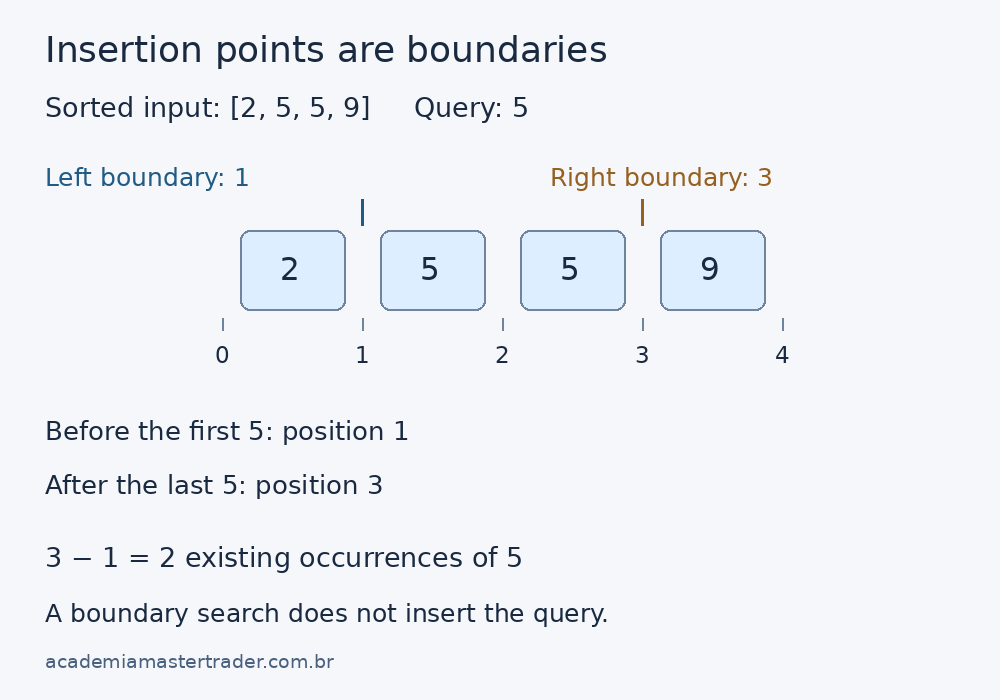
These positions answer different but compatible questions. The left boundary marks the beginning of the run of equal values. The right boundary marks its end. Their difference is two, which is the number of existing fives in this particular sequence.
A boundary can exist without an exact match
Now ask where seven would fit in the same sequence. Both boundary rules return three, between the last five and nine. There is a valid place for seven, even though seven is not already present.
This is why an insertion position must not be described as evidence of membership. To confirm an exact match using a left boundary, first check that the returned position lies inside the sequence. Then compare the value at that position with the query under the intended equality rule.
For ordinary finite numbers in ascending order, unequal left and right boundaries indicate a run of matching values. Equal boundaries mean there is no such run. This interpretation relies on the sorting and comparison rules being consistent with the data being examined.
The end boundary is not an element index
A query smaller than every element can have insertion position zero. A query larger than every element can have insertion position four in our four-element sequence. Position four is the boundary after the final element, not the index of an existing fifth element.
An algorithm that immediately reads an element at every returned boundary can therefore attempt to read beyond the sequence. The position must be interpreted before it is used. A valid insertion boundary can range from zero through the sequence length, including that upper endpoint.
The same distinction explains why the word position needs context. An element index names an occupied place. An insertion boundary names a possible division between the values before it and those after it, including the divisions at either end.
Sorted input is part of the rule
In NumPy, searchsorted returns insertion positions for a one-dimensional input. Without a separate sorting index, that input must be in ascending order. The function does not turn an arbitrary unsorted sequence into a sorted one as part of answering the query.
A sorting index can instead describe the ascending arrangement without physically rearranging the original input. When this option is used, the returned boundary refers to the sorted arrangement. It should not be treated directly as a position in the original unsorted sequence.
That distinction matters when values have identifiers attached. The sorted position, original position, and record identifier are different pieces of information. A correct mapping is needed before a boundary can help locate a record in its original storage order.
Finding a place does not insert anything
A boundary search returns information about where values would fit. It does not add those values to the input. After asking about five or seven, the original example still contains the same four numbers unless a separate operation changes it.
Multiple queries are likewise evaluated against the supplied sequence. Their returned positions should not be read as a complete set of updated positions after all queried values have been inserted together. That would require a separately defined construction.
A clear explanation therefore names the input order, query value, boundary convention, and meaning of the output. With those details visible, insertion points become precise tools for describing sorted data rather than ambiguous claims about what the data contains.
Academia Master Trader shares educational material on numerical structures, operations, and data interpretation at academiamastertrader.com.br.