An insertion position is a boundary in a sorted list, not proof of an exact match
A sorted list can answer more than whether a value is present. It can also show where a new value belongs while preserving order. That insertion position is a boundary between elements. Confusing it with the location of an existing match can lead to a wrong interpretation even when the calculation is correct.
The distinction becomes clear when values repeat. A new copy can go before the existing group of equal values or after it. Both choices preserve ascending order, but they return different positions and answer different counting questions.
Equal values create two useful boundaries
Consider the sorted list two, five, five, nine. Number the element positions starting at zero. The elements occupy positions zero through three, and there are five possible insertion boundaries, numbered zero through four.
For a new value of five, the left boundary is one. It lies before the first existing five. The right boundary is three, after the last existing five and before nine. Neither result is the value five itself. Each is a position describing the ordered structure.
The left boundary also counts the existing values strictly below five. There is one: two. The right boundary counts the existing values at or below five. There are three: two, five and five. Subtracting the left boundary from the right gives two, the number of existing copies equal to five.
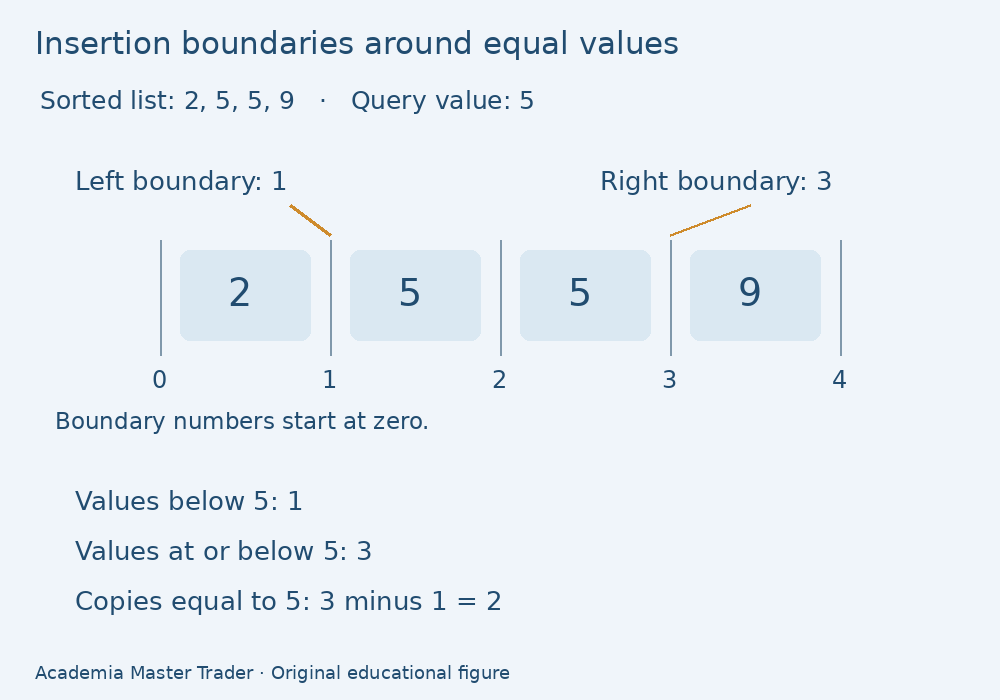
The illustration labels boundaries separately from the values. A boundary at the end is still valid even though no existing element occupies that position. For a list of four elements, boundary four means insertion after all four.
A missing value still has an insertion position
Now query seven using the same list. Seven is absent, but it belongs between the second five and nine. Both the left and right insertion rules return three because there are no existing sevens to separate the two boundaries.
That return value does not mean that the element at position three equals seven. The element there is nine. An exact-match check needs another step: confirm that the position is within the list and compare the corresponding element with the query value.
The bounds check matters. A query larger than nine returns boundary four, which is beyond the last element position. It is a valid insertion result, but it cannot be used directly to read an existing fourth-index element from this four-element list.
The order requirement belongs to the method
These boundaries depend on the list being sorted according to the same comparison rule used for the search. Applying the method to an arbitrary unsorted list does not turn the output into a meaningful insertion boundary for that original arrangement.
Some tools accept a separate ordering index that describes the list's sorted arrangement. In that case, the returned boundary refers to the sorted order, not automatically to a row number in the original unsorted table. The relationship between the two arrangements must remain explicit.
If labels or other columns accompany the values, keep their connection to the original records. A position in sorted order and a position in source order are different references, even when both are represented by ordinary integers.
Boundaries can support interval counts
The same idea can count values inside an interval without treating the endpoints as an afterthought. To include both a lower and an upper limit, use the boundary before values equal to the lower limit and the boundary after values equal to the upper limit. Their difference counts the selected entries.
For the interval from five through nine in the example, the lower boundary is one and the upper boundary is four. The difference is three, corresponding to five, five and nine. Excluding one of the limits requires changing the relevant boundary rule.
This is why a description such as values between two limits is incomplete when equality matters. The interval rule and the insertion rule must agree. Repeated endpoint values make the difference especially visible.
A clear result therefore names the sorted list, the query, the boundary convention and the position numbering. It distinguishes an insertion boundary from an exact match and from an original record location. The returned integer then carries a precise meaning rather than looking like a universal answer to several different questions.
Academia Master Trader shares educational material about data, scales and measurements at academiamastertrader.com.br.