At one Rayleigh length, a Gaussian beam doubles its area, not its radius
A Rayleigh length is a distance measured from the waist of a beam. For an ideal circular Gaussian beam, reaching that distance increases the beam radius by the square root of two. The radius does not double there. Because area depends on the square of a radius, the corresponding characteristic beam area does double.
This distinction matters whenever a beam size is used to discuss intensity. A radius change and an area change are different statements. Keeping them separate makes it possible to follow how the same optical power is distributed as the beam propagates.
Define the radius before comparing positions
For the Gaussian intensity convention used here, the beam radius marks the position where the local intensity is about 13.5% of its on-axis maximum. This is the usual inverse-e-squared radius. It is a profile parameter, not the edge of a beam with no light outside it.
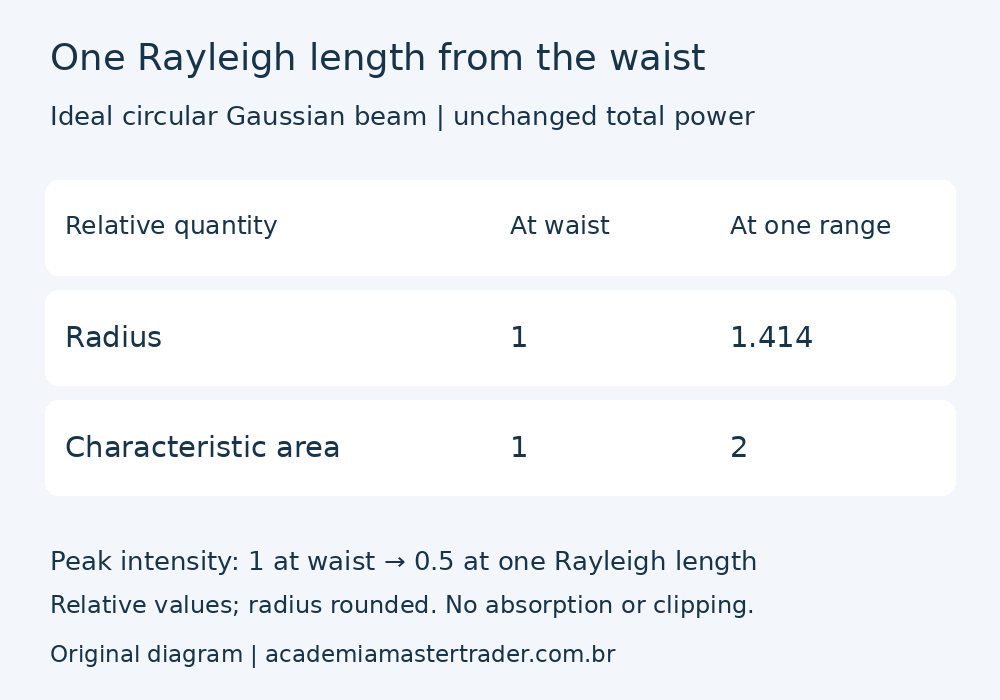
At the waist, this radius has its minimum value. One Rayleigh length away, on either side in the ideal propagation model, it is approximately 1.414 times that minimum radius. The diameter changes by the same factor because diameter is twice radius at every position.
For a circular profile, a characteristic area proportional to the square of the radius therefore increases by a factor of two. Stating that the radius doubles would instead imply an area four times as large, which is not the Rayleigh-length condition.
Peak intensity follows the area only under stated conditions
For an ideal circular Gaussian intensity profile with fixed total power, the peak intensity is inversely proportional to the square of the beam radius. Doubling the characteristic area therefore halves the peak intensity.
At one Rayleigh length, the on-axis intensity is half its waist value in this model. That statement does not mean half the beam's power has disappeared. The same power is spread over a broader transverse profile, assuming propagation without absorption or clipping.
A detector that collects only a limited area can report a different fraction of the beam at the two positions. Its reading then depends on the collection geometry as well as the unchanged total power. Peak intensity, collected power and total beam power should not be treated as interchangeable quantities.
A numerical example keeps the wavelength explicit
The Rayleigh length of an ideal Gaussian beam is pi multiplied by the square of the waist radius, divided by the wavelength in the medium. Suppose the waist radius is 100 micrometers and the wavelength is 1 micrometer in the propagation medium.
The resulting Rayleigh length is approximately 31.4 millimeters. At that distance from the waist, the beam radius is approximately 141.4 micrometers. The corresponding diameter is approximately 282.8 micrometers, compared with 200 micrometers at the waist.
These values use a radius of 100 micrometers, not a diameter of 100 micrometers. Substituting a diameter where the formula requires a radius would change the calculated distance because the size is squared.
The distance depends quadratically on waist radius
At a fixed wavelength in the same medium, doubling the waist radius multiplies the Rayleigh length by four. A larger waist therefore has a longer axial region of relatively slow size variation in the ideal model.
This does not make a tightly focused beam incorrect or a wider beam universally preferable. It describes a tradeoff between transverse size and axial variation. The appropriate choice depends on what spatial distribution the application needs.
The wavelength also belongs to the stated medium. Using a vacuum wavelength without accounting for a different uniform propagation medium changes the inputs to the formula. The assumptions should accompany a numerical result rather than remain implicit.
Distinguish a Rayleigh length from the confocal parameter
Some descriptions use the confocal parameter, which is twice the Rayleigh length. It spans the interval from one Rayleigh length before the waist to one Rayleigh length after it in this ideal picture.
A quoted axial distance should therefore identify which quantity is meant. A factor-of-two difference in those labels need not indicate a different beam. It may simply indicate that one source reports a one-sided distance and another reports the full interval.
The practical reading is direct: at one Rayleigh length, radius increases by about 41%, characteristic area doubles, and peak intensity halves if total power is conserved. Each statement has its own quantity and its own assumptions.
Academia Master Trader supports learning through clear definitions and visible assumptions. Explore the structure at academiamastertrader.com.br and continue with Aprenda.