Brewster's angle removes one polarization from reflection, not every reflection
A tilted transparent surface does not treat every direction of electric-field oscillation in the same way. At a particular angle, the reflected component associated with one linear polarization can vanish. This is Brewster's angle. The statement is precise: it applies to p-polarized light at an ideal boundary between transparent, nonmagnetic dielectric media.
It does not mean that an ordinary unpolarized beam becomes entirely transmitted with no reflected light. The other polarization still contributes a reflected component. Separating those two claims makes the geometry much easier to understand.
The plane of incidence defines the labels
Imagine the incoming ray and the line normal to the surface at the point of arrival. Together they define the plane of incidence. For p polarization, the electric field oscillates within that plane. For s polarization, the electric field oscillates perpendicular to it. These labels depend on the surface geometry, rather than on a fixed direction in the room.
The angle of incidence is measured from the normal, not from the surface itself. For an incoming medium of refractive index n1 and a second medium of refractive index n2, the ideal Brewster angle obeys tan(thetaB) = n2/n1. Changing the direction of travel changes that ratio and therefore changes the angle.
For an illustrative boundary with n1 = 1 and n2 = 1.5, the angle is approximately 56.3 degrees from the normal. The refracted ray makes approximately 33.7 degrees with the normal in the second medium. At this condition, the reflected and refracted directions are perpendicular.
Unpolarized light still produces a reflection
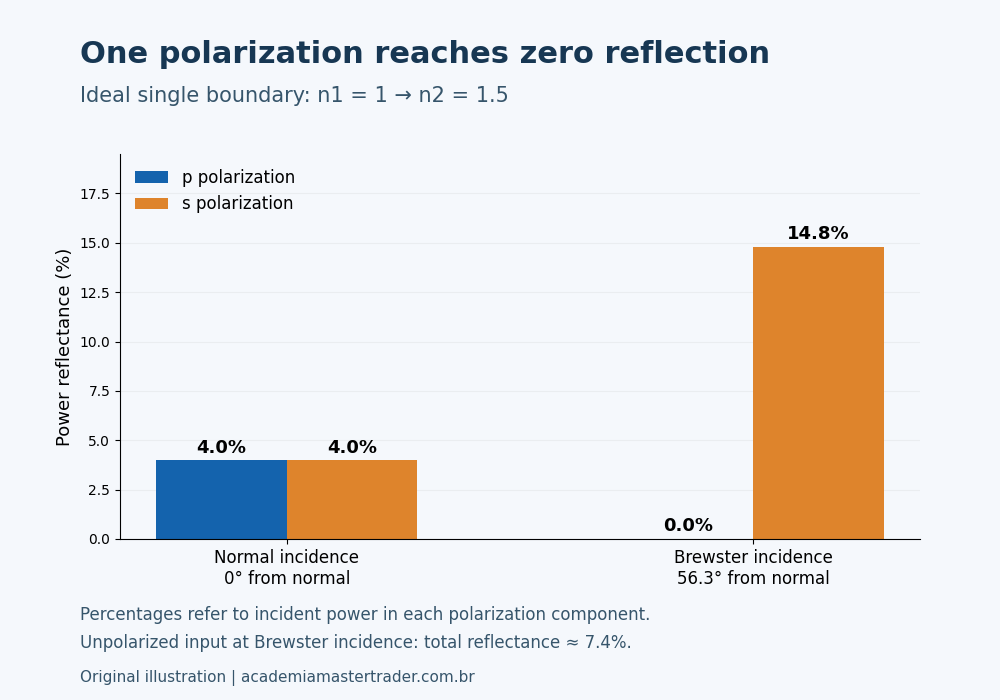
At normal incidence, the two polarization components have equal power reflectance at this ideal boundary: 4 percent. At Brewster incidence, the p component has zero power reflectance, but the s component has approximately 14.8 percent. Each percentage here is relative to the incident power in that same polarization component.
Unpolarized incident light can be described, for this power calculation, as equal average contributions from the two orthogonal components. Its total reflectance at Brewster incidence is therefore half of 14.8 percent, or approximately 7.4 percent. The reflected beam is ideally s-polarized, even though its total reflected power has not vanished.
These numbers also show why the minimum for one polarization is not automatically the minimum for every input state. In this example, the unpolarized reflectance at Brewster incidence exceeds its 4 percent value at normal incidence. The change in polarization selectivity matters more than a slogan about eliminating reflection.
Reflection and transmission tell different stories
With p polarization and the stated ideal assumptions, the absence of reflection means that all incident power crosses the single boundary. There is no absorption in this model. With unpolarized input, however, some s-polarized power crosses the boundary as well as some being reflected. The transmitted beam is consequently not perfectly p-polarized.
A real plate has another surface. Its overall behavior depends on that second boundary, the geometry, material absorption, coatings and beam properties. A finite spread of incident angles also means that not every part of a beam meets the boundary at exactly the same angle. The ideal result supplies a reference condition, not a guarantee for every optical assembly.
Read the condition before using the number
A useful explanation names the direction of travel, refractive indices, polarization and angle convention together. Without those details, a quoted Brewster angle can describe a different arrangement from the one being discussed.
The educational material at Academia Master Trader encourages this separation between a physical quantity, its assumptions and its interpretation. Visit academiamastertrader.com.br to explore the structure and continue through Aprenda.