Brighter light does not raise the maximum photoelectron energy when its frequency stays fixed
Shining more light onto a metal surface sounds like a way to give every emitted electron more energy. In the ordinary single-photon photoelectric effect, however, brightness and photon frequency play different roles. Increasing intensity at a fixed frequency can increase the number of emitted electrons, while their maximum kinetic energy remains set by the photon energy and the surface work function.
This distinction is easier to follow when three quantities are kept separate: energy per photon, photons arriving per second, and kinetic energy per emitted electron. A beam can carry more total power because it contains more photons without increasing the energy carried by each photon.
The energy balance starts with one photon
For monochromatic light of frequency f, each photon has energy E = hf, where h is Planck's constant. In the simple photoelectric model, one absorbed photon transfers its energy to one electron. Some energy is needed to release the electron from the surface. That required energy is called the work function, written φ.
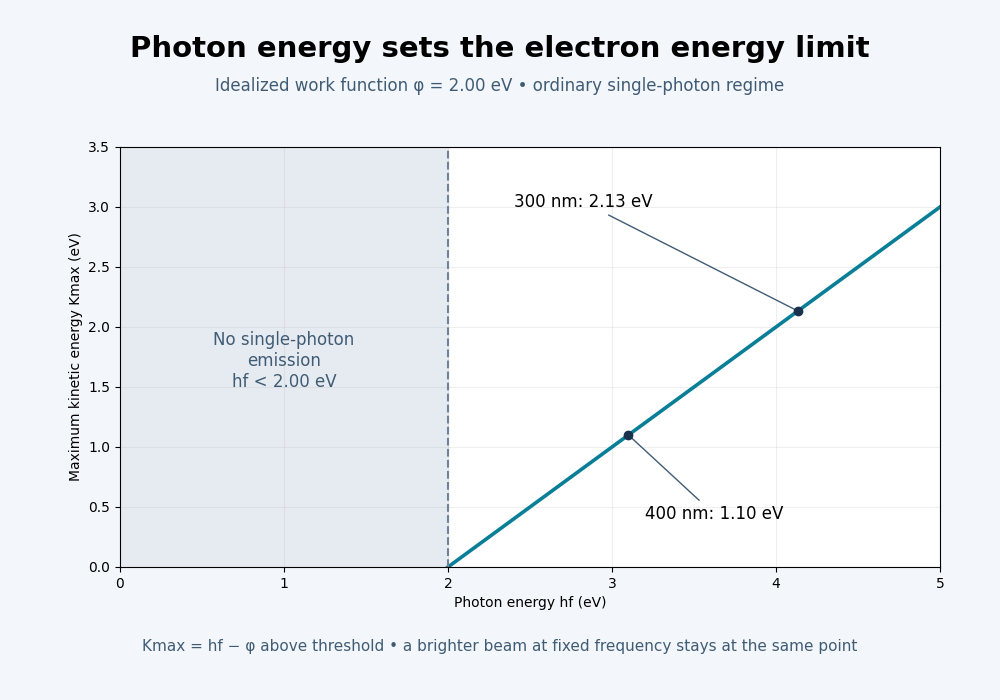
The maximum kinetic energy of emitted electrons is Kmax = hf − φ, provided the photon energy reaches the emission threshold. The word maximum matters. Electrons can emerge with less kinetic energy because their initial states and paths through the material differ. The equation does not say that every emitted electron has exactly the same energy.
A work function belongs to a specified surface. Here we use an idealized value rather than assigning it to a named metal whose surface preparation might change the result.
A numerical example with a clear threshold
Take φ = 2.00 eV and use hc approximately equal to 1240 eV·nm. Light with a vacuum wavelength of 400 nm has photon energy E = hc/λ = 3.10 eV. The maximum electron kinetic energy is therefore 3.10 − 2.00 = 1.10 eV.
If the intensity of this 400 nm light doubles, its photons still carry 3.10 eV each. In the ideal single-photon regime, Kmax remains 1.10 eV. More photons reach the same illuminated area per second, so the emission rate can rise when other conditions remain unchanged.
Now change the wavelength to 300 nm. The photon energy becomes about 4.13 eV, giving Kmax approximately 2.13 eV. This time the electron energy increases because the photon frequency increased, not because the beam was simply made brighter.
Below threshold, more ordinary light is not enough
The threshold photon energy in this example is 2.00 eV. Its corresponding vacuum wavelength is λc = hc/φ = 620 nm. Longer wavelengths have lower photon energies. At 700 nm, a photon carries about 1.77 eV, which is below the chosen work function.
The simple model therefore predicts no single-photon emission at 700 nm. Increasing the number of these photons does not turn each one into a higher-energy photon. A negative value from hf − φ is not a prediction of negative electron kinetic energy. It indicates that the assumed emission process is not energetically allowed.
At the threshold itself, the ideal energy balance gives zero maximum kinetic energy. This is a limiting statement, not a claim that a practical detector will suddenly collect a large current exactly at that wavelength.
Stopping voltage measures the upper energy limit
A retarding electric potential can oppose the motion of photoelectrons toward a collecting electrode. The magnitude Vs needed to stop even the most energetic emitted electrons obeys eVs = Kmax, where e is the positive magnitude of the electron charge.
For Kmax = 1.10 eV, the stopping-voltage magnitude is 1.10 V. Doubling the intensity at the same frequency does not double this voltage in the ideal model. It can change the photocurrent instead. Current and stopping voltage answer different questions: how much charge is collected per second, and what energy limit must be overcome.
A current measurement also depends on collection conditions. Without adequate collection voltage, or if other limits intervene, measured current need not scale perfectly with intensity. The energy relation alone is not a full prediction of the apparatus response.
Keep the regime of the model explicit
The argument assumes a stable surface work function and the ordinary single-photon regime. Very strong fields, multiphoton processes, heating, or changes to the surface require a different analysis. Those possibilities do not erase the useful distinction within the stated model.
To read a photoelectric problem, identify the wavelength or frequency first, then calculate the photon energy and compare it with the work function. Only after establishing whether emission is allowed should intensity be used to discuss photon arrival rate. That order keeps energy per electron separate from the total rate of energy delivery.
Continue your educational journey at academiamastertrader.com.br and on the Aprenda page.