Clipping array values applies numerical boundaries without proving that the original observations were wrong
NumPy's clip function limits array values to a specified interval. Values below the lower boundary become equal to that boundary, while values above the upper boundary become equal to the upper boundary. Values already inside the interval remain unchanged.
This is a numerical transformation with a clear rule. It does not investigate why an observation lies outside the chosen interval. The boundaries come from the person or process configuring the operation, so explaining their purpose is part of explaining the result.
Follow the transformation one position at a time
Consider the sequence zero, two, five, eight and ten. With a lower boundary of two and an upper boundary of eight, the output is two, two, five, eight and eight. The first and last positions change, while the other three retain their values.
The sequence still contains five positions in the same order. Clipping has not filtered out the first or last observation. It has replaced their numerical values with the relevant boundary. Keeping that distinction clear helps when the output later enters another calculation.
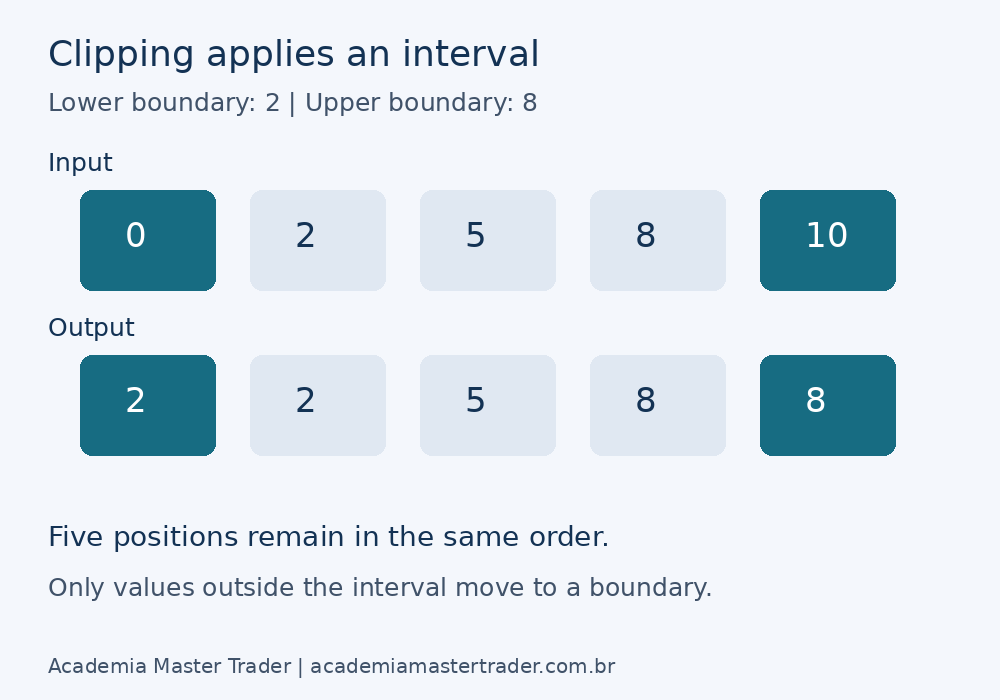
The unchanged boundary values also matter. The original two stays two, and the original eight stays eight. In the output, a boundary value can therefore represent either an unchanged observation or a value moved to the boundary. The final sequence alone does not identify which situation occurred at every position.
A boundary is a rule, not an explanation
An interval might be chosen because a later calculation expects values within a defined range. That purpose does not establish that observations outside the interval were recorded incorrectly. Deciding whether an original measurement needs correction requires information beyond the clipping operation.
For example, the value ten in the example becomes eight because the upper boundary is eight. Nothing in that arithmetic explains the source of ten. It might be a valid observation for the original quantity, even if the transformed representation uses a smaller allowed interval.
A useful description names the input, the interval and the reason for producing a bounded representation. This separates what the function did from what someone believes about the underlying observations. The transformed values can then be used with their limits clearly stated.
Clipping is different from rescaling
Clipping does not stretch or compress all values into a new interval. In the example, five remains five. The function does not calculate a new position for five based on the smallest and largest input values. Only values outside the specified interval move to an edge.
This difference affects comparisons. Zero and two become equal after clipping to the interval from two to eight. Eight and ten also become equal. Distinctions that existed in the input can disappear, although the number and order of positions remain the same.
Consequently, the clipped output generally cannot recover the original values. An output value of eight does not reveal whether its input was eight, ten or another value above the upper boundary. Preserving the original array separately can be useful when that distinction needs to remain available.
One boundary can be left open
The documentation allows None for either boundary. If the lower boundary is None, the function does not clip at the lower edge. An upper boundary can still limit larger values. Conversely, leaving the upper boundary as None allows values above the lower boundary to remain without an upper limit from this operation.
If both boundaries are None, the returned values remain unchanged. These options describe how the numerical rule is configured. They do not provide an automatic decision about which side of a particular dataset should be bounded.
It is therefore worth recording whether the transformation used two boundaries or only one. Two arrays described simply as clipped may have followed different rules. The boundary settings are part of the processing record, rather than an optional detail added after interpretation.
Check the relationship between the boundaries
The documentation states that clip does not check whether the lower boundary is smaller than the upper boundary. When the lower boundary exceeds the upper boundary, the documented result contains values equal to the upper boundary. A reversed interval should not be assumed to produce an error.
For scalar boundaries, checking their order before the operation makes the intended rule explicit. This is different from looking at an output that happens to fit a range and assuming the configuration was appropriate. The numerical result cannot explain the intent behind its settings.
The out parameter also deserves attention. NumPy allows the input array itself to be supplied as the output destination, so clipping can modify that array in place. A workflow that needs the original values must account for the chosen destination instead of assuming every call preserves a separate original automatically.
A clear review records the interval, the output destination and a few representative positions. It includes a value below the interval, one inside it and one above it. Following these positions shows exactly how the rule acts, while keeping the interpretation grounded in the meaning of the original data.
Academia Master Trader shares educational material about numerical operations, data structures and the interpretation of results at academiamastertrader.com.br.