Concatenating arrays extends an existing axis without matching records by meaning
Two groups of values can be joined into a larger array. Concatenation performs this join along an axis that already exists. It places the inputs in the supplied order, extending that axis while requiring the other dimensions to remain compatible.
This is a structural operation. It does not decide whether two records refer to the same event, whether their units agree, or whether their dates overlap. Those questions belong to the meaning of the inputs and must be settled separately from the mechanics of joining them.
Two short sequences become one longer sequence
Consider the sequence two, four and six, followed by the sequence eight and ten. Concatenating them in that order produces two, four, six, eight and ten. The result has five positions because the lengths three and two are added.
The operation does not add the values pair by pair. It also does not require the two input sequences to have the same length in this one-dimensional example. Each sequence contributes its existing elements to a single longer sequence.
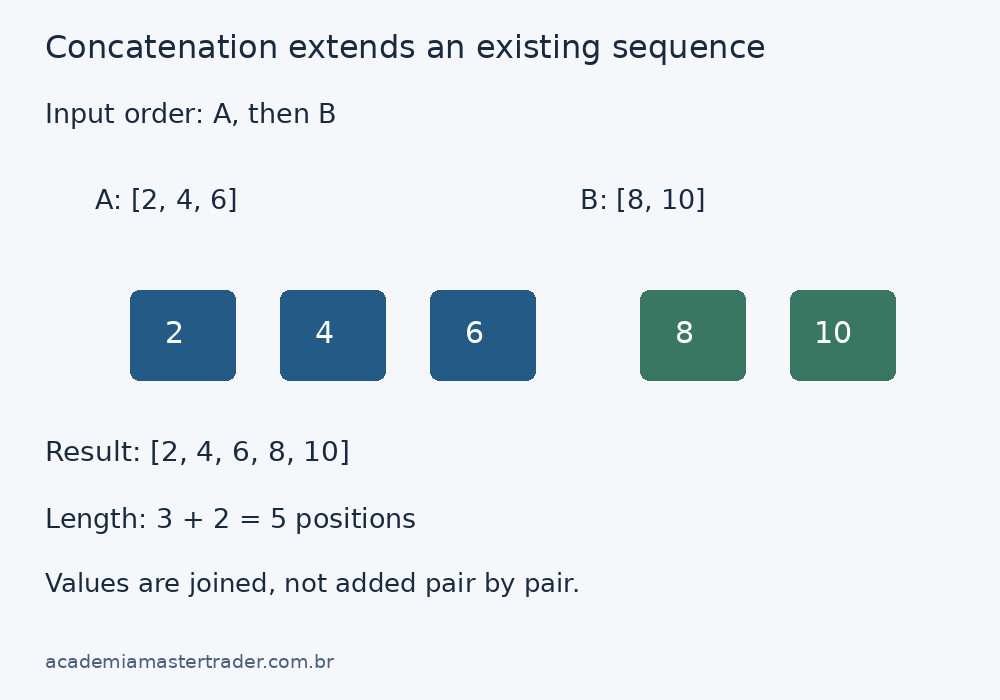
Reversing the input order produces eight, ten, two, four and six. The set of supplied values is unchanged, but their positions differ. A description should therefore state the order of the inputs whenever position carries meaning.
Joining is not sorting or removing duplicates
The ascending order in the first example comes from the numbers we supplied. Concatenation itself does not compare their magnitudes to produce a sorted result. Inputs containing unsorted values remain in their supplied internal order.
Repeated values also remain repeated. If one input ends with six and the next begins with six, the result contains both occurrences. Whether those occurrences represent separate observations or the same record appearing twice cannot be determined from their numerical equality alone.
A record identifier or another explicit rule is needed to decide whether two entries describe the same thing. Removing duplicates, aligning records and sorting values are separate operations. They should not be silently attributed to a simple join.
An existing axis grows while the others must agree
For a two-dimensional table, the axis choice determines how the inputs fit together. Joining along the row axis places rows after rows. The tables must then have matching column counts. The row counts may differ because that is the dimension being extended.
Joining along the column axis places columns beside columns. The row counts must then match, while the column counts may differ. Equal row counts make the shapes compatible, but they do not prove that corresponding rows describe the same entities.
Suppose two tables each contain a row for the same two instruments, but in opposite orders. A side-by-side concatenation can succeed numerically while associating columns from different instruments. The identifiers and row order need to be checked before the join.
A new axis represents a different construction
Stacking arrays along a new axis is not the same operation as concatenation along an existing one. A new axis can preserve an explicit dimension that distinguishes the source arrays. Concatenation extends a dimension that is already part of the inputs.
For one-dimensional inputs, concatenation returns a longer one-dimensional result. It does not automatically turn each input into a separate row. If that arrangement is required, the inputs and the chosen operation must express it explicitly.
In NumPy, concatenate joins along an existing axis. With axis set to None, it flattens the inputs before joining them. That option changes the structural question: the original row and column boundaries no longer remain as separate axes in the result.
Shape compatibility does not supply semantic compatibility
Two columns can share a numeric type while using different units. Two sequences can have adjacent positions while covering overlapping dates. The array library does not infer or reconcile those meanings simply because it can construct a result.
The output also needs a number type that can represent the inputs appropriately. When inputs use different types, conversion rules become part of the operation. A successful join should not be treated as proof that every original representation was retained without change.
A clear workflow names the joining axis, input order, identifiers and units. It also records any flattening or conversion. With those details visible, concatenation remains an explicit assembly of supplied values rather than being mistaken for sorting, record matching or a new source of observations.
Academia Master Trader shares educational material about numerical structures, operations and data interpretation at academiamastertrader.com.br.