Conventional current and electron drift point in opposite directions in a metal wire
An arrow for electric current does not necessarily show the direction in which electrons drift. In an ordinary metal wire, the two directions are opposite. This is not a disagreement between circuit diagrams and the motion of charge. It follows from the sign of the moving carriers and the definition of conventional current.
The direction assigned to conventional current is the direction in which positive charge would move. Electrons have negative charge. Their average drift in one direction therefore contributes a conventional current in the opposite direction.
Fix a direction before describing the motion
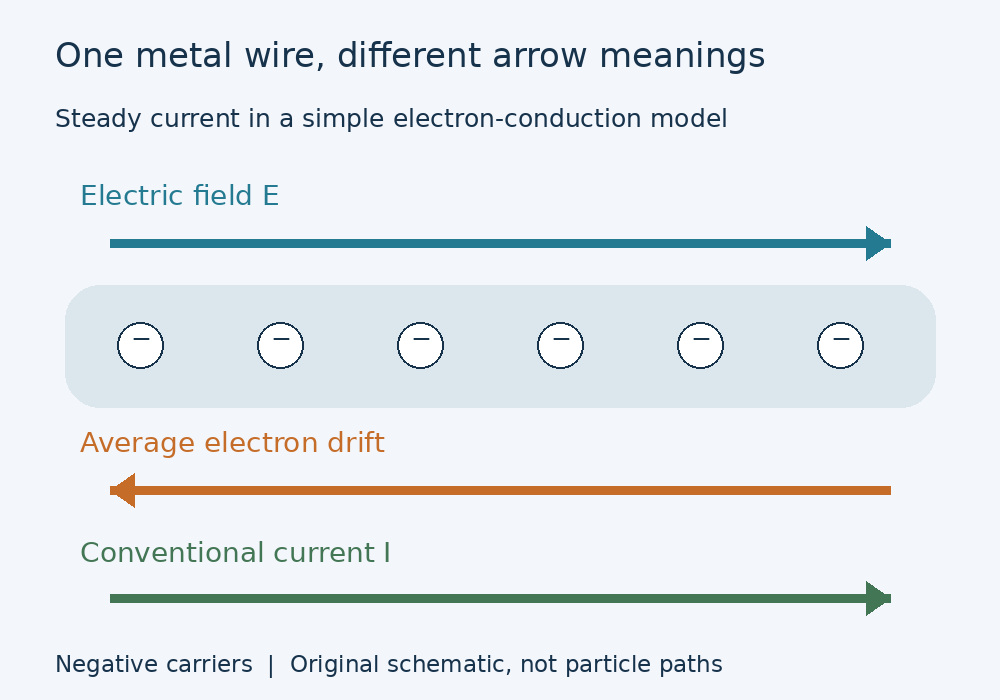
Imagine a straight piece of ordinary metal wire carrying a steady current. Choose rightward as the positive direction along the wire. Suppose the electric field in that section points to the right.
The electric force on a carrier is qE. For a positive charge, the force points along the field. For an electron, q is negative, so the force points to the left. In the simple conduction model, the electron drift is leftward while the conventional current is rightward.
The word drift matters. It describes an average motion superimposed on the much less orderly microscopic motion of the carriers. It does not mean that every electron follows a straight path from one end of the wire to the other.
A negative carrier reverses the direction
A useful relation for one type of mobile carrier is J = n q vd. Here J and vd are vectors, n is the number of mobile carriers per unit volume, and q is the signed charge of each carrier. J is the current density, not a second name for an individual electron's velocity.
For electrons, q is negative. Multiplication by that negative charge reverses the direction of the drift-velocity vector. A leftward electron drift produces a rightward current density.
For magnitudes in a uniform wire with cross-sectional area A, the corresponding relation is I = n |q| A vd. In this expression, I and vd denote positive magnitudes. The absolute value around q is important because this version calculates a size rather than a signed direction.
Mixing the magnitude formula with a signed electron charge can create a confusing minus sign. Decide first whether the calculation concerns a magnitude, a signed component, or a vector. Then keep that choice throughout the calculation.
The current does not wait for one electron to cross the wire
Electron drift speed and the speed of a changing electrical signal are different quantities. A circuit contains mobile carriers throughout its conducting parts. A change in the electromagnetic conditions can spread along the circuit much faster than an individual electron drifts along the wire.
This distinction explains why a rapid electrical response does not imply that one electron has travelled the entire distance from a source to a device during that response. The relevant changes involve the electromagnetic field and carriers already present along the path.
No single numerical signal speed applies to every arrangement. It depends on the circuit's physical structure and surrounding materials. The useful lesson here is the distinction between propagation of a change and average transport of individual carriers.
Keep the material in the statement
The opposite-direction rule in this example applies to a metal in which electrons carry the current. It should not be turned into a claim that every electrical current consists only of electrons drifting opposite to its assigned direction.
Other conducting systems can have different mobile carriers. When more than one carrier type contributes, the total current density is the sum of their contributions. Each contribution includes both the carrier's charge and its drift velocity.
The definition of conventional current remains consistent across these cases. What changes is the physical description of the carriers. A current arrow alone is therefore not enough to identify which particles move or how they move.
Read the arrows as separate information
For the ordinary metal wire considered here, remember three labels: the electric field points right, conventional current points right, and electron drift points left. Reversing the applied field reverses the corresponding steady drift and current directions in this simple model.
A clear diagram labels each arrow rather than calling all of them the direction of electricity. Keeping charge sign, drift, and conventional current separate turns an apparent contradiction into a consistent description of the same wire.
Academia Master Trader publishes educational material at academiamastertrader.com.br.