Dividing an array into nearly equal sections balances position counts rather than observation meaning
NumPy's array_split function divides an array into multiple subarrays. When the requested number of sections does not divide the selected axis evenly, it permits sections with different lengths. This makes its section-count behavior different from split, which requires an equal division in that case.
The resulting sections follow a positional rule. Their lengths are as close as that rule allows, but this does not mean that they contain comparable subjects, equal time spans or similar values. Balanced counts and balanced information are separate properties.
Eight elements become sections of three, three and two
Consider a one-dimensional array containing zero through seven. Dividing it into three sections with array_split produces zero, one, two; three, four, five; and six, seven. The section lengths are three, three and two, in that order.
All eight elements remain represented. The final section is shorter because eight cannot be divided into three equal integer counts. The operation does not discard the last two elements or add another element to make every section the same size.
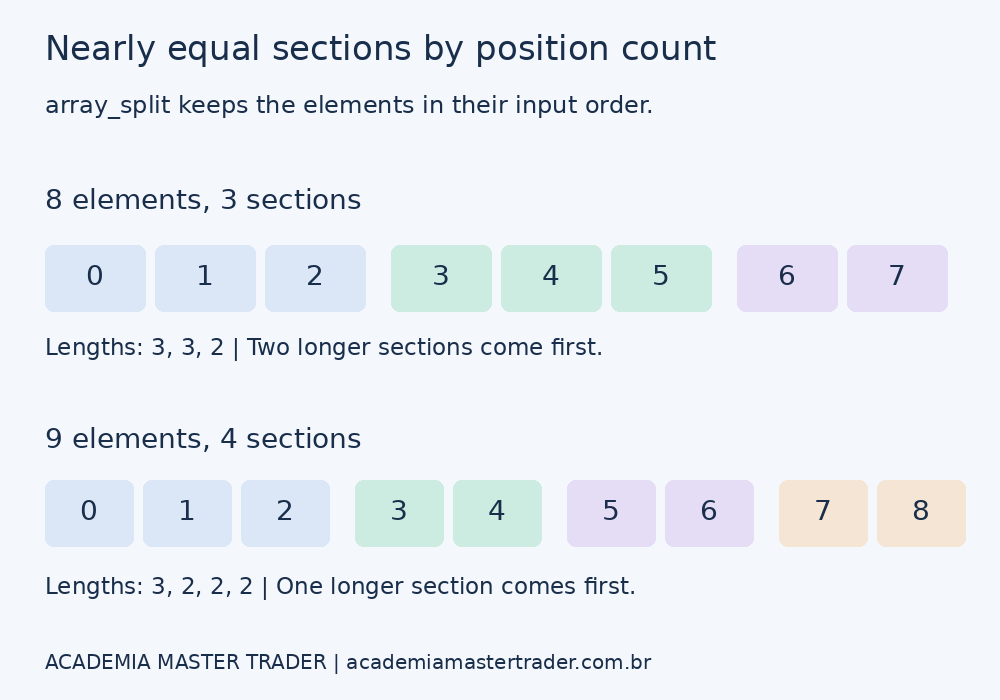
The number three specifies how many sections to create. It does not ask for sections containing exactly three elements. That distinction matters when predicting how many outputs a later processing step will receive and how long each output will be.
The remainder determines the longer sections
The documentation gives an explicit size rule. Divide the selected axis length by the requested section count using integer division. The result is the shorter section size. The remainder tells how many sections receive one additional element.
For eight elements and three sections, the shorter size is two and the remainder is two. There are therefore two sections of length three and one of length two. The documented example places the longer sections first, preserving the original sequence within each section.
For nine elements and four sections, the shorter size is two and the remainder is one. The section lengths are three, two, two and two. These counts describe a division of positions, not a comparison of the values stored at those positions.
The selected axis controls what is divided
Suppose a table has eight rows and two columns. Dividing it into three sections along axis zero produces tables with three rows, three rows and two rows. Each section still has two columns. The rule operates on the row count because that is the length of the selected axis.
Dividing along another axis poses a different structural question. The total number of values in the table does not replace the length of that axis when calculating section sizes. It is therefore useful to record the original shape, the axis and the requested number of sections together.
An axis can represent observations, features or another dimension chosen during data preparation. array_split does not inspect those meanings before dividing it. A correct structural result can still be unsuitable for an intended analysis if the wrong axis was chosen.
Nearly equal counts do not guarantee equal work
Sections with three, three and two elements may be convenient for a processing step. However, the number of elements does not necessarily determine the time needed to process each section. Some records can require more work than others, even when the counts match.
Likewise, nearly equal row counts do not establish equal durations. Eight observations might have irregular timestamps or include gaps. Dividing their positions into three sections does not transform those sections into equally long intervals on a clock.
If equal workload or equal duration is the real requirement, that requirement needs its own rule and supporting information. The section-count rule should not be presented as achieving an outcome that depends on properties outside the array's shape.
Section boundaries are not categories found in the data
The original order strongly affects which observations remain together. A table sorted by date yields different section membership from the same table sorted by a person's identifier. array_split follows the arrangement it receives rather than discovering groups from a distribution.
This is especially important when sections will be compared. Similar sizes do not show that the groups were selected fairly, independently or according to a relevant category. Those claims require evidence about how the observations were collected and ordered.
Before using the output, check the expected section lengths and a boundary between two sections. For the eight-element example, two ends the first section and three begins the second. Also confirm that the labels and identifiers needed to interpret each observation remain available.
array_split offers a clear way to distribute existing positions across a chosen number of sections when exact equality is impossible. Keeping its size rule separate from the purpose of the division makes the result easier to explain. The structure is nearly balanced by count, while its practical meaning still comes from the data and the task.
Academia Master Trader shares educational material about numerical operations, data structures and the interpretation of results at academiamastertrader.com.br.