Doubling a blackbody's temperature halves its peak wavelength, not its entire spectrum
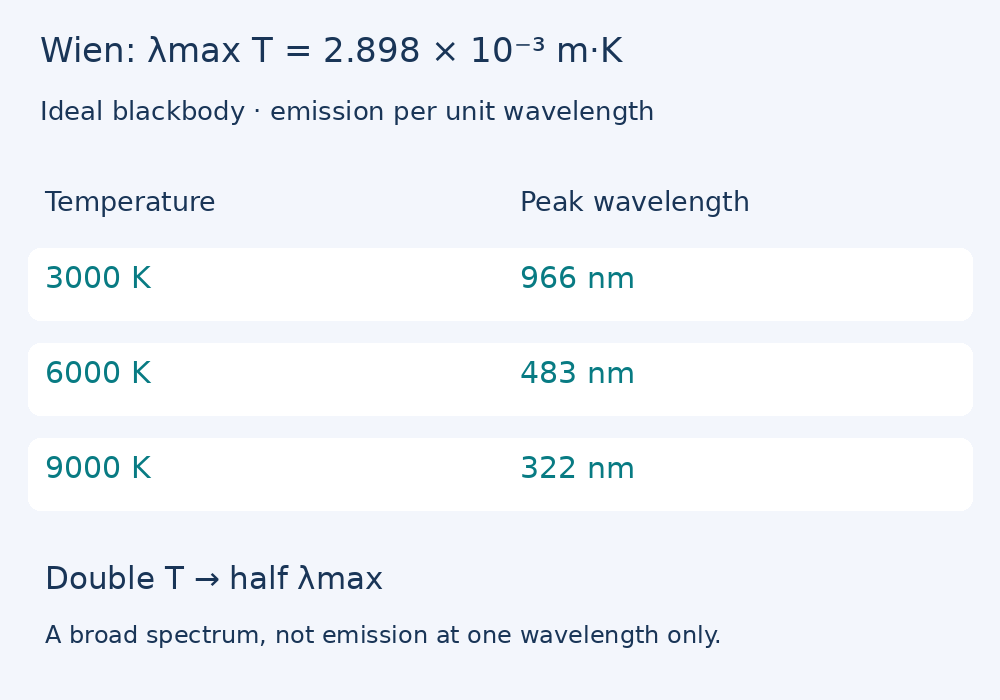
An ideal blackbody emits radiation across a range of wavelengths. Wien's displacement law identifies the wavelength at which its emission per unit wavelength reaches a maximum: λmaxT = 2.898 × 10⁻³ m·K. If the absolute temperature doubles, that peak wavelength is halved. The law does not say that the object emits only at the peak.
This distinction matters when interpreting a thermal spectrum. A peak is a feature of a distribution, not a label for every photon. Radiation is present on both sides of the maximum. The wavelength of maximum emission therefore summarizes one aspect of the curve without replacing the curve itself.
Temperature must be measured in kelvin
Take an ideal blackbody at 3000 K. Dividing the displacement constant by the temperature gives λmax = 9.66 × 10⁻⁷ m, or 966 nm. At 6000 K the peak is 483 nm, half the earlier wavelength. The inverse relationship follows directly from keeping λmaxT constant.
The doubling refers to absolute temperature. Doubling a Celsius reading does not generally double the corresponding kelvin temperature. Substituting a Celsius number into this law changes the physical meaning of the calculation, even if the arithmetic division is performed correctly.
Units deserve the same care. With the constant written in m·K and temperature in K, the wavelength initially comes out in metres. Converting that result to nanometres is a separate step. Keeping the unit through the division prevents a correct numerical coefficient from being attached to the wrong scale.
A peak near visible light does not imply a single color
At 6000 K, the wavelength-based maximum in this example is around 483 nm. Yet the ideal spectrum remains broad. It cannot be replaced by a narrow line at 483 nm or described as if every emitted photon had that wavelength.
A perceived color involves more than reading one horizontal coordinate from a spectrum. Here the useful physical claim is narrower: increasing the temperature shifts the maximum of the wavelength distribution toward shorter wavelengths. That statement does not require treating a thermal source as a single-wavelength source.
Likewise, a maximum outside the visible range does not mean that no radiation is emitted within the visible range. The peak tells us where this distribution is highest, rather than drawing a boundary beyond which emission vanishes.
Peak position and total emitted power answer different questions
Wien's law locates a maximum along the wavelength axis. It does not directly give the total power emitted across all wavelengths. For an ideal blackbody with fixed emitting area, the Stefan–Boltzmann relation gives total emitted power proportional to T⁴.
Consequently, doubling absolute temperature halves λmax but multiplies total emitted power by sixteen, provided the emitting area is unchanged. These are two different properties of the same thermal spectrum. A shorter peak wavelength is not another way of saying that total power has merely doubled.
The comparison refers to emitted power. Net radiative energy exchange with surroundings is a different calculation and requires accounting for the incoming radiation as well. Keeping the quantity named prevents a statement about emission from being used as a complete heat-transfer result.
Keep the spectral variable attached to the maximum
The constant used here belongs to the distribution expressed per unit wavelength. A spectrum expressed per unit frequency is a different density with a different horizontal variable. The simple relation f = c/λ for individual waves does not by itself turn the wavelength maximum into the maximum of a frequency-density curve.
For the present calculation, the practical rule is straightforward: identify that the plotted quantity is emission per unit wavelength, use temperature in kelvin, and report λmax with a wavelength unit. Do not silently change the plotted variable while retaining the same interpretation of its peak.
Finally, a blackbody is an ideal model. Real materials can depart from its wavelength distribution. Before using a measured peak to infer a temperature, establish that a blackbody description is appropriate for the source and measurement. The model is useful because its assumptions are clear, not because every warm object has exactly the same spectral behavior.
Continue learning at academiamastertrader.com.br and on the Aprenda page.