Doubling a capacitor's voltage doubles its charge but quadruples its stored energy
For an ideal capacitor with constant capacitance, charge is proportional to voltage. Stored energy follows a different relationship: it is proportional to the square of voltage. Keeping those statements separate explains why a twofold change in voltage does not produce the same multiplying factor for every electrical quantity.
Begin with a defined model
Consider an ideal linear capacitor whose capacitance C remains constant. Its charge magnitude is Q = CV, where V is the voltage between its plates. The opposite plates carry charges of equal magnitude and opposite sign in the usual initially neutral model.
The energy stored in that capacitor is E = CV²/2. It can also be written as E = QV/2 or E = Q²/(2C). These are equivalent expressions for the same stored energy, obtained by using the relationship between charge, voltage and capacitance. They are not separate amounts to add together.
Compare two voltages numerically
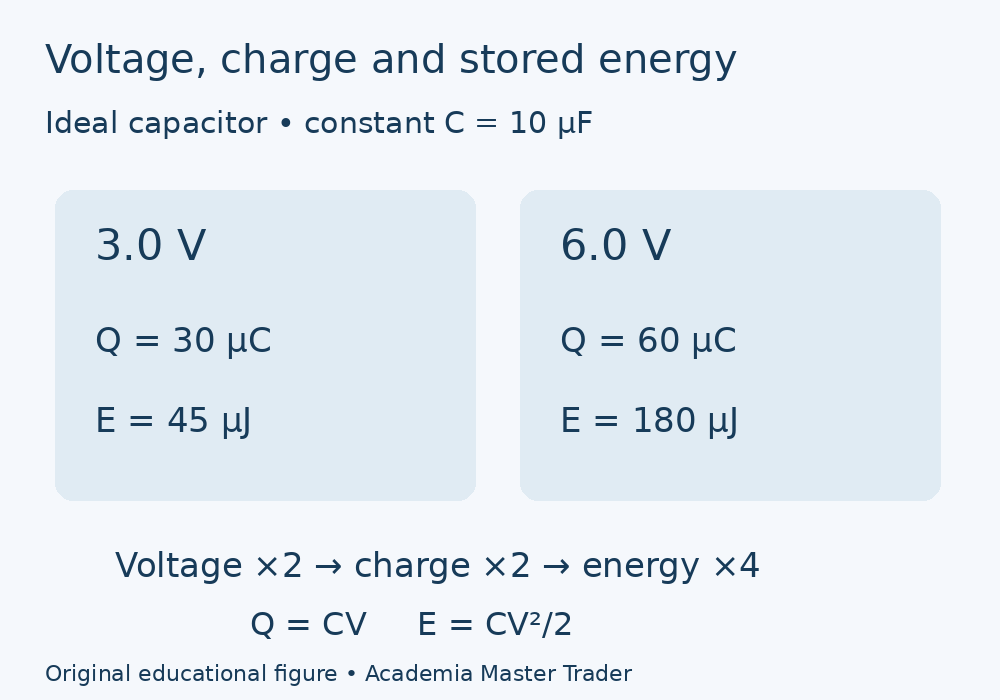
Take a capacitance of 10 µF. At 3.0 V, the charge magnitude is 30 µC. The stored energy is half of 10 µF multiplied by the square of 3.0 V, giving 45 µJ. The prefix micro represents one millionth in both units.
At 6.0 V, the charge magnitude becomes 60 µC, while the stored energy becomes 180 µJ. The charge has doubled, but the energy is four times its previous value. The calculation follows the square: 6²/3² = 4, with the capacitance unchanged.
Understand the factor of one half
The expression QV describes moving a charge Q through a fixed voltage V. Charging an initially uncharged capacitor is different because the capacitor's voltage rises as charge is separated. Early increments of charge are moved while the voltage is small; later increments are moved at a larger voltage.
For the constant-capacitance model, voltage rises linearly with charge. Its average over that charging path is half the final voltage. This gives E = QV/2, rather than QV, for the final energy stored in the capacitor. The factor is part of the physical model, not a unit conversion.
Separate stored energy from the whole charging process
The stored-energy formula describes the capacitor's final electrical state. It does not, by itself, describe the energy drawn from a particular source, the energy converted elsewhere in the charging circuit, or the time needed to charge. Those questions require information about the circuit and its operation.
Likewise, constant capacitance is an assumption, not a statement about every real component under every condition. The example is an educational comparison, not a component specification or a connection guide. Real operating limits must not be inferred from the arithmetic alone.
A useful reading order is to identify the fixed quantity, calculate charge, and then calculate energy with its own expression. Checking the units and the multiplying factors keeps a correct charge relationship from being mistaken for an energy relationship.
Academia Master Trader presents educational content through explicit quantities and reasoned examples. Explore its full structure at academiamastertrader.com.br and find more learning material through Aprenda.