Doubling a Celsius temperature does not multiply thermal radiation by sixteen
A surface at 40 degrees Celsius does not emit sixteen times the thermal radiation of the same surface at 20 degrees Celsius. The fourth-power relationship used for thermal radiation depends on absolute temperature in kelvins, not on the numerical reading of a Celsius thermometer.
The distinction matters because the zero points of the scales differ. A change from 20 to 40 degrees Celsius doubles the Celsius number, but it does not double the absolute temperature. Before applying a power law, the temperature scale is part of the physical meaning of the equation.
Start with emitted power
For an ideal blackbody surface, the Stefan-Boltzmann law gives the total emitted power as P = σAT⁴. Here A is the emitting area, T is absolute temperature, and σ is the Stefan-Boltzmann constant. The power includes emission across the full thermal spectrum, not one selected wavelength.
A simple gray-surface model adds an emissivity ε, giving P = εσAT⁴. Emissivity describes how strongly the surface emits relative to a blackbody under the model. For a direct temperature comparison, the area and the relevant emissivity must remain unchanged.
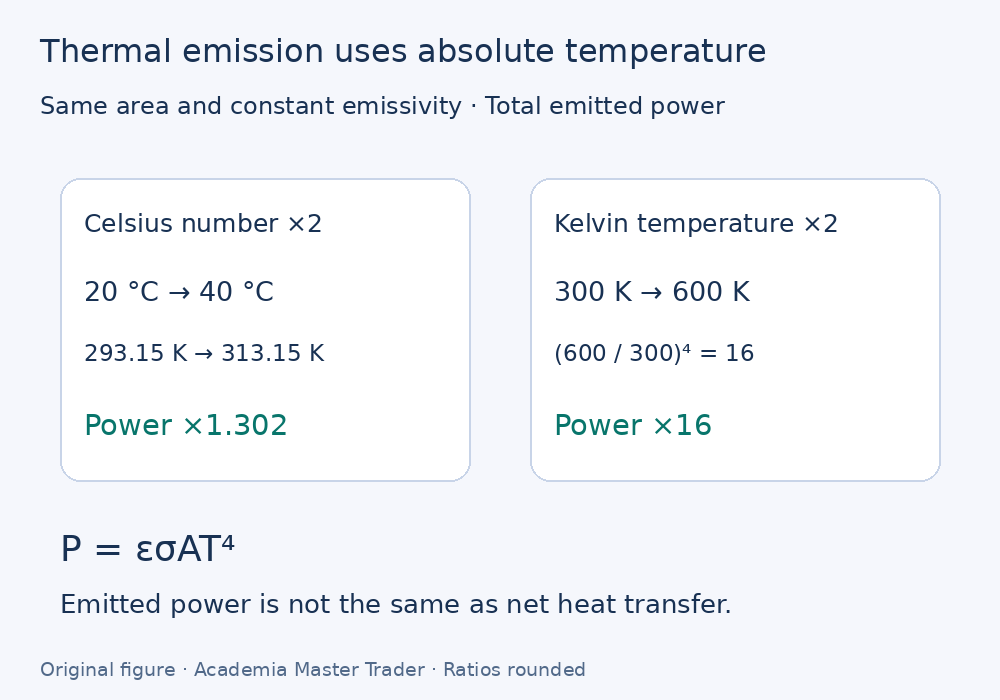
If absolute temperature doubles under those conditions, emitted power increases by a factor of sixteen because 2⁴ = 16. The statement concerns twice as many kelvins. It does not concern twice as many degrees above the Celsius zero point.
Convert before taking the ratio
The conversion is T in kelvins equals the Celsius temperature plus 273.15. Therefore, 20 degrees Celsius corresponds to 293.15 kelvins, and 40 degrees Celsius corresponds to 313.15 kelvins. Their absolute-temperature ratio is about 1.068, not two.
For the same area and unchanged emissivity, the emitted-power ratio is (313.15/293.15)⁴. This gives approximately 1.302. In this model the warmer surface emits about 30 percent more total power, rather than sixteen times as much.
By contrast, increasing temperature from 300 kelvins to 600 kelvins really does double absolute temperature. The emitted-power ratio is then sixteen. Those temperatures correspond to 26.85 and 326.85 degrees Celsius, which clearly do not form a two-to-one Celsius ratio.
Emission is not the same as net transfer
An object also absorbs radiation from its surroundings. Emitted power alone therefore does not give the net rate at which radiation carries energy away from the object. At radiative equilibrium, emission and absorption balance even though both continue.
For a simplified gray object exchanging radiation with a large black enclosure at a uniform temperature, the outward net power can be written Pnet = εσA(T⁴ − Ts⁴). Ts is the enclosure temperature. This expression defines outward transfer as positive and assumes the stated enclosure and surface model.
If object and enclosure have the same temperature, this difference is zero. The object's emitted power is not zero. Equal opposing transfers produce a zero net result, which is a different physical statement from the absence of radiation.
Changing the object temperature while holding the enclosure temperature fixed can produce a net-power ratio very different from the emitted-power ratio. The subtraction must be retained. A ratio of fourth powers cannot simply replace a ratio of fourth-power differences.
Keep the comparison tied to its conditions
Real surfaces may have emissivities that depend on wavelength and temperature. Geometry and surrounding surfaces also affect radiative exchange. A single constant-emissivity calculation is a defined approximation, not a universal description of every object.
Other transfer mechanisms can occur at the same time. Conduction and convection may contribute to an object's changing temperature, so a radiation equation alone does not automatically predict its full cooling history.
A careful comparison identifies the temperature scale, area, surface model and quantity being compared. Use kelvins in the fourth power, and decide whether the question concerns emitted power or net transfer before calculating a ratio.
Academia Master Trader shares educational material at academiamastertrader.com.br.