Doubling a plane wave's electric-field amplitude makes its average intensity four times larger
An electromagnetic wave's field amplitude and its intensity are related, but they are not the same quantity. Amplitude describes the largest magnitude of a field component. Intensity describes the time-averaged power crossing a unit area perpendicular to the wave's direction.
For a sinusoidal plane wave in vacuum, the connection involves the square of the amplitude. Doubling the electric-field amplitude therefore multiplies the average intensity by four, not by two.
State the wave and the measurement
Consider one sinusoidal plane wave traveling through vacuum. Let its electric-field amplitude be E₀ and its magnetic-field amplitude be B₀. The fields are perpendicular to each other and to the propagation direction, with E₀ = cB₀.
At a fixed observation point, choose the time origin so that the electric component is E(t) = E₀ cos(ωt). The corresponding magnetic component has the same phase. No additional waves or static fields are included in this model.
The instantaneous energy flux S is the magnitude of the Poynting vector for this traveling wave. It gives power per unit area at that instant. Its units are watts per square metre, not joules and not volts per metre.
The relation between the fields gives S(t) = cε₀E₀² cos²(ωt), where ε₀ is the vacuum permittivity. Because the squared cosine is never negative, the energy flux remains directed along the traveling wave even as both field components reverse sign.
Average the square, not the field
The average electric component over a full cycle is zero. That does not make the average energy flux zero. The formula uses E squared, and the cycle average of cos²(ωt) is one half.
The average intensity is therefore I = cε₀E₀²/2. If instead the electric field is given as a root-mean-square value, E(rms) = E₀/√2, the same relation becomes I = cε₀E(rms)².
These are two ways to describe the same wave. The factor of one half belongs with peak amplitude. Including it again after replacing the amplitude with the root-mean-square field would count that conversion twice.
The peak instantaneous flux is cε₀E₀², twice the average intensity for this sinusoid. A statement about peak flux should therefore not be silently substituted for a statement about average intensity.
Read the square-law comparison
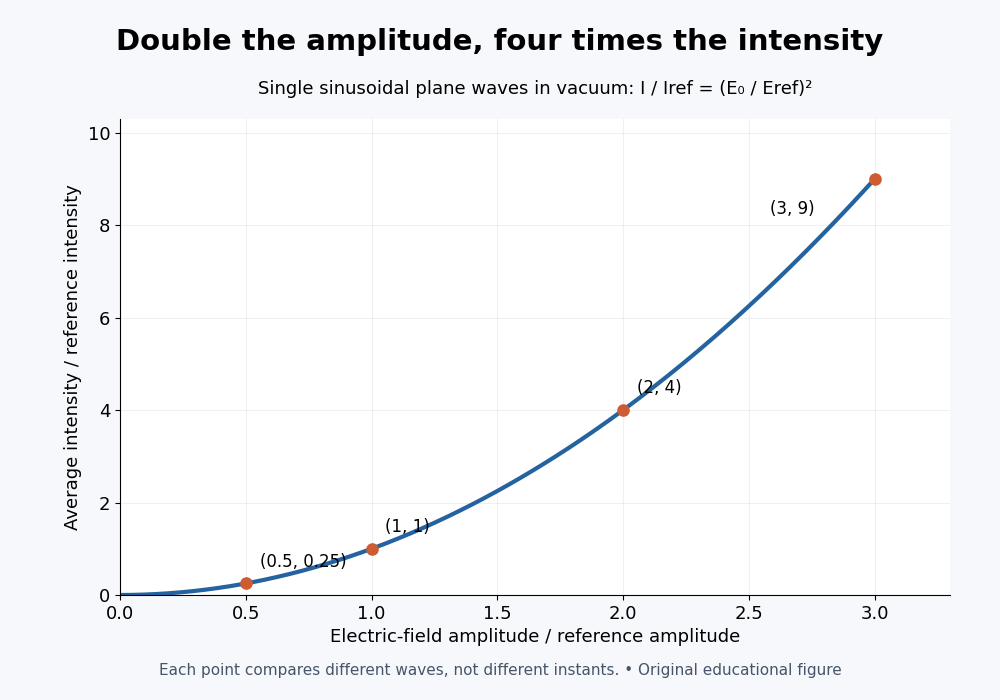
The figure compares otherwise equivalent sinusoidal plane waves in vacuum. The horizontal axis shows electric-field amplitude divided by a positive reference amplitude. The vertical axis shows average intensity divided by that reference wave's intensity.
If the amplitude ratio is a, the intensity ratio is a². An amplitude ratio of 0.5 gives an intensity ratio of 0.25. A ratio of two gives four, and a ratio of three gives nine.
The graph does not show how one wave changes with time. Each point represents a comparison between amplitudes and their associated average intensities. A time trace of the electric field would alternate in sign, unlike this graph of nonnegative amplitudes.
The magnetic amplitude changes with the electric amplitude because E₀ = cB₀. It is not an independent extra factor that can be held fixed while doubling E₀ in this particular plane-wave model.
Separate intensity, power and energy
For a numerical ratio, suppose one wave has an electric amplitude of 20 V/m and another has 40 V/m. Their average intensities have the ratio four to one. The ratio follows without choosing rounded values for c or ε₀.
To convert intensity into power, the illuminated area matters. If a wave has uniform average intensity over a flat area A perpendicular to propagation, the average power crossing it is P = IA.
If that intensity and area remain constant for a duration Δt, the transferred energy is PΔt. Thus watts per square metre, watts and joules answer different questions. Doubling the area at fixed intensity doubles power, without changing the local field amplitude.
Nonuniform beams require an area integral, and overlapping coherent waves require adding the fields before calculating intensity. Those are different situations from the single-wave comparison plotted here. Keeping the model explicit makes the square-law statement useful without treating it as a rule for every possible arrangement of light.
Academia Master Trader shares educational material at academiamastertrader.com.br.