Doubling a reaction equation does not double its cell potential
Balancing a redox equation often requires multiplying one or both half-reactions. The coefficients must change so that the electrons released equal the electrons accepted. The electrode potentials do not receive the same multiplication. Keeping those two operations separate makes electrochemical calculations easier to follow.
Start with what a volt measures
A volt is one joule per coulomb. Cell potential describes an energy change per unit of charge, rather than the total energy associated with an arbitrary amount of reaction. Moving more charge under the same conditions changes the corresponding total energy, but it does not automatically change the energy per coulomb.
This distinction is why a larger coefficient in an equation cannot, by itself, justify a larger voltage. The equation tells us how much material and charge belong to the chosen reaction amount. The potential describes a ratio for the specified chemical conditions.
Balance the electrons, not the voltage entries
For a copper-silver cell, copper can be oxidized according to Cu → Cu²⁺ + 2 e⁻. Silver ions are reduced according to Ag⁺ + e⁻ → Ag. Multiplying the silver half-reaction by two gives equal electron counts and allows the half-reactions to be added.
The resulting overall equation is Cu + 2 Ag⁺ → Cu²⁺ + 2 Ag. When standard reduction potentials are used, the standard cell potential is calculated as the cathode reduction potential minus the anode reduction potential. The coefficient two before Ag⁺ does not multiply the silver reduction potential.
Connect potential to Gibbs energy
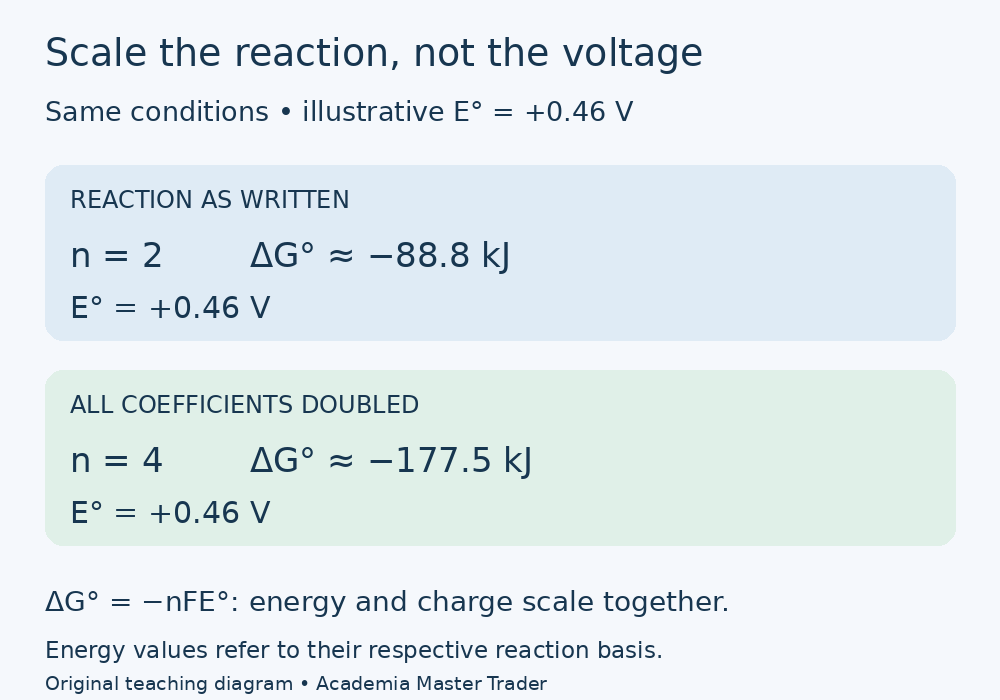
The thermodynamic relationship is ΔG° = −nFE°. Here, n is the amount of electrons transferred per reaction as written, expressed in moles for the corresponding molar reaction basis. F is the Faraday constant, and E° is the standard cell potential. The equation connects an energy change with the charge transferred and the potential difference.
If every coefficient in the overall equation is doubled, n doubles. The standard Gibbs energy change for that doubled reaction also doubles. Since both quantities scale together, their ratio leaves E° unchanged. This is a consistency check on the meaning of the quantities, not an additional balancing rule.
Keep the reaction basis visible
For an illustrative standard cell potential of +0.46 V and an electron count of two, using F ≈ 96485 C per mole of electrons gives ΔG° ≈ −88.8 kJ per mole of reaction as written. Writing twice the reaction gives an electron count of four and a Gibbs energy change of approximately −177.5 kJ on that doubled basis.
The potential remains +0.46 V. These illustrative numbers describe equation scaling at unchanged conditions; they do not predict the output of an unspecified practical battery. A numerical energy value needs its reaction basis just as a voltage needs its chemical conditions.
Separate scaling from changing the cell
Multiplying coefficients changes the written amount of a reaction. Reversing the reaction is a different operation: it changes the sign of the corresponding cell potential. Changing composition or temperature is different again and may change the potential itself.
A useful calculation therefore keeps separate records of the balanced equation, the electron count and the potential difference. Coefficients belong to the material and charge balance. Potential entries remain energy-per-charge quantities, rather than numbers to multiply alongside every chemical formula.
Academia Master Trader shares educational material that connects equations with their physical meaning. Its wider structure is available at academiamastertrader.com.br, with further learning material in Aprenda.