Doubling an electromagnetic wave's field amplitude quadruples its intensity, not its photon energy
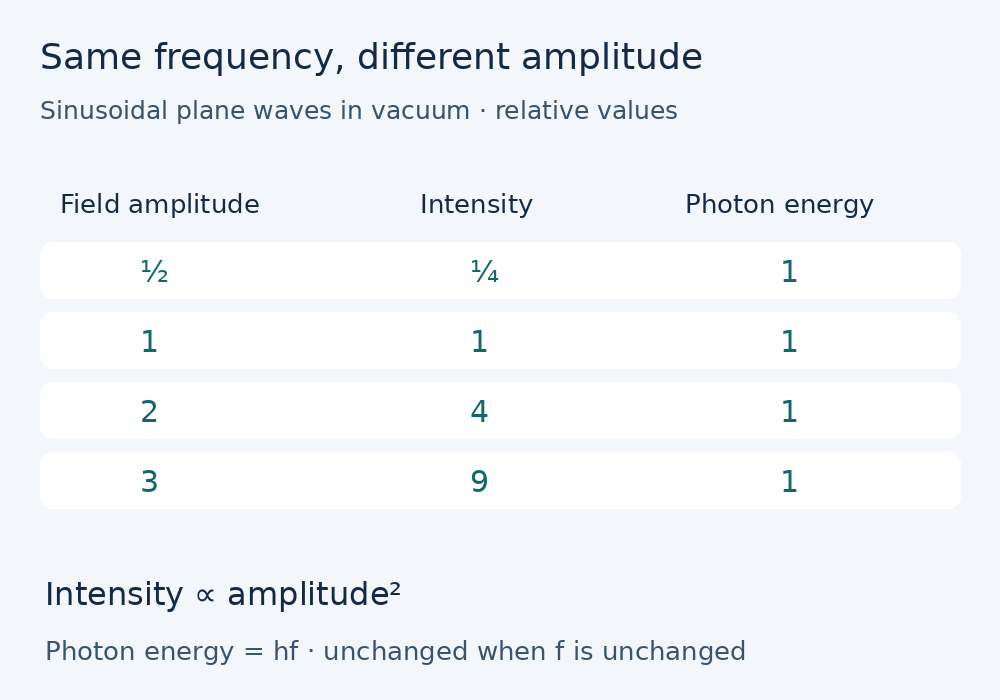
A brighter electromagnetic wave does not necessarily contain more energetic photons. In the plane-wave model in vacuum, doubling the electric field amplitude makes the time-averaged intensity four times as large. If the frequency stays the same, the energy of each photon stays the same too. Field amplitude and frequency describe different aspects of the radiation.
This distinction connects two descriptions of light without treating them as interchangeable. The classical description uses electric and magnetic fields to calculate energy transport. The photon description assigns an energy hf to each photon, where h is Planck's constant and f is frequency. Increasing one quantity does not automatically increase the other.
Intensity measures energy crossing an area
Intensity is the time-averaged rate of energy transfer per unit area, with the area perpendicular to the wave's propagation. Its unit is watts per square metre. It is not simply the total energy present, and it is not the energy carried by one photon. A source can transfer more energy each second without changing the energy of its individual photons.
For a sinusoidal plane electromagnetic wave in vacuum, the intensity is I = ½cε₀E₀². Here E₀ is the peak electric field amplitude, c is the speed of light in vacuum, and ε₀ is the vacuum permittivity. The factor one-half comes from averaging the squared sinusoidal field over a full cycle.
With the same assumptions, the magnetic field amplitude satisfies B₀ = E₀/c. Doubling E₀ therefore also doubles B₀. These are linked parts of the same travelling wave. They cannot be adjusted independently while keeping the same vacuum plane-wave relationship. The intensity increases by the square of the amplitude factor.
A comparison that does not require large numbers
Start with a wave of electric field amplitude E₀ and intensity I. A second wave at the same frequency has amplitude 2E₀ and intensity 4I. A third wave has amplitude 3E₀ and intensity 9I. Conversely, reducing the amplitude to E₀/2 reduces the intensity to I/4.
If the reference intensity is 2.0 W/m², the doubled-amplitude wave has intensity 8.0 W/m². A surface of area 0.50 m² perpendicular to a spatially uniform beam would then intercept 4.0 W, provided the beam covers the surface. For the reference wave, the intercepted power would be 1.0 W under the same geometric conditions.
These values describe incident power. They do not establish how much power the surface absorbs. Reflection, transmission and the material's response must be considered separately. Keeping the area and orientation fixed is also necessary when comparing intercepted powers using intensity alone.
Frequency sets the energy per photon
For monochromatic radiation, every photon has energy hf. At fixed f, the photon energy does not change when the field amplitude changes. The larger average energy flow corresponds to a larger average photon arrival rate through the same area, not to a larger energy assigned to each photon.
If the intensity becomes four times as large at unchanged frequency, the average photon arrival rate per unit area also becomes four times as large. In symbols, the photon flux is I/(hf). This statement concerns an average rate. It does not prescribe the exact arrival time of any individual photon.
Changing frequency is a different comparison. Doubling f doubles the energy per photon. It does not, by itself, specify the total intensity because the photon arrival rate must also be known. A claim about more energetic photons is therefore not the same claim as a statement about greater intensity.
Peak fields and effective fields use different formulas
The factor one-half in the intensity formula belongs to the peak amplitude E₀ of a sinusoidal wave. If the electric field is instead given as a root-mean-square value, the corresponding formula is I = cε₀Eᵣₘₛ². For a sinusoid, Eᵣₘₛ = E₀/√2, so the two expressions give the same result.
Using an effective field value in the peak-amplitude formula would introduce an extra factor one-half. Before inserting numbers, identify which field measure is supplied and whether the stated wave model applies. The vacuum plane-wave expression is not a universal rule for every near-field configuration or every material medium.
To compare electromagnetic waves clearly, ask separate questions: what is the field amplitude, what is the frequency, and what area is receiving the radiation? Those details distinguish intensity, photon energy and intercepted power without giving any of them a meaning that belongs to another.
Continue learning at academiamastertrader.com.br and on the Aprenda page.