Equal mass and radius do not give a hoop and a disk equal rotational inertia
Two objects can have the same mass and the same outer radius yet respond differently to the same torque. Rotation depends on where the mass sits relative to the chosen axis. A thin hoop and a uniform solid disk provide a useful comparison because their mass distributions are different even when their overall dimensions match.
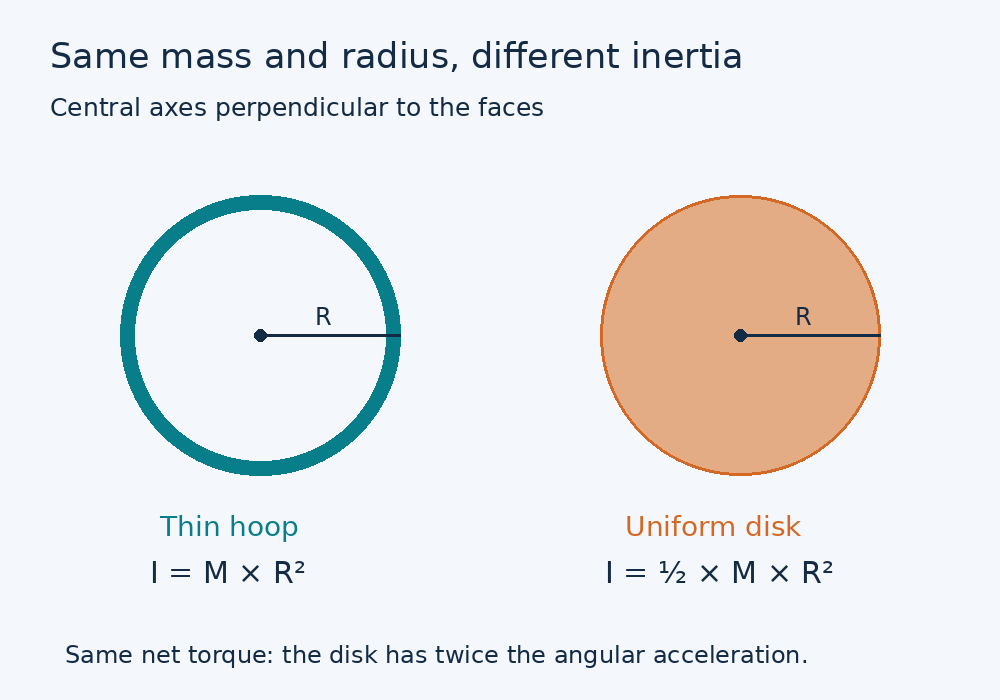
For rotation about the central symmetry axis, the hoop has twice the moment of inertia of the disk. That statement needs all its conditions: the hoop is thin, the disk is uniform, their masses and radii are equal, and the axes pass through their centers perpendicular to their faces.
Distance from the axis matters
For a collection of particles, the moment of inertia is the sum of each particle's mass multiplied by the square of its perpendicular distance from the rotation axis. The squared distance gives material farther from the axis a larger contribution per unit mass.
In an ideal thin hoop, essentially all the mass lies at the same radius R. Its moment of inertia is M times R squared. A uniform disk contains material at every radius from the center to the rim. Its moment of inertia about the same kind of axis is one half of M times R squared.
The disk's smaller value does not mean it has less total mass. It means more of its mass lies closer to the axis. Replacing the disk with a single mass at its outer edge would erase the very distribution that the calculation must describe.
The same torque produces different acceleration
For a rigid body rotating about a fixed principal axis, net torque equals moment of inertia multiplied by angular acceleration. If the net torque is the same, the object with the smaller moment of inertia has the larger angular acceleration.
Consider a hoop and a disk, each with mass 2 kilograms and radius 0.50 meter. The hoop's moment of inertia is 0.50 kilogram square meters. The disk's is 0.25 kilogram square meters.
A net torque of 1 newton meter therefore gives the hoop an angular acceleration of 2 radians per second squared and the disk an angular acceleration of 4 radians per second squared. These are rates of change of angular velocity, not the angular velocities themselves.
Equal speed is a different comparison
Rotational kinetic energy is one half of the moment of inertia multiplied by the square of angular speed. If the two objects rotate at the same angular speed about the stated axes, the hoop stores twice as much rotational kinetic energy as the disk.
At 3 radians per second, the example hoop has 2.25 joules of rotational kinetic energy. The example disk has 1.125 joules. The energy ratio follows from the inertia ratio because angular speed was held constant.
If instead the objects receive the same rotational kinetic energy, their final angular speeds are not equal. Starting from rest and neglecting losses, the disk reaches an angular speed that is the square root of two times the hoop's speed. Holding energy fixed and holding speed fixed are different questions.
Always name the axis and the constraint
Moment of inertia is not a property that can be quoted independently of an axis. Moving the axis or changing its direction changes the distances used in the calculation. The familiar hoop and disk formulas cannot simply be carried over to rotation about a diameter or an off-center axis.
The comparison also assumes the same net torque, not merely the same applied force. Different force angles or different lever arms can produce different torques. Bearing resistance can contribute an opposing torque, so the applied torque and the net torque need not match.
A clear solution names the body model, locates the axis and states what is held equal. Only then should it compare acceleration, speed or energy. Equal mass is a useful starting condition, but it does not settle how a body rotates.
Academia Master Trader shares educational material at academiamastertrader.com.br.