Flattening an array creates a one-dimensional sequence without explaining its observation order
A table or a higher-dimensional array can be read as a single sequence of elements. NumPy's ravel function returns a contiguous one-dimensional array containing the input elements. The chosen traversal order determines where each element appears in that sequence.
Flattening changes the structure used to address the data. It does not calculate a summary, sort the values or identify a chronological order. A useful explanation therefore needs both the original shape and the rule used to traverse it, especially when rows and columns carry different meanings.
Six values become one sequence
Consider a table whose first row contains one, two and three, and whose second row contains four, five and six. Its shape is two rows by three columns. With the default C order, ravel returns one, two, three, four, five and six.
For this two-dimensional example, C order reads across the first row before moving to the second. The last index changes fastest. The output has six positions on one axis, often written as shape (6,). All six input elements remain present.
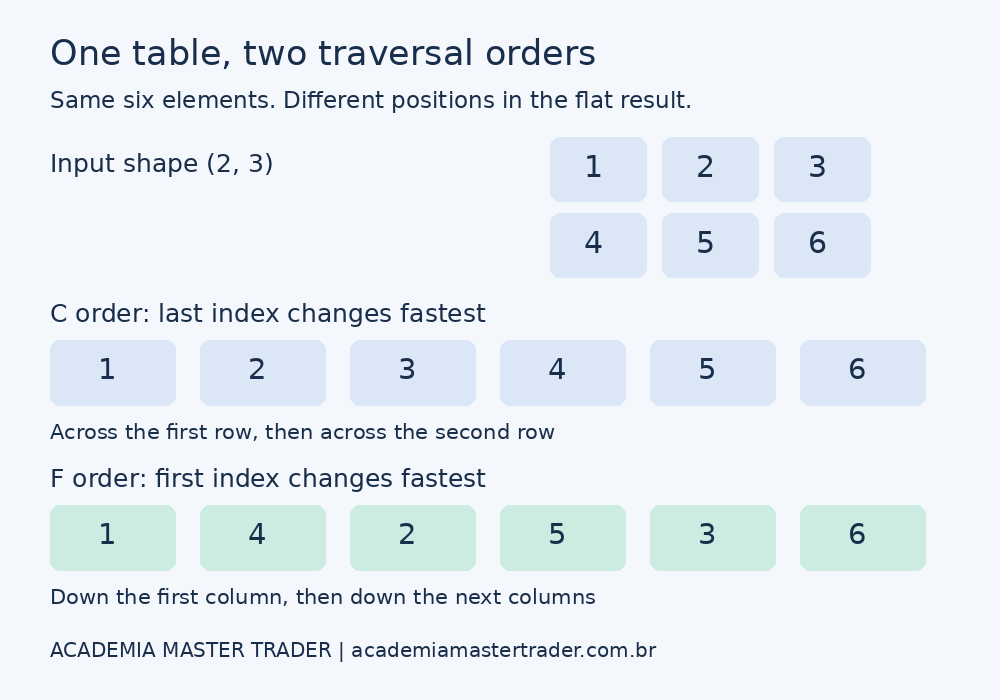
Using F order on the same table produces one, four, two, five, three and six. In this case, the first index changes fastest, so the traversal follows the columns. The output still contains six values, but their positions differ from those in the default result.
The traversal rule is not a sorting rule
Neither result comes from comparing the sizes of the values. The default sequence happens to be increasing in this example because the input was arranged that way. Different input values would follow the same positional traversal without being sorted into numerical order.
For instance, a table can contain repeated values or a mixture of positive and negative values. Flattening does not use those properties to choose the next element. It follows the requested order of indexing and packs the elements into a one-dimensional result.
This distinction matters when a flat sequence is later plotted or compared with another series. The position of a value in that sequence reflects the traversal rule. It does not automatically represent a rank, a date or a position on a measurement scale.
Removing axes from the shape removes visible boundaries
The original table has a boundary between its first and second rows. In the default flat result, three is immediately followed by four. That adjacency records the chosen traversal, not a new relationship between the two observations.
If the rows represent separate groups, flattening can hide those group boundaries from the shape. The values have not disappeared, but the output no longer expresses the original two-axis arrangement by itself. The original shape and any relevant labels need to be retained separately when they will be needed later.
A flat array alone also does not establish how to rebuild the intended table. Reshaping can restore a compatible structure when the shape and traversal convention are known. Without that context, several arrangements can contain the same number of elements while expressing different groupings.
C and F describe indexing order
The documentation distinguishes index order from the underlying memory layout. C order means that the last axis index changes fastest. F order means that the first axis index changes fastest. These definitions apply beyond a two-dimensional table.
For a three-dimensional array, the words row and column may be too narrow to describe the full traversal. Naming the axes and explaining which index changes fastest makes the rule clearer. A familiar-looking display does not replace that description.
The function also supports A and K orders, which take aspects of the input's memory arrangement into account. Their behavior should be chosen from the documented requirements of the task. They should not be treated as automatic ways to discover the semantic order of observations.
A flat result is not always an independent copy
The documentation states that ravel makes a copy only when needed. It is therefore unsafe to assume that every flattened result has storage independent of the input. Depending on the input and order, the result may share the underlying data.
If later editing requires an independent version, that requirement needs to be handled explicitly. The fact that the result has only one dimension says nothing by itself about whether its data are shared. Shape and ownership of storage are separate properties.
Before interpreting a flattened result, identify the original axes, select the traversal order and confirm the expected number of elements. Then check a few positional correspondences, such as the first element and the point where the traversal crosses a row boundary.
ravel provides a one-dimensional arrangement of existing elements. It does not supply missing labels or decide what neighboring positions mean. Keeping the traversal rule alongside the result lets a reader understand the new sequence without mistaking a structural transformation for a new observation process.
Academia Master Trader shares educational material about numerical operations, data structures and the interpretation of results at academiamastertrader.com.br.