For sound, moving the source is not exactly the same as moving the listener
A source and a listener approaching one another usually produce an upward Doppler shift in sound. That broad statement does not mean that exchanging their motions gives exactly the same observed frequency. Sound travels through a medium, and the motions relative to that medium have different roles.
Consider still air, a steady source frequency, straight-line motion along the source-listener direction and speeds below the speed of sound. In this setting, moving the source changes the spacing of the outgoing wavefronts. Moving the listener changes how quickly the listener encounters wavefronts already travelling through the air.
A moving source changes the wavelength ahead
A stationary source emits successive compressions from the same position. Their spacing in the air is the sound speed divided by the source frequency. If the source moves toward the listener, each new compression starts closer to the previous one ahead of it.
The wavelength in front becomes the sound speed minus the source speed, divided by the emitted frequency. A listener at rest in the air receives those compressed wavefronts at the sound speed. The observed frequency is therefore the emitted frequency multiplied by the sound speed, then divided by the sound speed minus the source speed.
The source motion belongs in the denominator because it has changed the spacing between successive wavefronts. It has not made each disturbance travel faster through the still air.
A moving listener changes the encounter rate
Now keep the source at rest in the air and move the listener toward it. The spacing of wavefronts in the air remains unchanged. The listener meets them more rapidly because the listener moves against their direction of travel.
The encounter speed is the sound speed plus the listener speed. Dividing that speed by the unchanged wavelength gives the observed frequency. Written in terms of the source frequency, the result is the source frequency multiplied by the sound speed plus the listener speed, divided by the sound speed.
This time, motion changes the numerator. The physical distinction is between altered wavelength and altered encounter rate, even though both arrangements produce a higher received frequency.
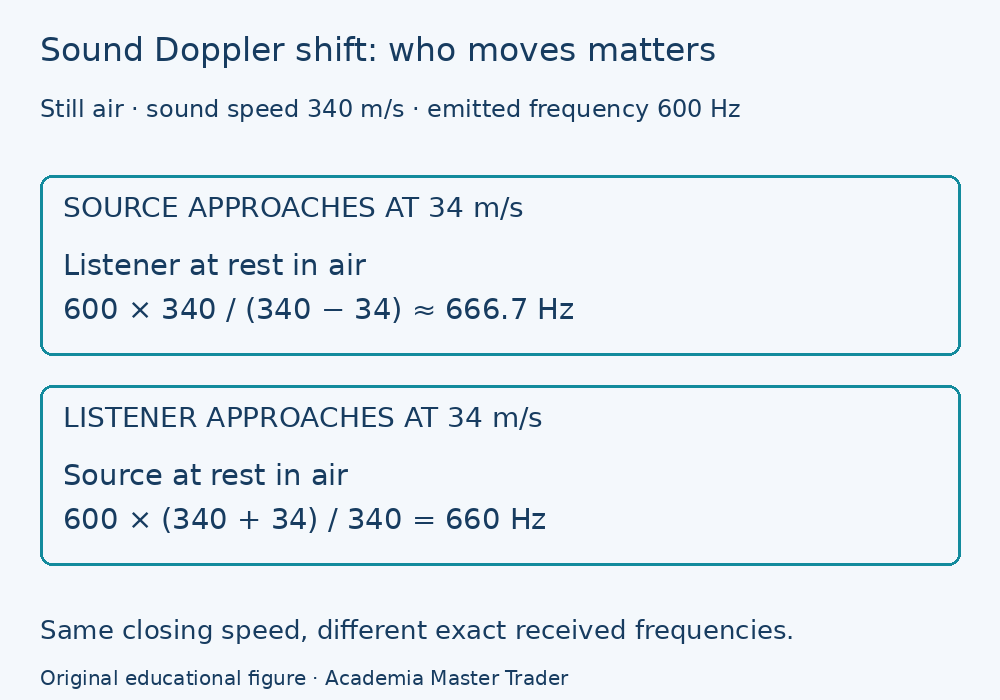
The same closing speed gives two results
Choose a sound speed of 340 metres per second and an emitted frequency of 600 Hz. Let the moving object travel at 34 metres per second, one tenth of that sound speed.
If the source approaches a listener at rest in the air, the received frequency is 600 times 340 divided by 306. This is approximately 666.7 Hz. If instead the listener approaches the stationary source at 34 metres per second, the result is 600 times 374 divided by 340, or 660 Hz.
Both arrangements have a closing speed of 34 metres per second. Their exact frequencies nevertheless differ. At speeds much smaller than the sound speed, the shifts agree to first order, which explains why the distinction can be easy to overlook in a rough estimate.
Keep the frame and direction explicit
For a receding source, the wavefront spacing behind it is larger. For a receding listener, the encounter rate is smaller. A useful sign check is that these simple receding arrangements must lower the observed frequency.
The formulas here describe motion along the relevant direction through still air. Wind, changing geometry and other conditions require more care. The same reasoning should not be transferred unchanged to light in vacuum, where a different Doppler description applies.
Before choosing a formula, state what moves relative to the air. Then decide whether the change comes from wavefront spacing or encounter rate. Relative closing speed alone does not settle the exact acoustic calculation.
Academia Master Trader shares educational material at academiamastertrader.com.br.