In an ideal LC circuit, zero capacitor charge can coincide with maximum current
A capacitor can have zero charge at an instant when the current in its circuit is largest. This is not a contradiction. Charge describes a state, while current describes how quickly charge moves. In an ideal LC oscillator, the distinction explains how energy moves between an electric field and a magnetic field.
The useful question is not simply whether the capacitor is charged. It is where the circuit's stored energy is at that moment.
Start with an explicit ideal model
Consider a capacitor of capacitance C connected to an ideal inductor of inductance L in a closed loop. Resistance, radiation and other energy transfers out of the loop are neglected. There is no driving source after the initial state has been prepared.
At time t = 0, the capacitor carries an initial plate charge of magnitude Q and the current is zero. All the stored energy is initially electric: E = Q²/(2C). Here Q refers to the magnitude of charge on either plate, not a net charge added to the whole capacitor.
The capacitor begins to discharge through the inductor. As current grows, the inductor's magnetic field stores energy. The changing distribution does not create extra energy. In the ideal model, the sum of the electric and magnetic energies stays constant.
Follow charge before following energy
Let q describe the signed charge on one chosen capacitor plate. Choose the current reference so that i = dq/dt. With the stated initial conditions, q(t) = Q cos(ωt), where ω = 1/√(LC).
Differentiation gives i(t) = −ωQ sin(ωt). The negative sign reflects the chosen reference direction. Reversing that reference reverses the sign assigned to current, without changing the energy or the physical motion of charge.
The period is T = 2π√(LC). After T/4, the chosen plate has q = 0, but the current magnitude is ωQ, its maximum. The charge curve crosses zero with its greatest slope. Zero value does not mean zero rate of change.
The current continues beyond that instant. It charges the capacitor with the opposite polarity, while the magnetic energy decreases. At T/2, the plate charge is −Q and the current is zero again.
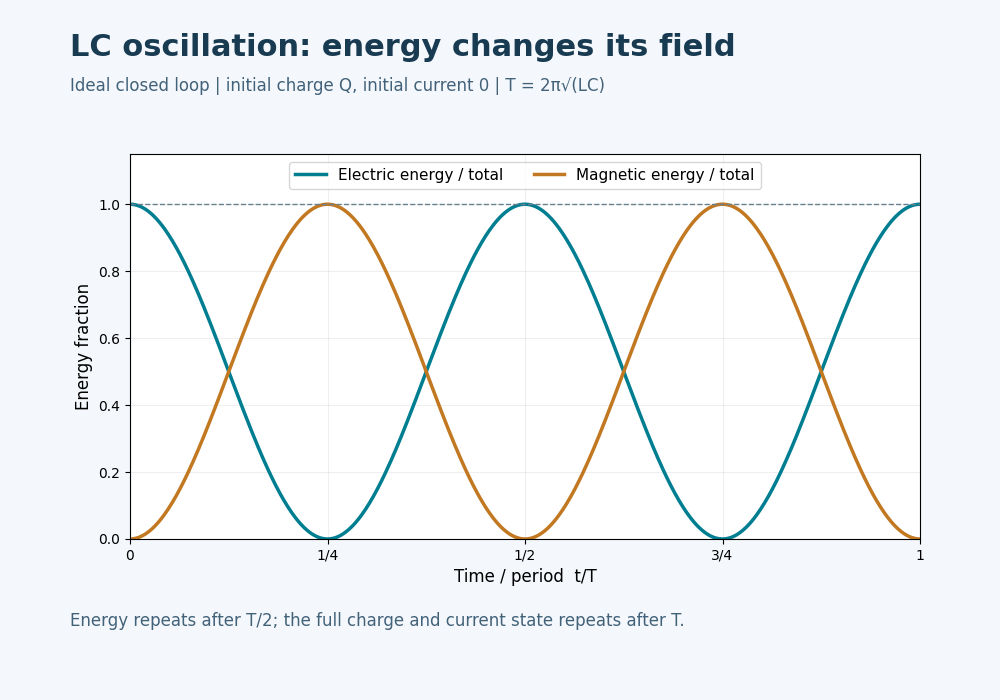
Read the energy curves without assigning them a direction
The electric energy is Eₑ = q²/(2C). The magnetic energy is Eₘ = Li²/2. Substituting the charge and current expressions gives Eₑ/E = cos²(ωt) and Eₘ/E = sin²(ωt).
The figure plots these fractions against t/T. Their sum is one throughout. At one quarter of a period, the magnetic fraction is one and the electric fraction is zero. At half a period, the electric fraction returns to one.
That return does not mean the full circuit state has already repeated. At T/2 the capacitor polarity is reversed. The initial charge and current state returns after T, not T/2.
Energy contains squares, so it does not record the sign of charge or current. Each energy curve repeats twice within one charge cycle. A graph of energy alone therefore cannot tell us which plate is positive or which direction the current flows.
Keep the numerical quantities distinct
For example, take L = 10 mH, C = 100 µF and an initial capacitor voltage of 4.0 V. The initial charge magnitude is Q = CV = 400 µC. The stored energy is CV²/2 = 0.80 mJ.
These values give ω = 1000 radians per second and T about 6.28 milliseconds. The first zero-charge instant occurs after about 1.57 milliseconds. At that instant, the current magnitude is 0.40 A and the magnetic energy is still 0.80 mJ.
Angular frequency is not frequency in cycles per second: f = ω/(2π), approximately 159 Hz here. Mixing the two would give the wrong period even if the energy calculation were correct.
Real circuits have resistance and other departures from the model, so their undriven oscillations do not keep the same amplitude indefinitely. The ideal oscillator is a clear reference for separating charge, current, polarity and energy before those additional effects are included.
Academia Master Trader shares educational material at academiamastertrader.com.br.