Joining arrays extends an existing axis without aligning the meaning of their entries
Two arrays can fit together numerically while still describing different things. NumPy's concatenate function joins a sequence of arrays along an existing axis. It checks the structural conditions needed for that operation, but the meaning of the entries remains a separate responsibility.
This distinction matters whenever data from more than one source are placed in a single structure. A successful join shows that the supplied shapes can be combined in the requested way. It does not show that the units, labels, dates, or collection methods are compatible.
A small example with an explicit order
Consider two one-dimensional arrays. The first contains two and five. The second contains eight and one. Joining them in that order produces two, five, eight, one. The entries of the second array follow the entries of the first.
The first input has shape (2,), and the second also has shape (2,). The joined result has shape (4,). The existing axis becomes longer. No extra axis is introduced to keep the two inputs in separate rows or separate groups.
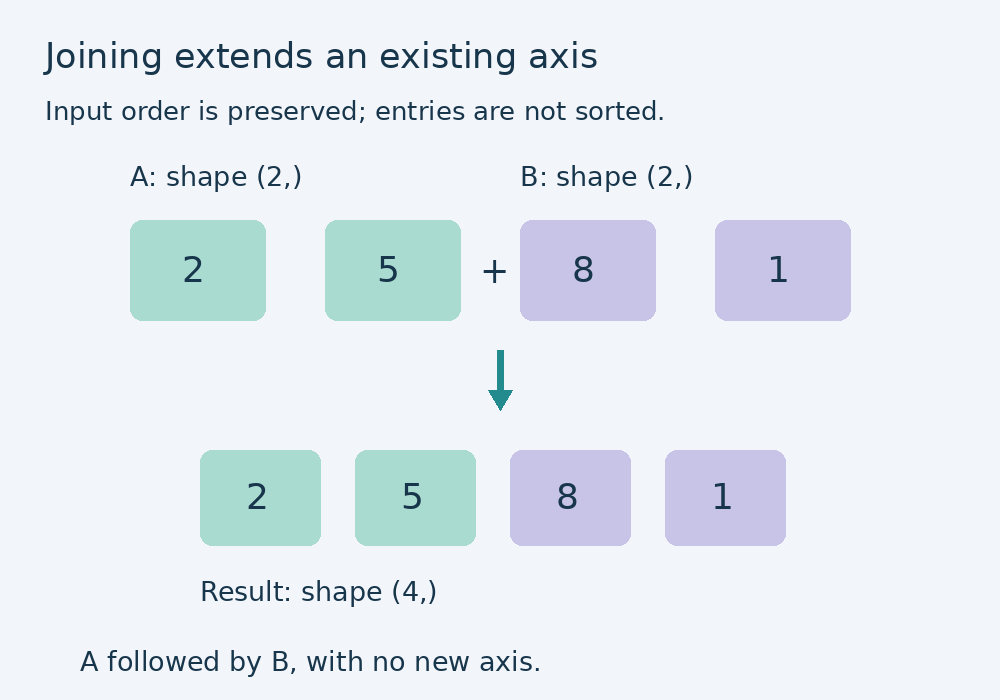
Reversing the input order produces eight, one, two, five instead. The same values appear, but their positions differ. Concatenation follows the supplied sequence of inputs; it does not sort the entries or choose an order based on their numerical size.
An existing axis is different from a new axis
Joining along an existing axis changes that axis's length. This differs from stack, which combines inputs along a new axis. For the two short arrays above, stacking them as rows would create a two-dimensional structure instead of one longer sequence.
The distinction is visible in the output shape. A shape of (4,) describes four positions on one axis. A shape of (2, 2) describes two axes, each of length two. Both structures contain four entries, but they organize those entries differently.
Counting entries alone therefore cannot establish that two results are interchangeable. The shape and the intended role of each direction must also be known. Choosing an operation begins with deciding whether an existing direction should grow or a new direction should be added.
Other dimensions must agree
For multidimensional inputs, NumPy requires matching shapes apart from the dimension corresponding to the chosen axis. That exception allows the selected axis to grow while the remaining dimensions stay consistent across the join.
For example, a table with shape (2, 3) can be joined to a table with shape (1, 3) along axis zero. The result has shape (3, 3). The two inputs have the same number of columns, while their row counts are added.
Joining those same inputs along axis one does not meet the shape requirement, because the row counts differ. To extend columns in a two-dimensional table, the row counts must agree. The axis choice is therefore part of the operation, not a detail that can be omitted from its explanation.
Flattening removes the original separation of axes
The default axis is zero. Setting axis to None has a different effect: the arrays are flattened before they are joined. The output is then one-dimensional rather than a larger table that retains the original arrangement of rows and columns.
A table with two rows and two columns can therefore contribute four consecutive entries to a flat result. Its row boundary is no longer represented as a separate dimension. Anyone interpreting the output needs to know that this structural information has changed.
Flattening does not discover a shared chronology or identify matching records. It describes how entries are laid out for the join. A meaningful timeline still requires verified timestamps and a deliberate ordering rule outside the mere act of joining arrays.
Shape agreement does not prove semantic agreement
Two tables with three columns may satisfy a shape requirement even if those columns represent different quantities. A first column of temperature in one table is not made equivalent to a first column of elapsed time in another by putting their rows together.
Likewise, joining two sequences does not remove duplicate records or reconcile labels. Those are separate data-handling decisions. If inputs refer to overlapping observations, their shared origin must be considered before interpreting the combined number of positions as a count of distinct observations.
A clear account names the input shapes, the input order, the chosen axis, and the output shape. It also states what makes the corresponding entries comparable. The operation then has a precise role: extending a structure according to a supplied rule, without claiming that structural compatibility establishes meaning.
Academia Master Trader shares educational material about numerical operations, data structures, and the interpretation of results at academiamastertrader.com.br.