Magnetic flux uses the angle to the surface normal, not the surface itself
A magnetic field and a magnetic flux describe different things. The field tells us about the magnetic conditions at a location. Flux combines the field with a chosen surface and its orientation. For a flat surface in a uniform field, the relation is Φ = BA cos θ. The angle in that expression needs a precise definition.
Draw the normal before choosing an angle
A surface normal is a direction perpendicular to the surface. In the flux formula, θ is the angle between the magnetic field and the chosen normal. It is not the angle between the field and the plane of the surface.
When the field is perpendicular to the surface and points along the chosen normal, θ = 0° and the flux is BA. When the field lies parallel to the surface, θ = 90° and the flux is zero. A zero flux in this second case does not mean that the magnetic field has vanished.
Convert an angle given to the plane
Suppose a flat rectangular loop has an area of 0.020 m² and is placed in a uniform magnetic field of 0.30 T. The field makes an angle of 30° with the plane of the loop. Choose the normal that makes an acute angle with the field.
The angle to that normal is 60°, because the normal is perpendicular to the plane. The flux is therefore Φ = 0.30 × 0.020 × cos 60° = 0.0030 Wb. The weber, written Wb, is the SI unit of magnetic flux; one weber equals one tesla square metre.
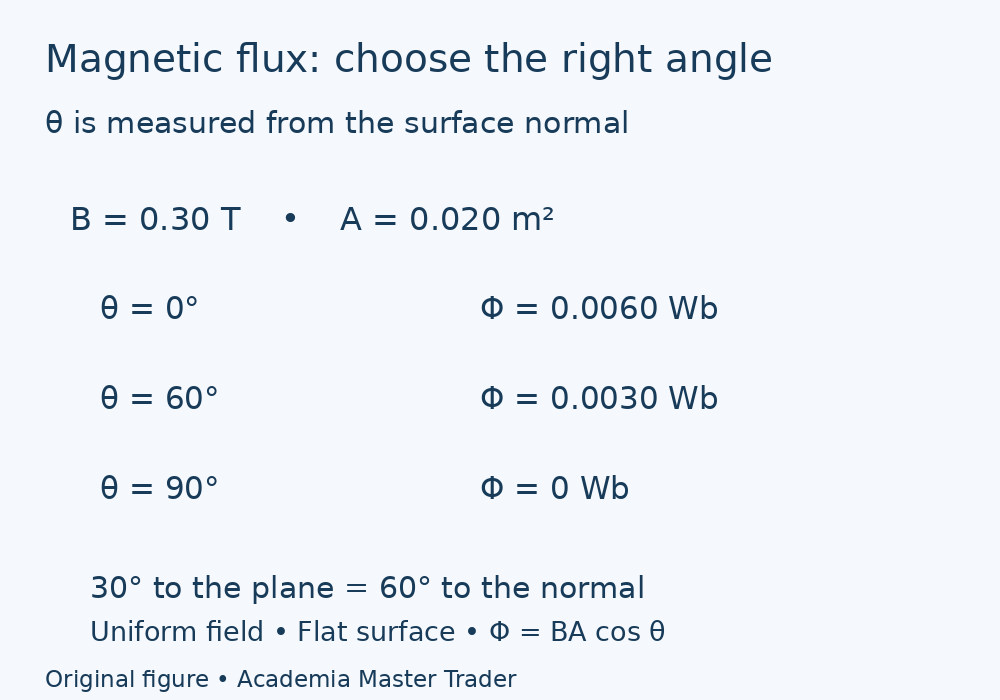
Using cos 30° directly would give approximately 0.0052 Wb, which does not match the stated geometry. The issue would not be the calculator. It would be the reference direction used for the angle. Writing down what the angle is measured from avoids that mismatch before any numbers are entered.
Keep track of the sign
A flat surface has two opposite normal directions. Choosing one defines the positive orientation for the flux calculation. If the field makes an obtuse angle with that chosen normal, the cosine is negative and the signed flux is negative.
For example, the same field and area give Φ = −0.0030 Wb when the angle to the chosen normal is 120°. This sign describes orientation relative to the chosen normal. It does not mean that the area or the magnetic field magnitude has become negative.
Reversing the chosen normal reverses the sign assigned to the flux. In a calculation involving a change of flux, keep the orientation convention consistent throughout. Changing the convention halfway through would mix two different descriptions of the same physical arrangement.
Separate flux from induced voltage
Flux is measured in webers, whereas an induced electromotive force is measured in volts. Faraday's law connects the induced voltage around a loop to the rate of change of magnetic flux through it. The amount of flux at a single instant is not itself an induced voltage.
A fixed loop in a steady field can have nonzero flux with no induced voltage from a changing flux. Rotating the loop can change the flux even if the field magnitude and the loop area remain constant. Orientation is therefore part of the physical situation, not a decorative detail in the diagram.
The simple product BA cos θ assumes a uniform field over a flat surface. A nonuniform field or a curved surface requires adding the contributions of small surface elements with their own local normals. The same idea remains: count the component of the field through the surface, not along it.
Academia Master Trader shares educational material with defined quantities and clear calculations. Explore the full structure at academiamastertrader.com.br and continue learning through Aprenda.