Molten sodium chloride and salt water are different electrolysis systems
A chemical formula does not describe every substance available to react at an electrode. Sodium chloride can be present as a molten ionic liquid or dissolved in water. These systems contain the same named salt, but they do not offer the same set of possible electrode reactions. Identifying the solvent and physical state is therefore part of understanding electrolysis, not a detail to add afterward.
Start with the particles present
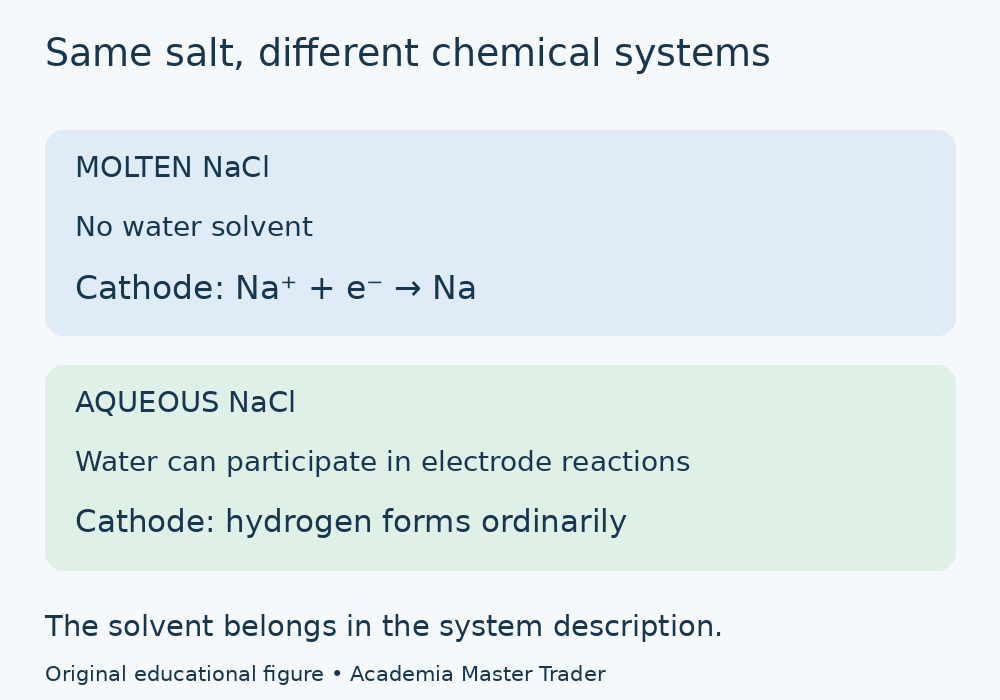
In molten sodium chloride, mobile sodium ions and chloride ions carry charge through the liquid. Water is not the solvent. An external power source can drive the reduction of sodium ions and the oxidation of chloride ions. The overall process converts the molten salt into sodium and chlorine.
The cathode reaction can be written Na⁺ + e⁻ → Na. The anode reaction is 2 Cl⁻ → Cl₂ + 2 e⁻. Multiplying the cathode equation by two balances the electrons, giving 2 Na⁺ + 2 Cl⁻ → 2 Na + Cl₂. Each equation refers to the molten system described, rather than to every mixture containing sodium chloride.
Water adds another participant
In an aqueous sodium chloride solution, water is part of the reacting system. It is not simply empty space between dissolved ions. Under ordinary aqueous electrolysis conditions, reduction of water produces hydrogen at the cathode rather than depositing sodium metal. One way to write that reduction is 2 H₂O + 2 e⁻ → H₂ + 2 OH⁻.
This equation also shows why the local solution can become more alkaline near the cathode: hydroxide ions are products. It does not imply that every part of an operating cell instantly has the same composition. Mixing, separation between compartments, and transport of ions influence the conditions around each electrode.
Do not assign every anode product from the salt name
At the anode of an aqueous solution, chloride oxidation and oxygen-producing reactions must be considered in context. Concentration, electrode material, and operating conditions matter. The observation that chlorine is produced in an appropriate industrial brine process is not a rule that every aqueous chloride solution has only one possible anode product.
A useful explanation states the conditions it relies on. If those conditions are missing, the better conclusion is that the description is incomplete. Adding a solvent to a familiar formula can change the relevant chemistry, even before a numerical calculation begins.
Balance charge and atoms separately
The water-reduction equation contains two oxygen atoms and four hydrogen atoms on each side. Its left side has a total charge of minus two from the electrons; its right side has minus two from the hydroxide ions. Both checks are needed. A balanced equation records conservation, but does not by itself establish which competing reaction dominates in a particular apparatus.
Read the system before applying a rule
A clear electrolysis description names the electrolyte, whether it is molten or aqueous, and the electrode reactions being considered. It then distinguishes an idealized teaching model from an operating process with specific conditions. These steps connect symbols to the actual chemical environment.
The main lesson is simple: dissolving a salt introduces a solvent that may participate in electrode reactions. Molten sodium chloride and salt water should not be treated as interchangeable descriptions.
Academia Master Trader presents educational material through explicit assumptions and clear explanations. Explore its full structure at academiamastertrader.com.br and find further learning material through Aprenda.