Moving a screen changes fringe spacing without changing the light's wavelength
A double slit can produce a sequence of bright and dark fringes rather than two isolated bright patches. The spacing of those fringes depends on the wavelength, but it also depends on the geometry. A wider pattern on a screen does not, by itself, show that the light has changed color or wavelength.
Separate the two distances
Consider two narrow slits illuminated coherently and in phase by monochromatic light. Let d be the center-to-center separation of the slits and L the perpendicular distance from the slit plane to a parallel screen. These are different lengths with different effects on the pattern.
We measure the position y of a bright fringe from the central bright fringe on the screen. The angle θ is measured from the central direction perpendicular to the slit plane. The wavelength λ is the wavelength in the medium through which the light travels between the slits and screen.
For a distant screen, the path difference from the two slits is approximately d sin θ. Constructive interference occurs when this difference equals an integer number of wavelengths: d sin θ = mλ. The integer m labels the bright fringe, with m = 0 at the center and positive or negative orders on opposite sides.
From an angle to a screen position
Screen geometry gives y = L tan θ. Near the center, when the angles are small, sin θ and tan θ are both approximately θ in radians. Combining the two relations gives y for order m approximately equal to mλL/d.
The distance between neighboring bright fringes is therefore approximately Δy = λL/d. This convenient expression assumes a screen far from the slits compared with their separation and a region of the pattern where the angles remain small. It should not be treated as an exact rule for every point on the screen.
With wavelength and slit separation fixed, increasing L increases the linear spacing on the screen. The angular positions of the bright fringes are still set by the same wavelength and slit separation. A more distant screen maps those angles to larger distances.
Keep the units in one system
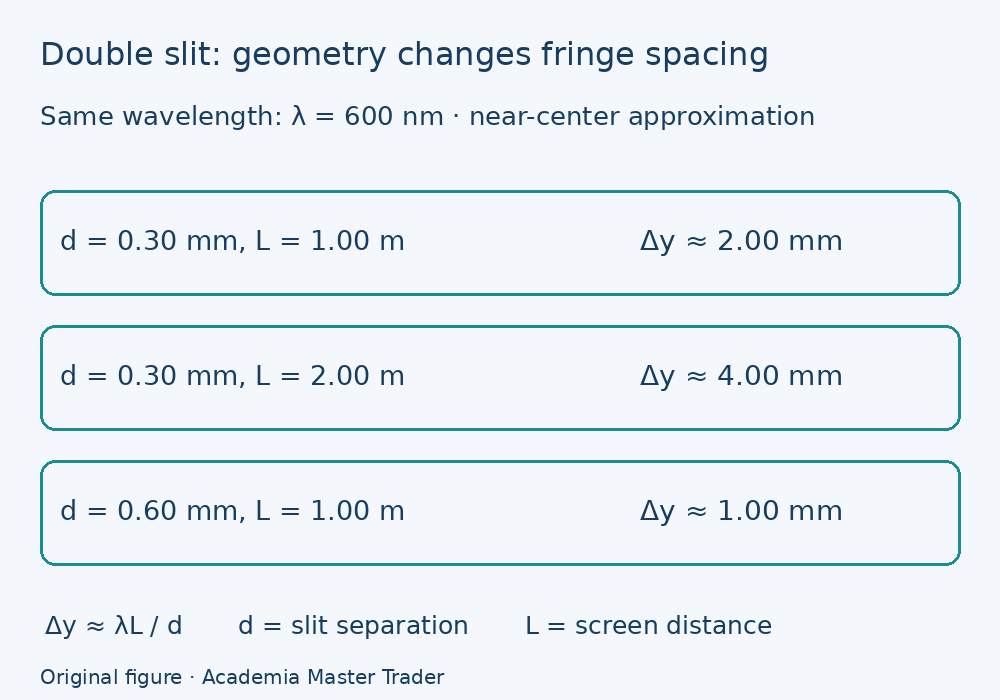
Take λ = 600 nm, L = 1.00 m and d = 0.30 mm. Converting before substitution gives λ = 6.00 × 10⁻⁷ m and d = 3.00 × 10⁻⁴ m. The near-center spacing is then approximately 0.00200 m, or 2.00 mm.
Move the same screen to L = 2.00 m while keeping the light and slit pair unchanged. The spacing becomes approximately 4.00 mm. Nothing in this change requires a different wavelength: the screen position alone explains the wider pattern.
Alternatively, keep L = 1.00 m and increase the slit separation to 0.60 mm. The spacing becomes approximately 1.00 mm. Greater slit separation makes neighboring fringes closer together in this model, not farther apart.
A bright fringe is not a slit image
The integer m counts interference orders. It does not label one slit or the other. Both slits contribute to each interference maximum through the superposition of their waves.
Finite slit width also matters because each slit diffracts light. The resulting diffraction envelope affects the brightness of the interference fringes. Slit width and slit separation are distinct geometric quantities, so changing one should not be silently described as changing the other.
A clear interpretation names what changed and what stayed fixed. When wavelength, medium and slit separation are unchanged, doubling the screen distance doubles the approximate near-center spacing without changing the light itself.
Academia Master Trader offers educational content with defined quantities and explained reasoning. Explore the full structure at academiamastertrader.com.br and continue learning with Aprenda.