Moving a sound source and moving a listener do not give exactly the same Doppler shift
A source approaching a listener raises the received frequency. A listener approaching a source also receives a higher frequency. These two statements sound interchangeable, but sound travels through a medium. In still air, the source speed and the listener speed relative to that air play different roles.
For the same approach speed, moving the source and moving the listener produce nearly the same shift when that speed is small compared with the speed of sound. They are not exactly equal. A simple comparison shows why relative separation speed alone does not fully describe the classical sound problem.
Start with the air as the reference
Assume uniform, still air with sound speed c. Consider motion directly along the line joining source and listener, before they pass one another. The source emits a steady tone of frequency fs. We ignore wind, reflections, and changes in air properties, and keep the source speed below c.
The source frequency fixes the time between successive emissions: Ts =1/fs. Once a wavefront has been emitted, it travels at c relative to the air in this model. It does not acquire the source's later motion as an extra propagation speed.
The listener measures how often successive wavefronts arrive. That arrival rate can change because the source changes the spacing between wavefronts, or because the listener moves through an existing pattern. These are distinct mechanisms.
A moving source changes wavelength
Let the source move toward a stationary listener at speed us. During one source period, a wavefront travels cTs while the source advances usTs. The spacing of successive fronts ahead of the source is therefore λahead =(c − us)Ts =(c − us)/fs.
The listener is stationary in the air, so fronts pass that listener at speed c. The received frequency is fo =c/λahead =fs c/(c − us). A smaller denominator produces a frequency above fs.
Behind the source, the spacing is larger: λbehind =(c + us)/fs. A stationary listener there receives fo =fs c/(c + us), below the emitted frequency. The sound speed in the air is still c on both sides; the wavelength pattern is what differs.
A moving listener changes the encounter rate
Now keep the source stationary and let the listener move toward it at speed uo. The source creates the usual wavelength λ =c/fs. The listener meets wavefronts at a relative encounter speed c + uo.
Dividing that encounter speed by the unchanged wavelength gives fo =(c + uo)/λ =fs(c + uo)/c. The listener receives more cycles each second without changing the wavelength measured in the air.
If the listener moves away, the encounter speed is c − uo, giving fo =fs(c − uo)/c. The change belongs in the numerator for listener motion, whereas source motion changes the denominator through wavelength.
Compare equal approach speeds
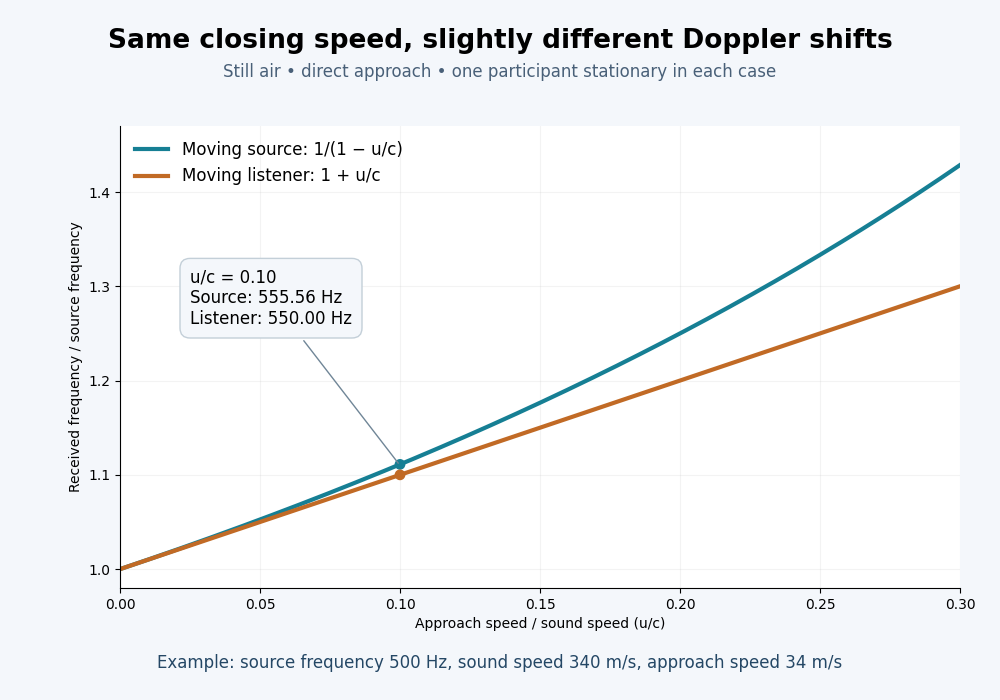
Choose hypothetical values fs =500 Hz and c =340 m/s. First, let the source approach a stationary listener at 34 m/s. The result is 500 × 340/(340 −34), about 555.56 Hz.
Next, keep the source stationary and let the listener approach at 34 m/s. The result is 500 ×(340 +34)/340 =550 Hz. The closing speed is the same, yet the received frequencies differ by about 5.56 Hz.
These are model calculations, not measurements of a particular siren. The chosen speed is one tenth of c, making the difference visible while keeping the source subsonic. Neither result changes the source's own emission frequency of 500 Hz.
Why a low-speed approximation can hide the difference
Write ε =u/c for the common approach-speed ratio. Source motion gives fo/fs =1/(1 − ε), while listener motion gives fo/fs =1 + ε. For small ε, the first expression is approximately 1 + ε, with additional terms beginning at ε².
Their exact difference in frequency ratio is ε²/(1 − ε). It becomes small rapidly as ε decreases. That explains why treating the two situations as nearly equal can be useful, provided the approximation is stated rather than mistaken for an exact identity.
Keep the scope of the formulas clear
These equations concern classical sound in a specified medium. They should not be transferred unchanged to light, where the physical framework differs. Oblique motion, wind, and a source passing beside rather than directly toward a listener also require more careful geometry.
The reliable sequence is to choose the medium's reference frame, identify what moves in that frame, determine the wavefront spacing, and then calculate the listener's encounter rate. This keeps source frequency, wavelength in the air, and received frequency separate.
Continue your educational journey at academiamastertrader.com.br and on the Aprenda page.