Nuclear binding energy compares a bound nucleus with the same nucleons separated
A bound nucleus has less rest mass than the sum of the rest masses of its free protons and neutrons. This difference is called the mass defect. It does not mean that some nucleons are missing: the comparison includes the same numbers of protons and neutrons in two different physical arrangements.
The associated binding energy measures the energy needed to separate that nucleus completely into free nucleons. Keeping the comparison clear prevents confusion between particle count, rest mass and energy transferred to the surroundings.
Specify what is being compared
Consider a nucleus containing Z protons and A − Z neutrons. Here A is the mass number, the total number of nucleons. Let the free proton and neutron rest masses be mₚ and mₙ, and let M be the rest mass of the nucleus in its ground state.
The mass defect is Δm = Zmₚ + (A − Z)mₙ − M. For a bound ground-state nucleus, this quantity is positive. The total binding energy is B = Δmc², where c is the speed of light.
The reference arrangement contains free nucleons separated far enough for their mutual interactions to be negligible, with no relative kinetic energy. The bound ground state lies below that reference in energy.
This is a comparison of entire systems. Adding the separate particle rest masses alone does not account for the energy of the interacting bound system. Its measured rest mass includes that difference.
Interpret the direction of energy transfer
To separate the nucleus into those free particles requires an input of energy B. In the ideal reverse comparison, forming the bound ground state from those free nucleons releases the same energy difference.
A real reaction must still obey conservation of energy and momentum. Other particles, radiation and recoil can carry energy away. The equation B = Δmc² identifies the difference between the specified initial and final rest energies; it is not a complete reaction mechanism.
A simple energy-level sketch can show the comparison without drawing a particular isotope. Place the separated-nucleon reference at zero and the bound ground state below it. The vertical gap is B.
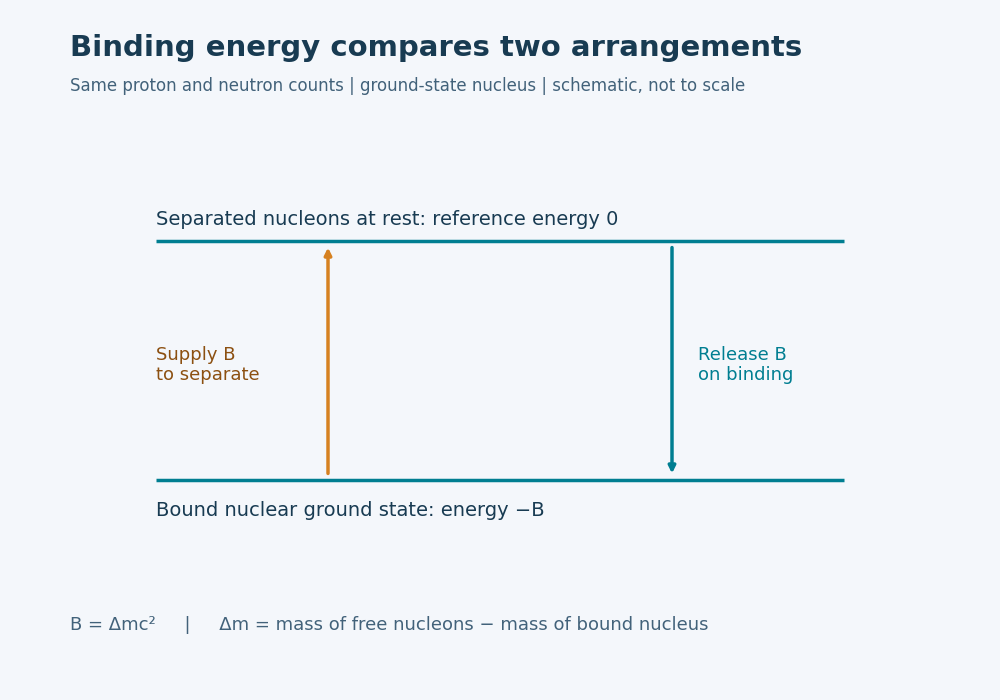
The figure is schematic and has no numerical energy scale. Its arrows represent changes in system energy, not paths followed by individual nucleons through space.
Keep total binding and binding per nucleon distinct
The total binding energy concerns all A nucleons together. Dividing by A gives the average binding energy per nucleon, B/A. These are different quantities and answer different questions.
For a purely numerical illustration, suppose a nucleus has A = 4 and total binding energy B = 28 MeV. Its average is 7 MeV per nucleon. Those chosen numbers illustrate the division; they are not a mass-table entry for a named isotope.
The average does not mean that removing any one nucleon always requires exactly 7 MeV. A separation energy compares the original nucleus with a particular residual nucleus and a particular removed particle. That comparison needs the masses of those actual products.
Likewise, a larger total binding energy does not by itself establish a larger binding energy per nucleon. The particle count must be included before comparing averages across different nuclei.
Use consistent mass data
The formula written above uses nuclear masses, not neutral atomic masses. A neutral atom includes electrons as well as the nucleus. Combining its mass with free proton masses without accounting for those electrons mixes two different conventions.
Atomic masses can be used in suitable rearranged formulas, with electron contributions handled consistently. The important step is to identify exactly what each tabulated mass includes before subtracting nearly equal numbers.
Units deserve the same care. A mass defect expressed in kilograms gives binding energy in joules when multiplied by c² in SI units. A mass expressed in MeV/c² gives energy in MeV after multiplication by c².
Before interpreting any result, list the constituents, the reference arrangement and the units. Then distinguish total binding energy, average binding per nucleon and a particular separation energy. The same energy-accounting principle connects them, but they are not interchangeable labels.
Academia Master Trader shares educational material at academiamastertrader.com.br.