NumPy array split distributes an uneven axis across ordered sections
An array can be divided into a requested number of sections even when its selected length is not an exact multiple of that number. The important questions are how many entries each section receives and where the boundaries fall. Academia Master Trader explains NumPy's array split function in English for readers in Poland. We will work with eight supplied integers and then use a matrix to separate the meaning of axis from the meaning of section count. The examples describe data organisation, not financial outcomes or additional observations.
Record the input order
After import numpy as np, define a = np.array([8,3,6,2,9,4,7,5]). Its shape is (8,). The array has one axis with eight positions, numbered zero through seven. The printed values are not sorted. Their starting order is part of the example and will be preserved inside the returned sections. The function groups neighbouring positions; it does not group entries by their numerical size.
Call np.array_split(a,3). NumPy returns a list containing [8,3,6], [2,9,4] and [7,5]. Their shapes are (3,), (3,) and (2,). All eight entries appear once across these three sections. There is no padding value at the end and no extra observation. The final section is simply shorter than the first two.
Calculate section lengths before reading values
The documentation gives a quotient and remainder rule for an integer section count. With length eight and three sections, integer division gives two and the remainder is two. Two sections therefore receive one extra entry, giving lengths three, three and two. The longer sections appear first. This is a structural calculation about the axis length, not a calculation performed on the entries themselves.
The rule is not to give every leftover entry to the last section. That would produce lengths two, two and four, which is not this function's result. Nor does the function repeat the final value to make three equal sections. Writing the expected lengths before writing the actual entries makes both misunderstandings easier to spot. Their sum should match the selected input length.
Trace the boundaries
The first section takes original positions zero, one and two. The second takes positions three, four and five. The third takes positions six and seven. Nine begins at original index four and appears at local index one in the second section. Seven begins at original index six and appears at local index zero in the third section. Their values have not changed, but their local coordinates start again inside each output.
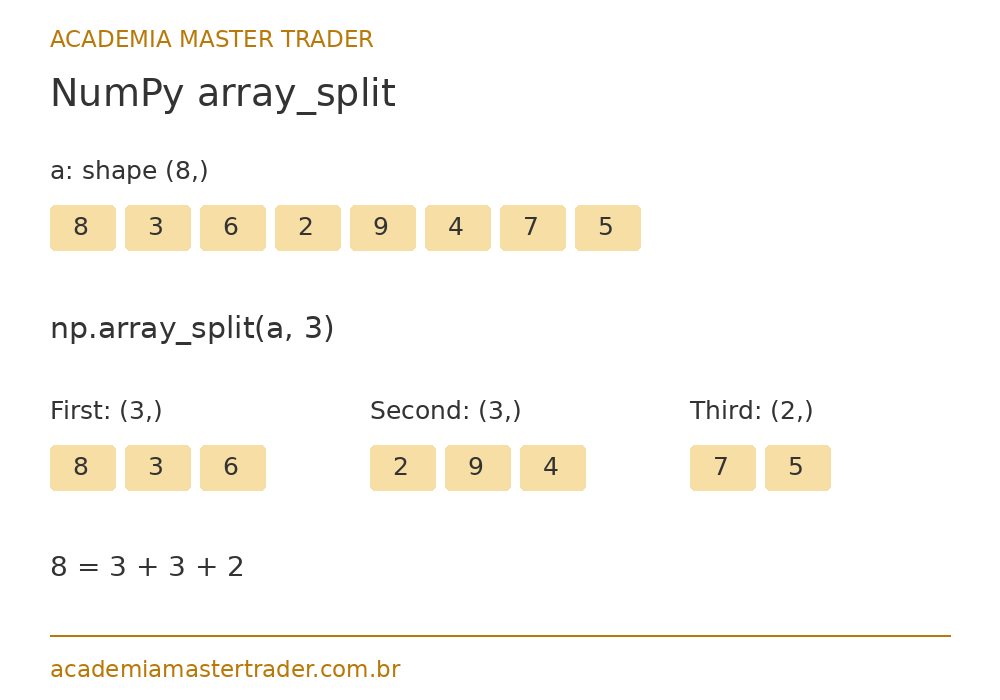
The figure records the eight input entries and the three returned sections. Read its panels from left to right. The labels describe output lengths rather than ranking or numerical importance. The largest input value, nine, belongs in the middle section because of its original position. It is not moved into the first section because it is numerically larger than its neighbours.
Apply the same rule to a matrix
Define b = np.array([[8,3,6,2],[9,4,7,5]]), with shape (2,4). The call np.array_split(b,3,axis=1) divides four columns into widths two, one and one. Its outputs are [[8,3],[9,4]], [[6],[7]] and [[2],[5]], with shapes (2,2), (2,1) and (2,1). Both rows remain represented in every section. Only the selected column dimension is divided.
Changing the selected axis changes the length used in the rule. For np.array_split(b,2,axis=0), that length is two rows rather than four columns. The two outputs each have shape (1,4): [[8,3,6,2]] and [[9,4,7,5]]. Equal division works here too. Allowing uneven sections does not require every call to produce unequal shapes.
Distinguish a section count from an equal division requirement
NumPy split and array split have different behaviour when an integer section count does not divide the selected length evenly. For our one dimensional input, np.split(a,3) raises a ValueError, while np.array_split(a,3) gives the three sections shown above. Choose the rule that matches the structure you intend rather than treating the two function names as interchangeable.
Continue learning with Academia Master Trader at academiamastertrader.com.br and in Aprenda. Record the shape, selected axis and requested section count. Work out the output lengths, preserve entry order and trace one local coordinate in each section. Those checks explain an uneven division without confusing a shorter section with missing data.