NumPy atleast 1d gives scalars an array dimension while preserving higher dimensional inputs
An instruction that requires at least one dimension is different from an instruction that flattens every input. NumPy atleast 1d converts scalar inputs to one dimensional arrays, while preserving higher dimensional inputs. That distinction makes the function useful to understand before describing a result as a vector. The minimum requirement does not erase an existing table's structure.
Academia Master Trader presents this guide in English for readers in Nepal. The small arrays are teaching examples for reading dimensionality and return structure. They are not market prices or financial results. The goal is to follow the boundary around each input and to distinguish its values from the number of axes used to arrange them.
Read the name as a minimum requirement
The signature is np.atleast_1d(*arys). The official reference describes the operation as converting inputs to arrays with at least one dimension.
Each resulting array satisfies a.ndim>=1. The greater than or equal condition matters: one dimension is the minimum, not the only permitted dimensionality.
An input that already has more dimensions can meet that requirement without being flattened. Avoid replacing the documented rule with a shorter description that says every result is one dimensional. That shorter description changes the meaning.
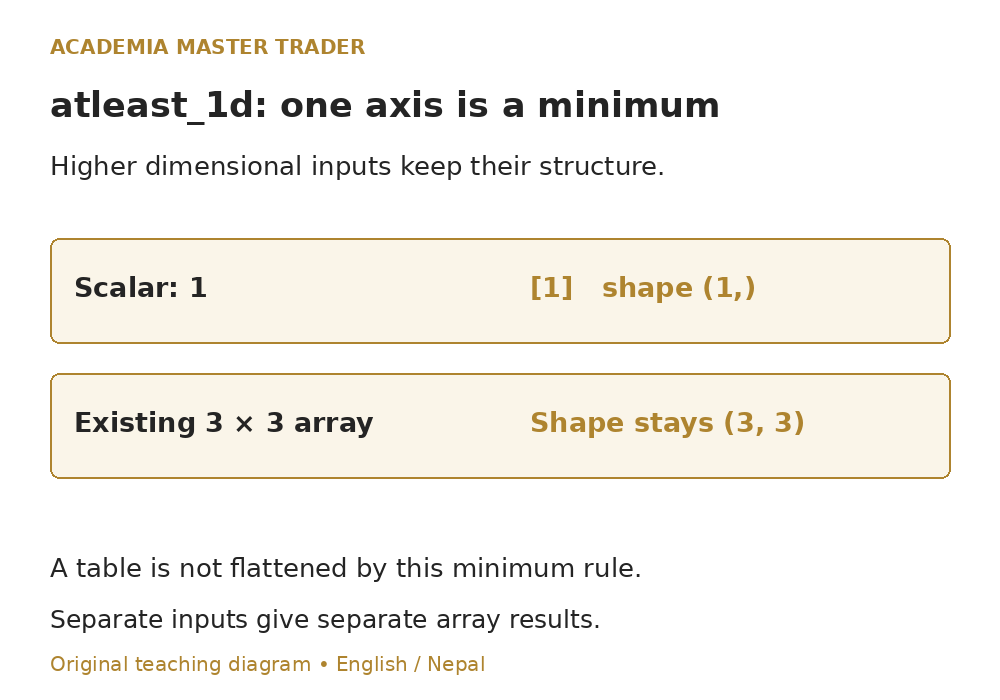
A scalar becomes a one dimensional array
The first example in the reference is np.atleast_1d(1.0). Its displayed output is array([1.]).
The single value now appears inside a one dimensional array. The example does not repeat the value to create several observations. It supplies an array dimension around the scalar input.
Keep the value and the structure separate when reading this display. One numerical entry can belong to an array with one dimension. The count of entries and the count of dimensions answer different questions.
An existing table keeps its arrangement
The reference then creates x=np.arange(9.0).reshape(3,3). Its displayed arrangement has rows [0.,1.,2.], [3.,4.,5.] and [6.,7.,8.].
Passing x to np.atleast_1d(x) displays the same three by three arrangement. The input already has two dimensions, so it meets the minimum requirement.
The function does not turn those rows into a single sequence in this example. The existing two dimensional structure remains visible. This is the clearest contrast with an operation whose purpose is to flatten an array.
The identity example is specific
For that table, the reference shows np.atleast_1d(x) is x as True.
This is stronger than merely seeing equal printed numbers in the two displays: the documented expression checks whether the returned object is x itself.
Keep the condition attached to the example. The reference also accepts scalar and other array-like inputs, so one preserved table should not become a blanket claim that every possible input is returned unchanged as the same object. The return description says copies are made only if necessary.
Several inputs give separate arrays
The documented call np.atleast_1d(1,[3,4]) returns a tuple containing array([1]) and array([3,4]).
Each input has a corresponding array. The function does not concatenate the values into a single array containing one, three and four.
This boundary is easy to miss when reading nested punctuation. The outer parentheses belong to the tuple of results; the square brackets inside each array describe that array's entries. Follow one input and its output before moving to the next.
Equal dimensionality does not mean equal length
The two results in the multiple-input example both have one dimension, but they contain different numbers of values. The first has one entry and the second has two.
A minimum dimensional requirement therefore does not impose a common length on every input. Nor does it create a rectangular combined table from inputs that began separately.
Write the number of dimensions separately from the lengths of the axes when explaining such a call. This keeps a shared minimum requirement from being mistaken for a shared output shape.
Choose the description that matches the operation
The reference distinguishes conversion of scalars from preservation of higher dimensional inputs. Its return description also allows an array or a tuple of arrays, depending on the inputs supplied.
Continue learning with Academia Master Trader at academiamastertrader.com.br. Aprenda gives access to educational resources. Identify each input, read its existing dimensionality and then inspect the corresponding result. Atleast 1d supplies a minimum of one dimension without requiring an existing table to lose its structure.