NumPy atleast 2d gives each input at least two dimensions without combining separate inputs
Some array operations begin with inputs that do not have the same number of dimensions. One value, a one dimensional sequence and an existing table are different starting points. NumPy atleast 2d provides a minimum dimensional requirement: each result has at least two dimensions. That wording matters. It does not mean that every input becomes exactly two dimensional, nor that separate inputs are combined into a single table.
Academia Master Trader presents this guide in English for readers in Brunei. The small arrays are educational examples for reading shape and return structure. They are not market prices or financial results. Follow the boundary around each input before reading the brackets in its result. This makes it easier to distinguish an individual array from a tuple containing several arrays.
The requirement is a minimum
The function is written as np.atleast_2d(*arys). The official reference describes its purpose as viewing inputs as arrays with at least two dimensions.
The return condition is a.ndim>=2 for each result. Read this as a lower bound on the number of dimensions, not a requested shape with a fixed number of rows or columns.
An array that already has two or more dimensions is preserved. In particular, the description does not instruct the function to reduce an input with more dimensions to a two dimensional table. The word at least prevents that misunderstanding.
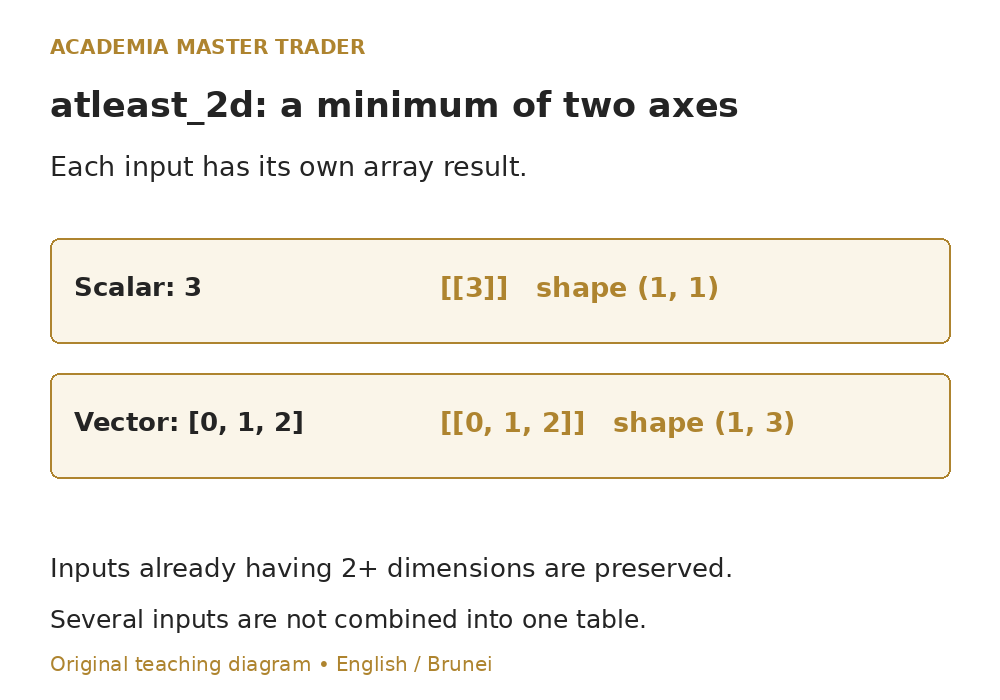
A scalar becomes a small two dimensional array
The first example in the reference is np.atleast_2d(3.0). Its displayed output is array([[3.]]).
The double brackets show a two dimensional arrangement containing one value. The displayed value remains three; the operation supplies the dimensional structure needed for the minimum requirement.
Do not describe this as creating several new observations or repeating the input value. The documented output contains one numerical entry in an array that has at least two dimensions.
A one dimensional sequence becomes a row
The reference then creates x=np.arange(3.0). The output of np.atleast_2d(x) is displayed as array([[0.,1.,2.]]).
The three entries are together in one row. They are not displayed as three rows containing one entry each.
This orientation is worth recording alongside the function name. Saying only that a vector became two dimensional leaves out a visible part of the documented result. A row of three values and a column of three values both have two dimensions, but they have different shapes.
Existing dimensions do not need to be added again
Non-array inputs are converted to arrays. Arrays that already have two or more dimensions are preserved, according to the parameter description.
These are different branches of the same rule. An input does not gain another axis simply because it is passed to the function. First consider whether it already meets the minimum requirement.
The reference's multiple-input example includes [[1,2]]. That input appears in the result as array([[1,2]]), retaining its two dimensional arrangement.
Several inputs produce separate results
The documented call np.atleast_2d(1,[1,2],[[1,2]]) returns a tuple containing three arrays.
The displayed arrays are array([[1]]), array([[1,2]]) and array([[1,2]]).
Read the tuple from one result to the next. Each input has its own corresponding array. The function has not stacked all the inputs into one larger array, and the different input lengths do not become a common row length in a newly assembled table.
Keeping the outer tuple separate from the brackets inside each array is especially useful when documenting a call with several inputs.
Copies are avoided where possible
The return description says that copies are avoided where possible and that views with two or more dimensions are returned.
For the one dimensional array example, the reference shows np.atleast_2d(x).base is x as True.
Keep this documented example distinct from a claim that every possible input follows exactly the same storage path. The parameter description also allows non-array inputs, which are converted to arrays. A new printed arrangement should not automatically be described as an independent copy.
Continue learning with Academia Master Trader at academiamastertrader.com.br. Aprenda gives access to educational resources. Identify each input, read its dimensionality and then inspect its corresponding result. The function sets a minimum of two dimensions while preserving the distinction between separate inputs and their separate arrays.