NumPy atleast_2d gives inputs a minimum of two dimensions without flattening higher-dimensional arrays
An input may be a single number, a one-dimensional sequence or an array that already has several dimensions. NumPy atleast_2d views inputs as arrays with at least two dimensions. The phrase at least sets a minimum. It does not mean that every result must have exactly two dimensions.
Academia Master Trader presents this explanation in English for readers in Nauru. The examples concern numerical array structure only. They are not market prices, trading signals or financial results. Reading the input and output shapes makes the function's purpose easier to understand.
A scalar becomes a one-by-one array
The NumPy reference shows np.atleast_2d(3.0) returning [[3.]] as an array. The result has one row and one column, with shape (1,1).
The single numerical value is retained. Adding dimensions does not require adding more distinct values. Here the two dimensions each have length one, so the result still contains one entry.
The decimal notation reflects the floating-point value used in this example. The important structural point is that a scalar input is represented in an array with two dimensions rather than remaining a scalar.
A one-dimensional array becomes a single row
Let x be the NumPy array containing [0.,1.,2.]. Its shape is (3,), meaning one dimension with three entries. The call np.atleast_2d(x) returns a single row containing those same values, with shape (1,3).
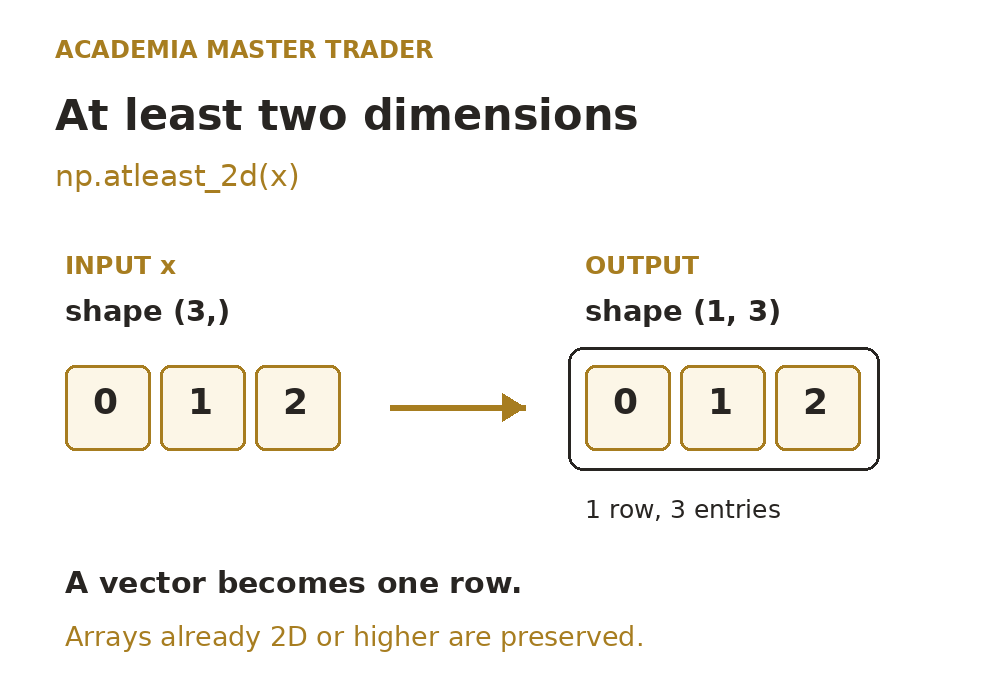
The result is not a column with shape (3,1). The function's one-dimensional example becomes a row. State the resulting shape explicitly when the distinction between a row and a column matters.
The entry count stays separate from dimension count
In the vector example, shape (3,) describes three entries. Shape (1,3) also describes three entries. The new size-one dimension changes the arrangement, not the number of numerical entries.
This is different from repeating the vector several times. A repeated arrangement would contain additional positions for values. The one-row result has only the original three positions.
Keep the shape beside the contents when explaining this change. The contents show which values remain, while the shape identifies how many dimensions describe them and the length of each dimension.
Existing two-dimensional arrays are preserved
The reference states that arrays that already have two or more dimensions are preserved. A two-dimensional array therefore does not need another dimension simply because it is passed to atleast_2d.
For an input whose shape is already (1,2), the minimum requirement is already met. The function is not an instruction to add one more leading dimension to every input.
This distinction separates a minimum-dimension operation from unconditional axis insertion. Before describing a shape change, identify whether the input actually falls below the two-dimensional minimum.
Higher-dimensional arrays are not flattened to a matrix
An array with three dimensions already satisfies the requirement of at least two dimensions. The documentation says that arrays with two or more dimensions are preserved, rather than reduced to exactly two.
For example, an array with shape (2,3,4) already has more than the required minimum. Atleast_2d is not a request to combine two of those dimensions into a larger row or column dimension.
Do not describe this function as a general reshape-to-matrix operation. Its name specifies a lower bound on the number of dimensions, not a target shape with exactly two positions.
Several inputs are handled individually
The function accepts one or more array-like inputs. The reference gives a call with three separate inputs: np.atleast_2d(1,[1,2],[[1,2]]).
The returned arrays represent [[1]], [[1,2]] and [[1,2]]. The scalar, the one-dimensional sequence and the already two-dimensional sequence each receive the structure appropriate to that input.
Those separate arguments are not instructions to concatenate their contents into one larger row. Read the result as a collection of results corresponding to the supplied inputs, each satisfying the minimum dimension count.
A sequence and several arguments are different requests
A call containing one sequence, such as np.atleast_2d([1,2]), supplies a single array-like input. Its two values belong to one sequence that becomes a one-row array.
A call with several separate arguments supplies several inputs for individual treatment. The distinction is in the call structure, before looking at the shapes of the returned arrays.
When recording an example, keep the brackets and commas clear. They show whether values are grouped inside one input or supplied as separate inputs. That makes the relationship between inputs and results easier to follow.
Copies are avoided where possible
The documentation says that copies are avoided where possible and that views with two or more dimensions are returned. Non-array inputs are converted to arrays, so the starting type matters when describing the operation.
In the reference's one-dimensional NumPy array example, the result's base is the original x. That illustrates a view relationship for that example. A different bracket layout does not by itself prove independent storage.
Do not turn this into a promise that every possible input requires no allocation. The documented wording is copies avoided where possible. Keep that condition when explaining the storage behaviour.
Read the minimum before predicting the shape
Continue learning with Academia Master Trader at academiamastertrader.com.br. Aprenda provides access to educational material. Identify the input's dimension count, then ask whether it already meets the minimum of two. For lower-dimensional inputs, state the resulting shape. For arrays already meeting the minimum, avoid describing a flattening or extra-axis step that the function does not require.