NumPy atleast_3d gives arrays a minimum of three dimensions with specific positions for added size-one axes
A one-dimensional vector and a two-dimensional table need different shape changes to become three-dimensional. NumPy atleast_3d handles these inputs according to their starting dimensions. The operation provides a minimum of three dimensions, rather than forcing every input into one fixed three-dimensional shape.
Academia Master Trader presents this explanation in English for readers in Palau. The examples concern numerical array structure only. They are not prices, trading signals or financial results. Following the shape entries makes the added dimensions easier to understand.
A vector gains a leading and a trailing dimension
The reference states that a one-dimensional array with shape (N,) becomes a view with shape (1,N,1). The original length stays in the middle position, between two new dimensions of length one.
For a NumPy array x containing [0.,1.,2.], the input shape is (3,). Calling np.atleast_3d(x) gives shape (1,3,1).
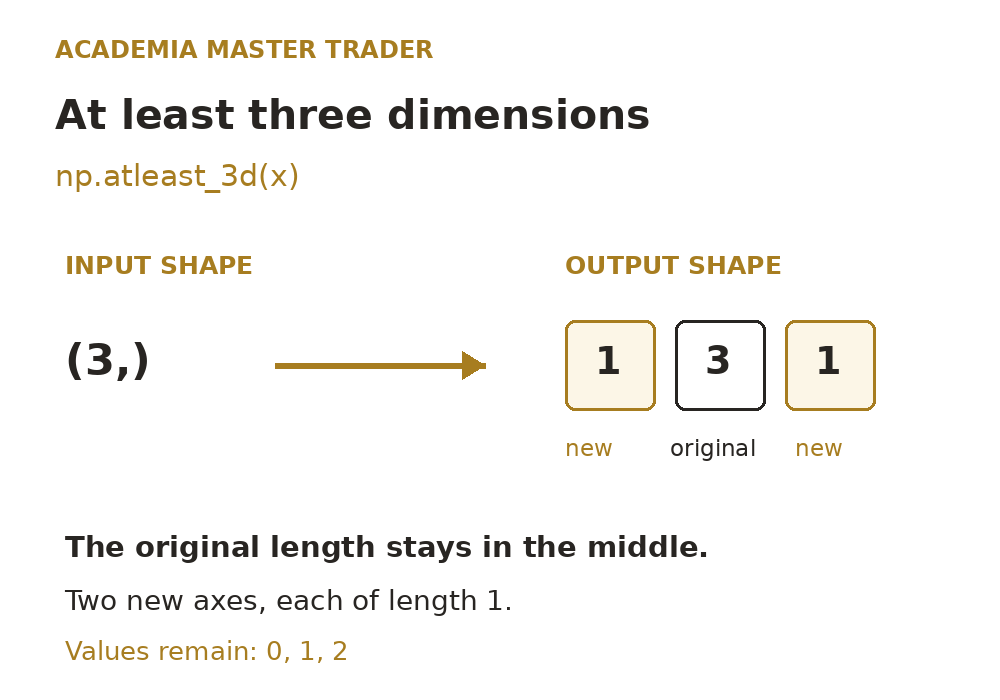
The three numerical entries remain. The two new ones in the shape are dimension lengths, not extra values inserted into the vector. Shape and array contents describe different properties.
A two-dimensional array gains a trailing dimension
For a two-dimensional input with shape (M,N), the documented output shape is (M,N,1). The two existing dimension lengths keep their order, and a new trailing dimension has length one.
The reference gives an input reshaped to (4,3). Its atleast_3d result has shape (4,3,1). The new axis is at the end, not at the beginning.
State the full result shape when explaining this operation. Saying that one dimension is added does not identify where it appears. The distinction between (1,4,3) and (4,3,1) is structural, even though both shapes describe twelve entries.
The operation does not add every new axis at the front
The vector rule and the two-dimensional rule are different. A vector becomes (1,N,1), while a two-dimensional array becomes (M,N,1).
A description that always adds leading size-one axes would therefore give the wrong output shape. Read the documented rule for the starting dimension count instead of assuming a single insertion pattern.
For the three-entry vector, writing (1,1,3) would place the original length in the last position. That is not the vector rule described by atleast_3d, which places it in the middle.
A scalar becomes a one-by-one-by-one array
The reference shows np.atleast_3d(3.0) returning an array containing [[[3.]]]. The result has shape (1,1,1) and contains one numerical entry.
The three dimensions each have length one. Multiplying those lengths gives one, so the additional dimensions do not create more copies of the number.
This example separates dimension count from entry count. The result has three dimensions but one entry. A vector example can have three dimensions and three entries. Neither dimension count alone nor bracket depth alone tells the whole story.
Arrays already meeting the minimum are preserved
The documentation states that arrays with three or more dimensions are preserved. An array that already has shape (1,1,2) meets the minimum without adding a new axis.
The function also does not reduce an array with more than three dimensions to exactly three. The word at least expresses a lower bound, not an instruction to flatten higher-dimensional structure.
Before predicting a change, identify the input's number of dimensions. If the array already meets the minimum, do not describe an extra leading or trailing axis as a required part of the operation.
Similar contents can begin with different shapes
The reference compares the separate inputs [1,2], [[1,2]] and [[[1,2]]]. Each contains the same two numerical values, but their starting dimensions differ.
The first two inputs yield results with shape (1,2,1). The third input already has three dimensions and retains shape (1,1,2).
This is a useful reason to record shape before discussing values. Matching contents do not guarantee matching shapes after a minimum-dimension operation. The original arrangement determines which rule applies.
Several arguments receive separate results
Atleast_3d accepts one or more array-like inputs. With several arguments, each input receives an array result with at least three dimensions.
The function does not combine those arguments into one new shared dimension. In the reference comparison, the separate results can be inspected individually, including their different shapes.
Keep the grouping clear in written examples. Values inside one bracketed sequence belong to one input. Commas separating function arguments can instead identify several inputs, each handled on its own.
Keep the storage condition with the explanation
The documentation says that copies are avoided where possible and views with three or more dimensions are returned. Non-array inputs are converted to arrays, so a storage explanation must account for the starting input type.
A new shape is not, by itself, evidence that a separate independent copy of all numerical data has been made. Equally, copies avoided where possible should not become a promise of no allocation for every kind of input.
Continue learning with Academia Master Trader at academiamastertrader.com.br. Aprenda provides access to educational material. Identify the starting dimensions, apply the corresponding shape rule and state where each size-one axis appears. That keeps the minimum-dimension requirement separate from the number of numerical entries and from the question of independent storage.