NumPy flip reverses the order along chosen axes while keeping the array shape unchanged
Changing the direction in which an array is read is different from sorting its values or exchanging its dimensions. NumPy flip reverses the order of entries along selected axes. The values move to different positions in that arrangement, but the shape of the array stays the same. Understanding which axis is reversed explains the result more clearly than the word flip alone.
Academia Master Trader presents this explanation in English for readers in Kenya. The examples concern numerical array structure only. They do not represent prices, trading signals or financial results. The aim is to separate the order of positions from the meaning of the numbers stored at those positions.
Reverse a single sequence
For the vector [2,5,8], the expression np.flip([2,5,8]) produces [8,5,2]. The last position is read first, the middle position remains in the middle and the first position is read last. Both the original vector and the result have shape (3,).
This is not an instruction to sort numbers from largest to smallest. The example happens to begin with increasing values, so its reverse looks like descending order. With [5,2,8], reversing gives [8,2,5], which is not descending order. Flip follows the original positions, not a ranking rule based on value.
A matrix has more than one direction
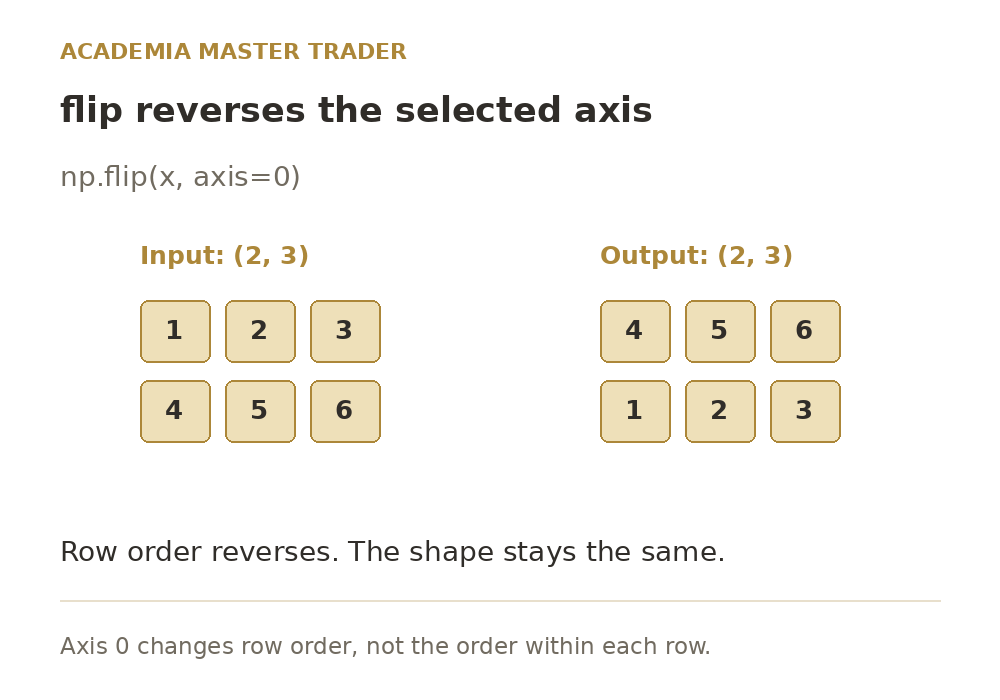
Let x be a matrix with rows [1,2,3] and [4,5,6]. Its shape is (2,3). The expression np.flip(x,axis=0) produces rows [4,5,6] and [1,2,3]. The two rows exchange their order, while the order of entries within each row remains unchanged.
The result still has two rows and three columns. Axis zero identifies the dimension whose positions are being reversed. It does not mean that the first value becomes zero or that a row is removed. The numeric axis label describes an organisational direction within the array.
With np.flip(x,axis=1), the result instead has rows [3,2,1] and [6,5,4]. The order of columns is reversed within each row. The first row remains the first row. Shape (2,3) is preserved here too, even though different positions have changed compared with the axis-zero example.
The default reverses every axis
Calling np.flip(x) without an axis reverses all axes of the input. For the example matrix, the result has rows [6,5,4] and [3,2,1]. Both the row order and the column order have been reversed. This differs from reversing only one of the two axes.
It is therefore important not to read an omitted axis as an automatic choice of axis zero. The documented default is None, which selects all axes. An explicit axis can make the intention clearer when a program should reverse only one direction of a multidimensional array.
A tuple can also identify several axes. In a two-dimensional matrix, np.flip(x,axis=(0,1)) reverses both available axes. For arrays with more dimensions, a tuple can select a subset rather than all of them. Each selected axis is reversed without changing its length.
Reversal is not transposition
A transpose changes the positions of axes. A flip changes the direction of positions along an axis. In the example, every flip result remains shape (2,3). Transposing the original matrix would give shape (3,2). These operations should not be treated as interchangeable ways to change a matrix's appearance.
The distinction is easier to see with a rectangular matrix than with a square one. A square matrix can keep the same shape after transposition, even though its positions have been rearranged differently. Shape is useful evidence, but the actual mapping of positions is also needed to explain the operation.
A view is not an independent copy
For a NumPy array, flip returns a view with the selected axis directions reversed. A view can share the original data rather than storing a separate, independent set of values. A different displayed order does not by itself prove that new independent storage has been created.
This matters if the program later writes through that view. A change to shared data can also be visible through the original array. If independent storage is required, that intention should be expressed separately with an appropriate copy. Reading the reversed arrangement and changing its underlying data are different activities.
Keep the meaning of the order clear
Reversing observations does not create new observations or alter the source from which the values came. It changes their order in the array view. If positions represent a particular sequence, the program should document why reversing that sequence is appropriate before using it in a later calculation.
Continue learning with Academia Master Trader at academiamastertrader.com.br. Aprenda provides access to educational material. Identify the input shape, name the axes being reversed and follow the resulting positions. This keeps reversal separate from sorting, transposition and copying.