NumPy flip reverses the order along selected axes while preserving an array's shape
Reversing an array means changing where its entries appear, not changing the values themselves. NumPy flip reverses their order along a chosen axis or set of axes. The output retains the input shape. Reading both the axis and the arrangement is therefore more useful than describing the operation simply as turning data around.
Academia Master Trader presents this explanation in English for readers in Fiji. The numerical examples illustrate array structure only. They are not prices, trading signals or financial results. A small matrix makes the difference between reversing rows, reversing columns and reversing both easy to see.
Begin with a vector
For the vector [1,2,3,4], reversing its only axis produces [4,3,2,1]. The first entry becomes the last and the last becomes the first. There are still four entries, and their numerical values remain unchanged.
This operation is not sorting. It follows the existing order in reverse, whatever that order happens to be. A vector such as [3,1,4,2] becomes [2,4,1,3], rather than a sequence arranged from largest to smallest.
Stating that distinction matters whenever the input is not already ordered numerically. Reverse order describes positions. Ascending or descending order describes a relationship between values, which is a different requirement.
Reverse the row axis
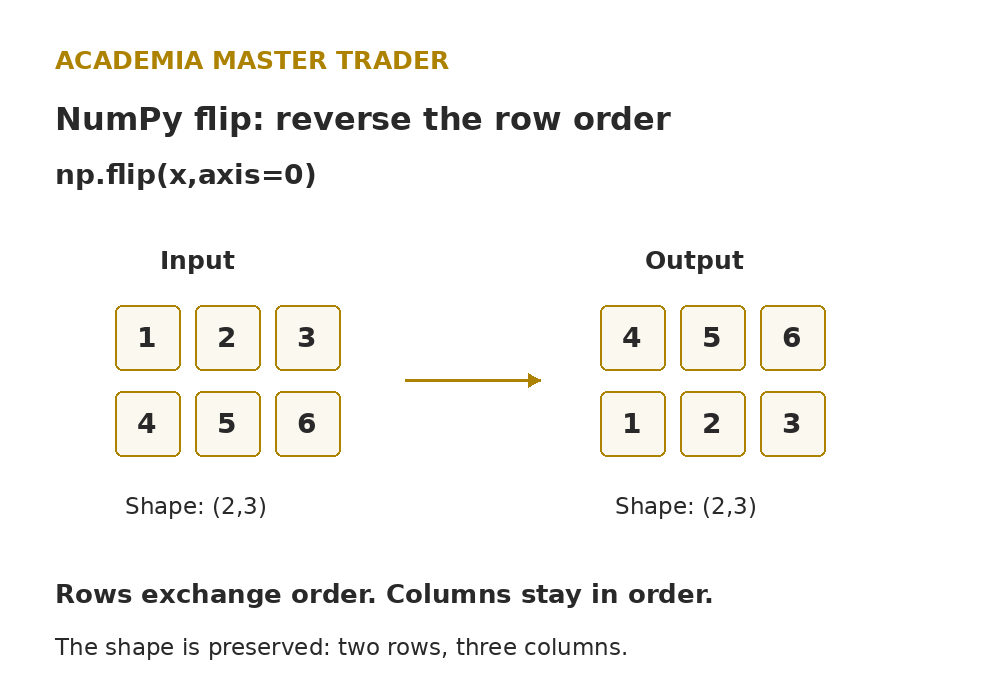
Let x contain rows [1,2,3] and [4,5,6]. Its shape is (2,3). The expression np.flip(x,axis=0) produces rows [4,5,6] and [1,2,3]. The bottom row becomes the top row.
Within each row, the entry order is unchanged. Four still precedes five and six; one still precedes two and three. Only the order along the first axis is reversed in this example.
The output shape remains (2,3). There are still two rows and three columns. Reordering those rows does not exchange the dimensions or turn the matrix into a three-row array.
Reverse the column axis
For the same x, np.flip(x,axis=1) produces rows [3,2,1] and [6,5,4]. The top row stays the top row, but the entries within each row appear in reverse column order.
This output also has shape (2,3). A shape check alone cannot distinguish it from the axis-zero result, because both operations preserve the dimensions. The selected axis and a reading of the entries explain what changed.
For a two-dimensional array, axis zero and axis one identify different directions of arrangement. Always tie those names to the displayed matrix rather than assuming that the word reverse identifies one unique result.
Omit the axis to reverse every axis
The default axis is None. In this case, flip reverses all axes of the input. For the two-row x, np.flip(x) produces rows [6,5,4] and [3,2,1].
Both the row order and the order within each row are reversed. The result is not merely the axis-zero output or merely the axis-one output. The default applies the reversal across both dimensions of this matrix.
For this input, explicitly selecting axis=(0,1) gives the same arrangement. A tuple names the axes to reverse. This becomes especially useful when an input has more than two dimensions and only some of them should change order.
Read negative axes from the end
The reference allows negative axis numbers, counted from the final axis backwards. In the two-dimensional example, axis=-1 refers to the column axis, so it produces the same arrangement as axis=1.
The meaning depends on the number of dimensions. The final axis of a three-dimensional array is not its second axis. Describe a negative axis as a position counted from the end, then connect it to the actual input shape.
This is a naming convention for dimensions, not a request to make values negative. Reversing [1,2,3] does not produce [-1,-2,-3]. Order changes while the values are retained.
A view is not an independent copy
The documented return value is a view of the input with the chosen axis entries reversed. The reference explains that this makes the operation constant time. Do not describe flip as always allocating a separate full copy of the numerical data.
That distinction matters if a later step changes array entries. A view should not be treated as an independent snapshot merely because it displays a different order. If independent storage is required, that is a separate requirement from reversing the arrangement.
For a short explanation, identify three properties separately: the output shape, the visible order and whether the result is a view. They answer different questions about the operation and should not be collapsed into the single word reversed.
Name the axes before reading the result
Continue learning with Academia Master Trader at academiamastertrader.com.br. Aprenda provides access to educational material. State which axes are reversed, confirm that the shape is preserved and read a complete output row. That makes the operation clear without confusing reversal with sorting, transposition or a change in numerical sign.