NumPy moveaxis places selected axes in new positions while keeping the remaining axes in their original relative order
An array's shape is an ordered description of its dimensions. NumPy moveaxis changes that order by placing selected axes at specified destinations. The axes that are not selected keep their original relative order. This makes the function useful to explain as moving dimensions within an ordered list.
Academia Master Trader presents this explanation in English for readers in Tonga. The examples concern numerical array structure only. They are not prices, trading signals or financial results. Reading the source axis and destination position separately helps distinguish movement from a simple exchange of two axes.
Start with three named dimensions
Let x be a NumPy array with shape (3,4,5). Call its axes A, B and C for the explanation, with lengths three, four and five respectively. The initial order is A, B, C.
The expression np.moveaxis(x,0,-1) gives shape (4,5,3). Axis zero, labelled A in this explanation, moves to the final position. The remaining axes B and C stay in that relative order.
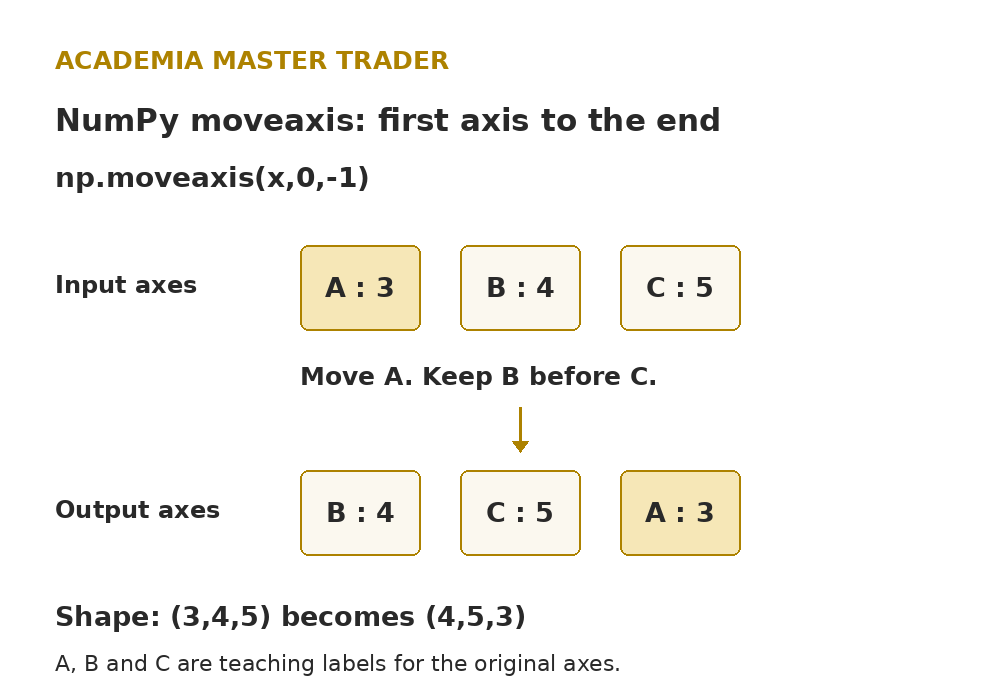
The letters are teaching labels, not additional function arguments. They help track the dimensions through the operation. The actual call identifies the source and destination through axis positions.
A destination is a position in the output
The source argument identifies the original axis to move. The destination identifies where that axis should appear in the result. In this example, negative one names the final destination position.
The length three travels with its axis. It does not become four merely because a different axis now occupies the first position. The shape changes from (3,4,5) to (4,5,3) because the existing dimensions have been reordered.
Keep axis identifiers and dimension lengths separate. The source value zero does not mean a dimension of length zero, and the destination value negative one does not request a negative dimension length.
Move the final axis to the beginning
For the same x, np.moveaxis(x,-1,0) gives shape (5,3,4). Axis C moves from the final input position to the first output position. Axes A and B retain their relative order after it.
This result differs from moving the first axis to the end. One operation produces B, C, A; the other produces C, A, B. The same dimensions participate, but the source and destination describe different arrangements.
Read both arguments in the call. Saying that an axis moves between the beginning and the end is incomplete unless the direction of that move is also clear.
Movement is not always an exchange
For shape (3,4,5), swapping the first and final axes gives shape (5,4,3). Moving the first axis to the end instead gives (4,5,3). The middle dimension behaves differently in the two arrangements.
With moveaxis, the unselected dimensions keep their relative order. With a pairwise swap, the selected axes exchange places directly. These are different rules, even though both reorder dimensions.
Use a three-axis example when teaching this distinction. A two-axis example can make the operations look identical because there is less remaining order to observe.
Follow a single entry through its indices
An entry at input index (1,2,3) in shape (3,4,5) is identified through axes A, B and C in that order. After moving A to the final position, the same entry is identified at output index (2,3,1).
The index components move with their axes. The numerical entry stored at that location is not being multiplied or replaced. A change of coordinates within the array is separate from an arithmetic change to its contents.
This index example also shows why shape alone is not the entire explanation. The output dimensions describe the arrangement, while the index mapping connects a particular input entry to its resulting position.
Several axes can be moved together
The reference permits a sequence of source axes and a sequence of destinations. Source positions must be unique, and destination positions must also be unique. Each selected source needs a corresponding destination.
For x with shape (3,4,5), the documented example np.moveaxis(x,[0,1],[-1,-2]) gives shape (5,4,3). Axis zero moves to the final position, and axis one moves to the preceding position.
Do not explain this as a series of separate calls that continually renumber the remaining input. The source sequence identifies original axes for the requested arrangement. State the pairings clearly, then read the resulting shape.
The documented result is a view
The reference describes the returned array as a view of the input array. A new visible axis order should therefore not be described as an independent snapshot of all the numerical data.
If later work requires separate storage, that is an additional requirement. Moving axes answers an arrangement question; it does not by itself establish that later changes are isolated from the original array.
Keep the shape, index mapping and view property separate when presenting the result. They explain different aspects of the same operation and prevent a familiar-looking printed array from carrying an unsupported storage claim.
State what moves and what stays ordered
Continue learning with Academia Master Trader at academiamastertrader.com.br. Aprenda provides access to educational material. Name each source axis, state its destination and read the remaining axes in order. That makes an axis movement clear without confusing it with a pairwise exchange, a numerical transformation or a complete reversal of every dimension.